
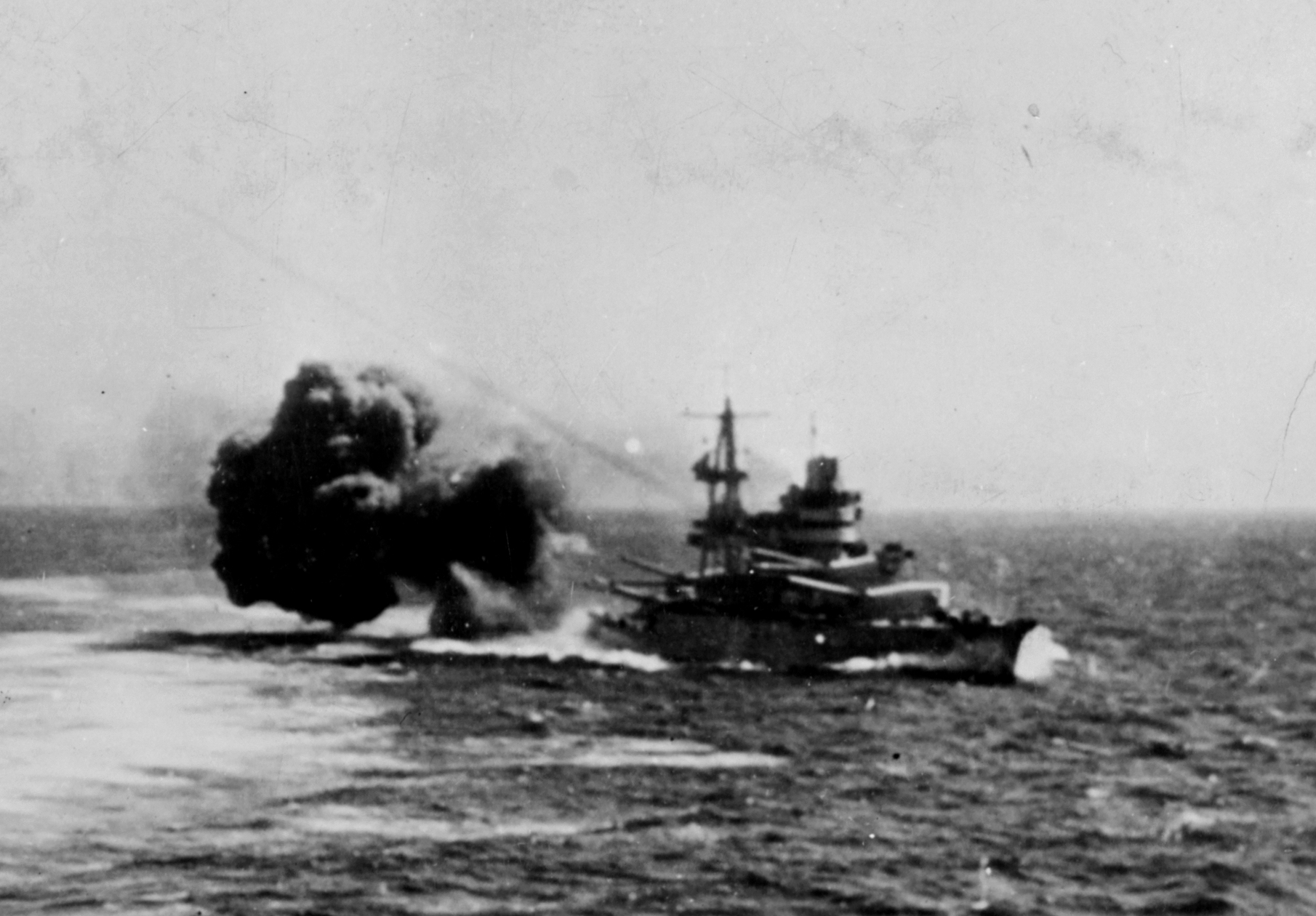
In September 1932, Italy's Regia Marina commissioned the Ansaldo shipyard to design something that had never existed in Italian naval history: a pocket battleship. Inspired by Germany's revolutionary Deutschland class, the project — known internally as Design 770 — called for an 18,000-ton warship armed with six 343mm guns in two triple turrets, protected by innovative layered armor, and driven by an 80,000-horsepower propulsion system capable of pushing her to 26 knots. She was to be powerful enough to face France's formidable new Dunkerque-class battlecruisers on roughly equal terms — a requirement that was, as the designers would discover, fundamentally impossible to meet at that displacement. Within three months, the project was dead, overtaken by escalating ambitions that would eventually produce the 35,000-ton Littorio-class battleships. But Design 770 remains one of the most fascinating "what-ifs" of interwar naval history — a ship that, had Italy's admirals been willing to accept more modest goals, might have given the Regia Marina exactly the warship it actually needed.
An Aging Fleet in a Dangerous Sea
By 1928, the Italian Navy's capital ship strength was a hollow shell. The five dreadnought battleships that had survived the First World War — two of the Conte di Cavour class, two of the Andrea Doria class, and the Dante Alighieri — were already obsolete when they entered service, and a decade of neglect had made them worse. None had been designed to face the latest generation of foreign battleships, and the Italian treasury, drained by the cruiser and destroyer building programs of the 1920s, could not afford to replace them.
Three of the five had already been decommissioned and placed in reserve. The Dante Alighieri, Italy's first dreadnought, was scrapped in 1928. Only the two ships of the Cavour class — Conte di Cavour and Giulio Cesare — remained in anything resembling active service, and even these received no significant modernization during the 1920s. Italy, which fancied itself a great Mediterranean naval power, was in reality a nation without a single battleship capable of fighting a modern engagement.
The problem was not merely financial. The Washington Naval Treaty of 1922 had imposed strict limits on the world's navies, and Italy and France — assigned equal status as second-tier naval powers — were each permitted a total of 175,000 tons of capital ships. After accounting for existing vessels, this left approximately 70,000 tons available for new construction. Both navies felt intense pressure to build smaller, more affordable ships rather than attempt to match the 30,000-ton, 35–40cm-gunned monsters maintained by Britain, the United States, and Japan. The British, in particular, actively encouraged Italy and France to build smaller units, and both public opinion and the political class in Rome were hostile to the idea of expensive new battleships.
The financial constraints made the smaller option genuinely attractive, especially for Italy. Unlike Britain or Japan, Italy had no need for ships with oceanic range — the Regia Marina operated exclusively in the confined waters of the Mediterranean, where the distances were short and land-based air cover was never far away. Italian designers began exploring concepts for battleships in the 23,000 to 26,000-ton range, though study designs for the full 35,000-ton Washington Treaty maximum were also produced.
The London Conference and the French Response
At the 1930 London Naval Conference, Britain attempted to formalize the trend toward smaller capital ships by proposing a reduction in the maximum battleship displacement to 25,000 tons and the maximum gun caliber to 305mm (12 inches). The proposal was rejected, primarily due to American opposition — the United States Navy had no intention of giving up its 16-inch guns — but it reflected a genuine belief among British naval planners that smaller, more numerous capital ships were preferable to a few enormously expensive ones.
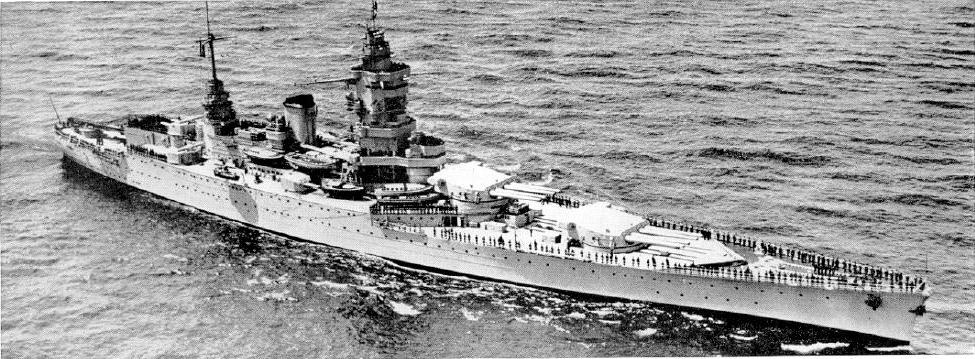
The French Navy's designers, working in parallel, had initially conceived plans for 17,500-ton battlecruisers. Four of these ships would have neatly consumed the 70,000-ton allocation. But France's thinking changed dramatically after the launch of Germany's first pocket battleship, the Deutschland, in 1931. The Deutschland was, by any objective measure, weaker than the planned French battlecruisers in every department — firepower, protection, and speed. Yet the French naval establishment, driven by a mixture of institutional anxiety and political pressure, concluded that their 17,500-ton ships would not provide a sufficiently decisive margin of superiority. The displacement was increased first to 25,000 tons, then to 26,500 tons. The result was the Dunkerque class — fast, powerful battlecruisers armed with eight 330mm guns, capable of 30 knots, and specifically designed to hunt down and destroy the German pocket battleships.
The German Inspiration
Where France saw the Deutschland as a threat to be countered, Italy saw it as an example to be followed. The German pocket battleship represented a new philosophy of naval warfare: a ship too fast for any battleship to catch and too heavily armed for any cruiser to fight. For a navy that operated in the confined Mediterranean, where encounters would be brief and escape routes short, this was an appealing concept.
In September 1932, the Regia Marina commissioned the Ansaldo shipyard in Genoa to produce designs for an 18,000-ton warship modeled on the German concept. There was, however, one critical stipulation: the ship's firepower must not be inferior to that of the French battlecruiser then under construction — the Dunkerque. This was a breathtakingly ambitious requirement. The Dunkerque displaced 26,500 tons; the Italian ship was to achieve comparable firepower at barely two-thirds the weight. The laws of physics, not to mention the laws of naval architecture, would have something to say about that.
The designers recognized immediately that they could not match the Dunkerque's eight heavy guns. Like the Germans, they settled on two triple turrets — one forward, one aft — giving them six barrels. To compensate for the smaller number, they chose a larger caliber: 343mm (13.5 inches), compared to the French 330mm. This caliber had never been used in the Italian Navy. The guns were presumably to be developed from the existing 305mm weapons fitted on the older battleships, though whether this would have involved designing entirely new ordnance or simply relining the old barrels — as was later done when the reconstructed battleships received 320mm guns — remains unclear. No detailed work on the guns ever began.
Hull and General Arrangement
Over the following weeks, the project designated Design 770 began to take shape on the drawing boards. The ship that emerged was 185 meters long, 26.25 meters in beam, with a standard displacement of 18,000 tons and a full-load displacement of 20,000 to 21,000 tons. The relatively shallow draft of 7.65 meters made her well suited to the enclosed waters of the Mediterranean, where deep-water harbors were not always available.
The general arrangement was modern and clean. The most distinctive feature was the enclosed, block-type command bridge — a design that bore a striking resemblance to the bridge structures used on the heavy cruisers Pola and Bolzano. Behind the bridge stood a single, relatively compact funnel. The ship carried only one mast — the mainmast. In place of a traditional foremast, a tower-like structure atop the bridge supported the main battery fire-control director.

Main Armament: The 343mm Guns
The main battery of six 343mm guns was arranged in two triple turrets, one forward and one aft of the superstructure — the same layout as on the German pocket battleships. This caliber was entirely new to the Italian Navy. The guns were most likely to have been developed from the 305mm weapons used on Italy's existing dreadnoughts, though the possibility that the caliber increase might have been achieved simply by reboring the old barrels cannot be ruled out. The source text itself acknowledges the question of whether such a significant increase in bore diameter — from 305mm to 343mm — would have been structurally feasible within the existing barrel dimensions. In the event, the question was never answered: design work on the guns never progressed beyond the conceptual stage, and no technical specifications survive.
What is clear is that the choice of 343mm was a deliberate attempt to outmatch the French 330mm guns on a ship-for-ship basis, compensating for the Italian ship's smaller number of barrels — six against the Dunkerque's eight — with heavier individual shells. Whether this trade-off would have been successful in practice is debatable. A six-gun broadside, however powerful the individual rounds, produces a smaller pattern of shell splashes than an eight-gun broadside, making it harder to achieve straddles and correct aim at long range. The French ship would likely have held the advantage in a sustained gunnery duel.
Secondary Armament: The 152mm Battery
The secondary armament consisted of 152mm guns mounted in twin turrets — but their arrangement was highly unusual. The turrets were installed in pairs, side by side, behind each of the two 343mm main turrets, elevated one deck level higher to allow them to fire over the main battery. This gave the ship four twin 152mm turrets in total, with eight guns.
With the benefit of hindsight, this arrangement was far from optimal. Two triple turrets mounted on the centerline would have been a far more sensible solution. This would have saved significant weight — a critical consideration on an 18,000-ton hull — without meaningfully reducing firepower, since in a broadside engagement, four twin turrets mounted in pairs could bring no more guns to bear than two triples on the centerline. Indeed, the centerline arrangement would have been superior, as all six guns could have fired to either side, whereas the paired arrangement meant that only four of the eight could engage a target on any given bearing.
The guns themselves would almost certainly have been the 152.4mm Ansaldo weapons then entering service on the Italian Navy's light cruisers. These were formidable weapons for their caliber: each gun weighed seven and a half tons, measured 8.5 meters in length, and fired a 50-kilogram shell. The initial muzzle velocity was an impressive 1,000 meters per second, giving a maximum range of 24 kilometers — extraordinary for a 6-inch gun. The high velocity came at a cost, however: barrel wear was severe, and the muzzle velocity was later reduced to 850 meters per second by using a lighter propellant charge. This cut the maximum range to 22 kilometers, which was still excellent.

Anti-Aircraft Armament
The heavy anti-aircraft battery comprised 100mm guns in twin mounts, three on each side of the ship, positioned amidships alongside the superstructure. The center mount on each side was elevated above its neighbors — the same arrangement used on Italy's heavy cruisers. These were OTO 100/47 guns, themselves an interesting piece of military genealogy: they were direct descendants of the 100mm Skoda guns widely used on Austro-Hungarian warships during the First World War, which had come into Italian hands as war trophies. The Skoda design was so good that the Italians not only adopted it but continued developing it for decades. The Soviets, too, copied the Italian version of the gun and used it as the basis for their own heavy anti-aircraft weapons — a remarkable pedigree for a weapon originally designed in Pilsen before 1914.
The guns could fire eight to ten rounds per minute and were effective against aircraft at altitudes up to 10,000 meters. They could also be used against surface targets, hurling their 26-kilogram shells to a range of 15,000 meters.

The light anti-aircraft armament was where Design 770 was most innovative — and most flawed. The designers specified 37mm and 13.2mm weapons, almost certainly the Breda guns then entering Italian service. What was revolutionary was the mounting arrangement: instead of the conventional open gun positions used on virtually every warship of the era, the light AA guns were to be installed in enclosed turrets with their own integrated fire-control systems.
The twelve 37mm guns were grouped into two six-barrel turrets, each containing three guns arranged in two tiers. The sixteen 13.2mm machine guns were distributed among four quad turrets. This was an extraordinarily forward-thinking concept. Enclosed, centrally directed light anti-aircraft guns would not become standard on warships until well into the Second World War, and most navies never achieved it at all. The Italian designers were, in this respect, a decade ahead of their time.
The execution, however, was badly compromised by the turrets' placement. The two 37mm turrets were positioned between and in front of the 152mm turrets, where the secondary battery's superstructure severely restricted their fields of fire. They could have engaged targets effectively only within roughly 120 degrees of arc — directly ahead or directly astern. The 13.2mm turrets, mounted on the main deck flanking the 343mm turrets, were similarly obstructed and could fire through only about 150 to 180 degrees. In a design intended to defend against air attack, this was a critical deficiency.
The 37mm Breda guns could achieve a rate of fire of up to 120 rounds per minute, with an effective range of approximately 4,000 meters. The 13.2mm weapons had a theoretical maximum rate of 500 rounds per minute — considerably less in practice — but an effective range of barely 2,000 meters.

Torpedoes and Aircraft
The cramped hull left no room for torpedo tubes on the upper deck, but the designers were unwilling to omit torpedo armament entirely. Their solution was to install the tubes below deck level: four torpedo tubes at the stern, mounted above the waterline, and four to six tubes in the bow, mounted below the waterline — essentially submarine-style bow tubes, a highly unusual feature for a capital ship.
The ship was to carry four floatplanes, a generous allocation that reflected the Italian Navy's recognition of the importance of aerial reconnaissance in the Mediterranean. Since neither the bow nor the stern offered sufficient space for aircraft facilities, the hangars were placed alongside the bridge and funnel on both sides, with two folding catapults — one on each beam — integrated into the same structure. This was a compact but workable arrangement, though it added weight and topside clutter that the already-crowded design could ill afford.
Armor Protection
The small displacement imposed severe constraints on armor protection. The designers produced two alternative armor schemes, each representing a different philosophy — and each illustrating the painful trade-offs inherent in trying to build a capital ship on 18,000 tons.
The first scheme followed a conventional arrangement. The main belt was 280mm thick — a respectable figure that would have provided genuine protection against cruiser-caliber shells and reasonable resistance to the German 280mm guns. But the weight of the belt armor had to be offset by accepting thin deck protection: the main armored deck, spanning between the upper edges of the belt, was only 50mm thick, reinforced by 25mm decks above and below. Over the magazines, the main deck was thickened to 75mm. The lower 25mm deck curved downward at its edges to meet the bottom of the belt armor, forming the familiar "turtleback" arrangement. By the standards of the early 1930s, this level of deck protection was unimpressive, though it was roughly comparable to that of most World War I-era battleships still in service.
The belt covered only the essential section of the hull between the two main turrets. The bow and stern were entirely unarmored, as was the hull above the belt.
The second scheme — described in contemporary documentation as "Nelson-type," after the British battleship whose inclined belt it superficially resembled — was considerably more sophisticated. The armor was arranged in two layers: an outer plate of 70mm on the ship's side, mounted vertically in the conventional manner, and an inner plate of 210mm, inclined inward at approximately ten degrees, mounted inside the hull. The total thickness remained 280mm, identical to the first scheme, but the two-layer construction was expected to provide significantly greater resistance to penetration.
The principle was simple but effective. An incoming shell would first have to defeat the outer plate, which would deform or shatter the projectile's cap and destabilize its trajectory. The damaged shell would then have to penetrate the much thicker inner plate while traveling at a less favorable angle — and with the structural stresses from the first impact already weakening the shell body. Test firings conducted later in the decade for the Littorio class confirmed that this layered arrangement provided markedly better protection than a single plate of equivalent total thickness.
This armor philosophy directly foreshadowed the protection scheme adopted for the Littorio-class battleships. The Littorio design initially used the same arrangement as Design 770 — a vertical outer plate and an inclined inner plate — before evolving into its final form, in which both plates were inclined at the same angle with only a 250mm air gap between them. It is one of the curiosities of naval history that this layered armor concept — which bears a resemblance to the spaced armor used on modern main battle tanks — was developed and used only by Italy. No other navy adopted it.
The torpedo protection system had a maximum depth of 4.35 meters — the most the ship's narrow beam would allow. This was not a bad figure in itself, but weight constraints meant the inner torpedo bulkhead could not be armored: it consisted of only 5 to 7mm of structural steel, which would have provided minimal resistance to the blast effects of a torpedo detonation.
The main turrets and barbettes were protected by armor up to 280mm thick. The 152mm turrets would likely have received the 25–90mm protection standard on Italian cruiser turrets. The steering compartment received only 25mm of armor, while the forward torpedo room — below the waterline — received none at all.
Propulsion: Four Options, No Decision
Achieving the planned speed of 26 knots required approximately 80,000 horsepower. The engineers developed no fewer than four alternative propulsion schemes, reflecting the technological uncertainty of the era and the difficulty of choosing between proven and innovative solutions.
The first option was a two-shaft turbo-electric system, in which steam turbines would drive generators that powered electric motors connected to the propeller shafts. The second was a four-shaft diesel-electric arrangement, substituting diesel engines for the steam turbines. The third was a mixed system combining steam turbines and diesel engines — though the Italian plans appear to have proposed connecting both types of prime mover to each shaft, an arrangement whose practical utility is unclear. The fourth was a conventional two-shaft steam turbine installation.
The diesel options offered the advantage of greater fuel economy and longer range, but their lower power-to-weight ratio meant that four shafts were needed to achieve 80,000 horsepower — a significant weight penalty. On balance, it seems likely that the designers would have favored one of the two-shaft options had the project progressed to the decision stage. But the question was never resolved: in the last days of December 1932, work on Design 770 was halted.
Cancellation and the Road to Littorio
The Regia Marina's leadership, after more careful consideration, concluded that an 18,000-ton ship simply could not satisfy the requirements they had set. The fundamental problem was protection. Design 770's armor was substantially stronger than that of the German pocket battleships, and it would have been more than adequate against any cruiser — even a heavy cruiser with 203mm guns — and against the German 280mm weapons. But against the 330mm and 343mm guns of the French battleships, and still less against British 381mm shells, the armor offered no meaningful defense. And the displacement could not accommodate heavier protection without sacrificing speed or armament.
The most dangerous opponents would have been the new French Dunkerque-class battlecruisers, which outmatched Design 770 in both firepower and speed. The Italian ship carried six 343mm guns against the French ship's eight 330mm; the Italian ship could make 26 knots against the French ship's 30-plus. In any engagement, the Dunkerque could dictate the range and the terms of the fight. This was unacceptable to an Italian naval establishment that thought in terms of decisive fleet engagements.
The new direction was clear: build ships that were equal or superior to their French counterparts in every respect. In 1933, Ansaldo produced a design for a 26,000-ton battlecruiser based on the 18,000-ton concept, 200 meters long, armed with eight 343mm guns in four twin turrets, and capable of 29 knots. But even this was not enough. The naval leadership ultimately decided — predictably, in retrospect — to build to the maximum displacement permitted by the Washington Treaty: 35,000 tons. These ships became the Littorio class, Italy's most powerful battleships.
The Reconstruction Mistake
The design and construction of the Littorio class was a long process — the first ship was not completed until 1940. In the meantime, the Regia Marina needed something to replace its completely obsolete World War I-era battleships. Italy had already developed designs for 23,000-ton and 26,000-ton battlecruisers alongside Design 770. Two ships of either type could have been built relatively quickly — within three years — providing Italy with modern capital ships to bridge the gap until the Littorios entered service.
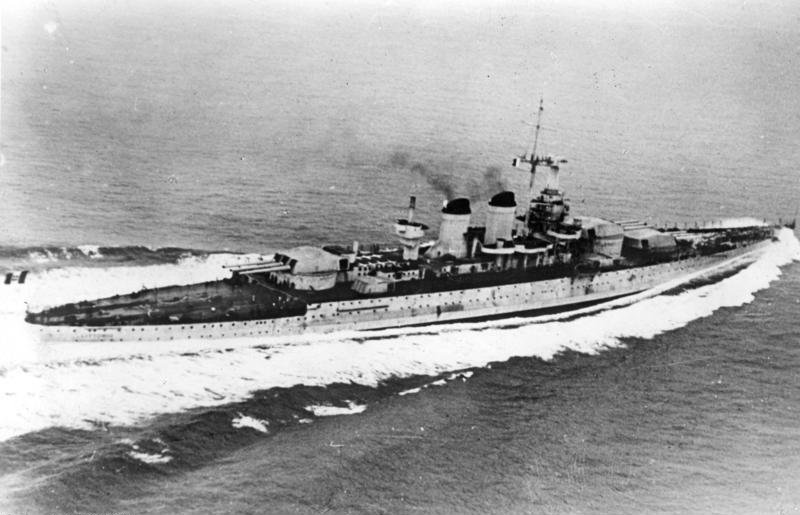
Instead, the Italian Navy chose what proved to be the worst possible option: rather than building new ships, they reconstructed the four surviving World War I dreadnoughts — Conte di Cavour, Giulio Cesare, Caio Duilio, and Andrea Doria. The reconstructions were comprehensive — the ships were essentially rebuilt from the keel up, receiving new propulsion systems, lengthened hulls, upgraded fire-control systems, and their 305mm guns bored out to 320mm. But the work was slow. The first two ships, Cavour and Cesare, were not completed until 1937 — and the other two, Duilio and Doria, not until 1940, by which time the Littorio herself was already in service, rendering the entire reconstruction program essentially pointless.
Worse, the reconstructions proved far more expensive than originally planned. The money spent on rebuilding four obsolete battleships could have paid for two 26,000-ton or three 18,000-ton new-build battlecruisers — ships that would have been vastly more capable.
The rebuilt dreadnoughts performed poorly in service. Their armament and armor were too weak to stand against French or British battleships in a fleet action. Their speed, while improved, was insufficient to keep pace with enemy cruisers. Their one genuine virtue was that they were fast enough to run away from British battleships — which they did, repeatedly, throughout the war.

Assessment: The Ship That Could Have Been
The verdict on Design 770 is paradoxical. It was simultaneously an excellent concept and an impossibly overambitious one. The design failed not because its engineering was poor — it was, by all evidence, highly competent — but because the requirements imposed on it were unreasonable. No 18,000-ton ship could have fought the Dunkerque on equal terms. The laws of displacement simply did not permit it.
But if the Italian Navy had been willing to set more modest goals — to design the ship for the role it could actually have filled rather than the role the admirals wished it could fill — the result might have been superb. The German pocket battleships were designed to raid commerce and fight cruisers, not to stand in the battle line against capital ships. An Italian equivalent, substantially larger and more powerful than the German originals, could have been devastating in that role.
The most obvious mistake was insisting on the 343mm caliber. Six 343mm guns were too few to match the Dunkerque's eight 330mm, and the weight penalty of the larger weapons consumed tonnage that could have been better used elsewhere. The British-proposed 305mm caliber would have been a far wiser choice. Better still, Italy could have simply reused the triple turrets from the old battleships, possibly with the barrels bored out to 320mm — exactly the modification that was later performed during the reconstructions. This would have saved enormous amounts of time, money, and engineering effort.
Further weight savings could have been achieved by eliminating the torpedo armament — of questionable value on a capital ship — and the aircraft hangars and catapults. In the relatively confined Mediterranean, within range of land-based air reconnaissance, shipboard floatplanes were not essential. Replacing the four twin 152mm turrets with two centerline triples would have saved additional weight while actually improving broadside firepower. The freed-up space would also have allowed far better positioning of the light anti-aircraft turrets, whose brilliant concept was sabotaged by their cramped placement in the original design.
If the ship had not been required to fight French battlecruisers, the belt armor could have been reduced to 200–250mm — still more than adequate against cruiser shells, especially with the inclined layered arrangement. The weight savings could have gone into strengthening the deck armor and increasing speed — exactly the qualities a commerce raider and cruiser-killer needed most.
With modifications of this kind, the Italian Navy could have acquired a genuinely useful class of warships: fast enough to catch any cruiser, powerful enough to destroy it, well-protected enough to shrug off cruiser-caliber fire, and available years before the ponderous Littorio class finally entered service. But the Regia Marina's leadership could not think in these terms. Like most interwar admirals, they were prisoners of the great-battle-fleet mentality — the conviction that naval wars were decided by clashes between battle lines of capital ships, and that every other type of operation was merely a sideshow in support of the decisive engagement.
In this framework, an 18,000-ton ship that could not stand in the line of battle had no place. The logic was internally consistent but strategically disastrous. Italy entered the Second World War with two modern battleships that spent most of the war in port conserving fuel, and four rebuilt antiques that spent most of the war running away. Three 18,000-ton pocket battlecruisers, aggressively employed against British convoys and cruiser squadrons in the central Mediterranean, might well have accomplished more than the entire Italian battle line ever did.
Frequently Asked Questions
What was Design 770?
Design 770 was an Italian warship design study produced by the Ansaldo shipyard in late 1932 for an 18,000-ton pocket battleship. It was inspired by Germany's Deutschland-class pocket battleships but was intended to be substantially more powerful, carrying six 343mm guns and 280mm of armor. The project was cancelled in December 1932 after the Italian Navy concluded that the ship could not match France's larger Dunkerque-class battlecruisers.
Why was it cancelled?
The Navy's leadership decided that 18,000 tons was insufficient to create a ship capable of fighting the French Dunkerque-class battlecruisers on equal terms. The fundamental problem was that the Dunkerque was faster, more heavily armed, and better protected — advantages that no amount of clever design could overcome at 18,000 tons. The Italians progressively increased their requirements through 26,000-ton and eventually 35,000-ton designs, culminating in the Littorio-class battleships.
Was the layered armor scheme used on later Italian ships?
Yes. The two-layer armor concept explored in Design 770's "Nelson-type" scheme was directly adopted for the Littorio-class battleships, which used a similar arrangement of a thinner outer plate and a thicker inclined inner plate. Test firings confirmed that this layered system provided significantly better protection than a single plate of equivalent total thickness. Italy was the only navy to employ this type of armor on its battleships.
How did Design 770 compare to the German pocket battleships?
Design 770 was substantially larger and more powerful. At 18,000 tons standard displacement, it was nearly twice the size of the German ships (which actually displaced about 12,000 tons despite their nominal 10,000-ton treaty limit). Its 343mm guns were heavier than the German 280mm, its armor was far thicker, and it carried a much heavier secondary and anti-aircraft battery. However, it lacked the German ships' diesel propulsion and consequently their extraordinary range — a less important consideration for a Mediterranean navy.
What was Umberto Pugliese's connection to the design?
Umberto Pugliese (1880–1961) was one of the Regia Marina's leading naval constructors. While his precise role in Design 770 is not documented in detail, he was the principal designer of the torpedo protection system later used on the Littorio class — a system that, interestingly, was not yet incorporated into the Design 770 plans. Pugliese, who was of Jewish descent, was removed from his position following Italy's racial laws of 1938 but continued to contribute informally to Italian warship design.