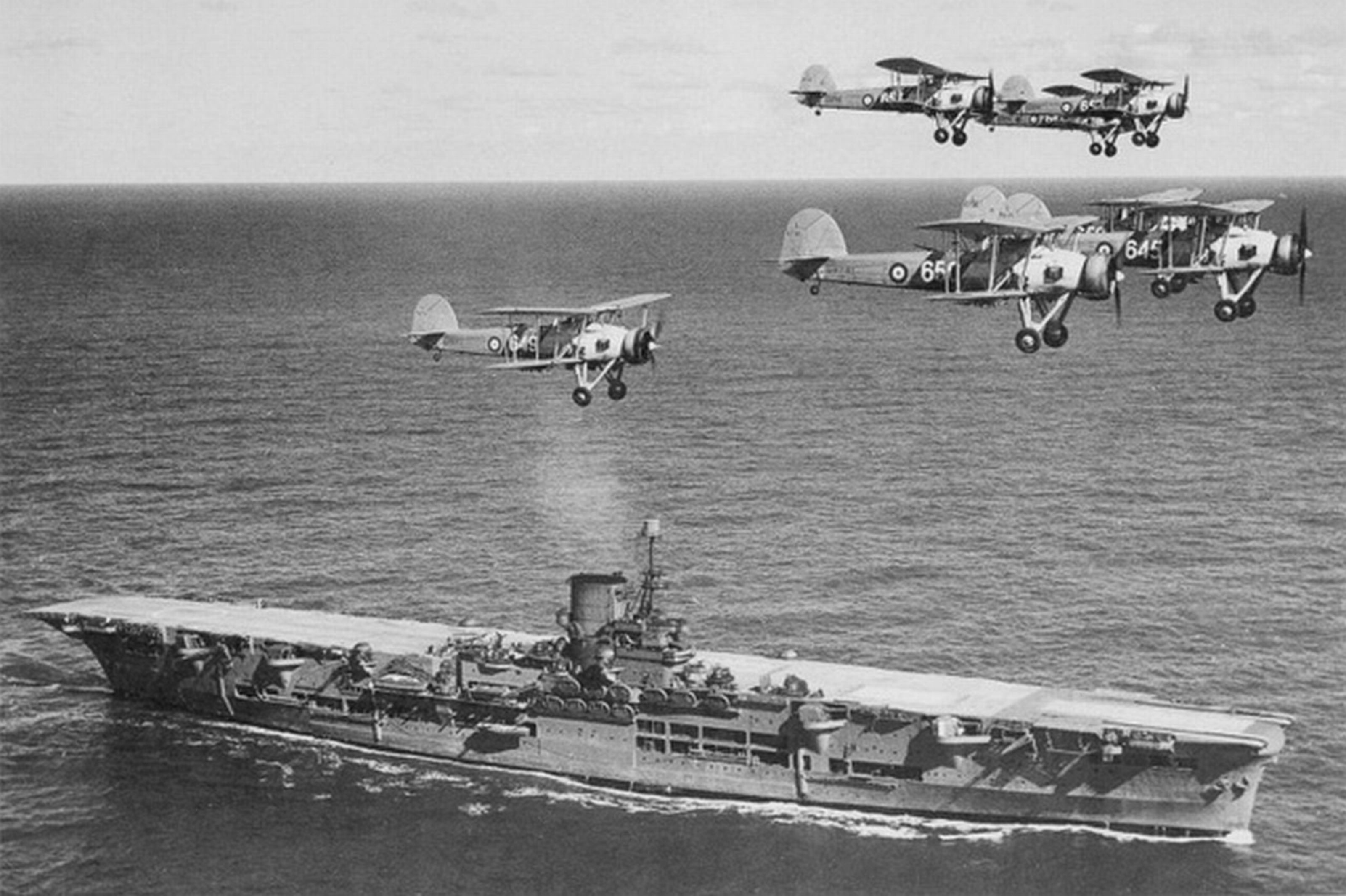
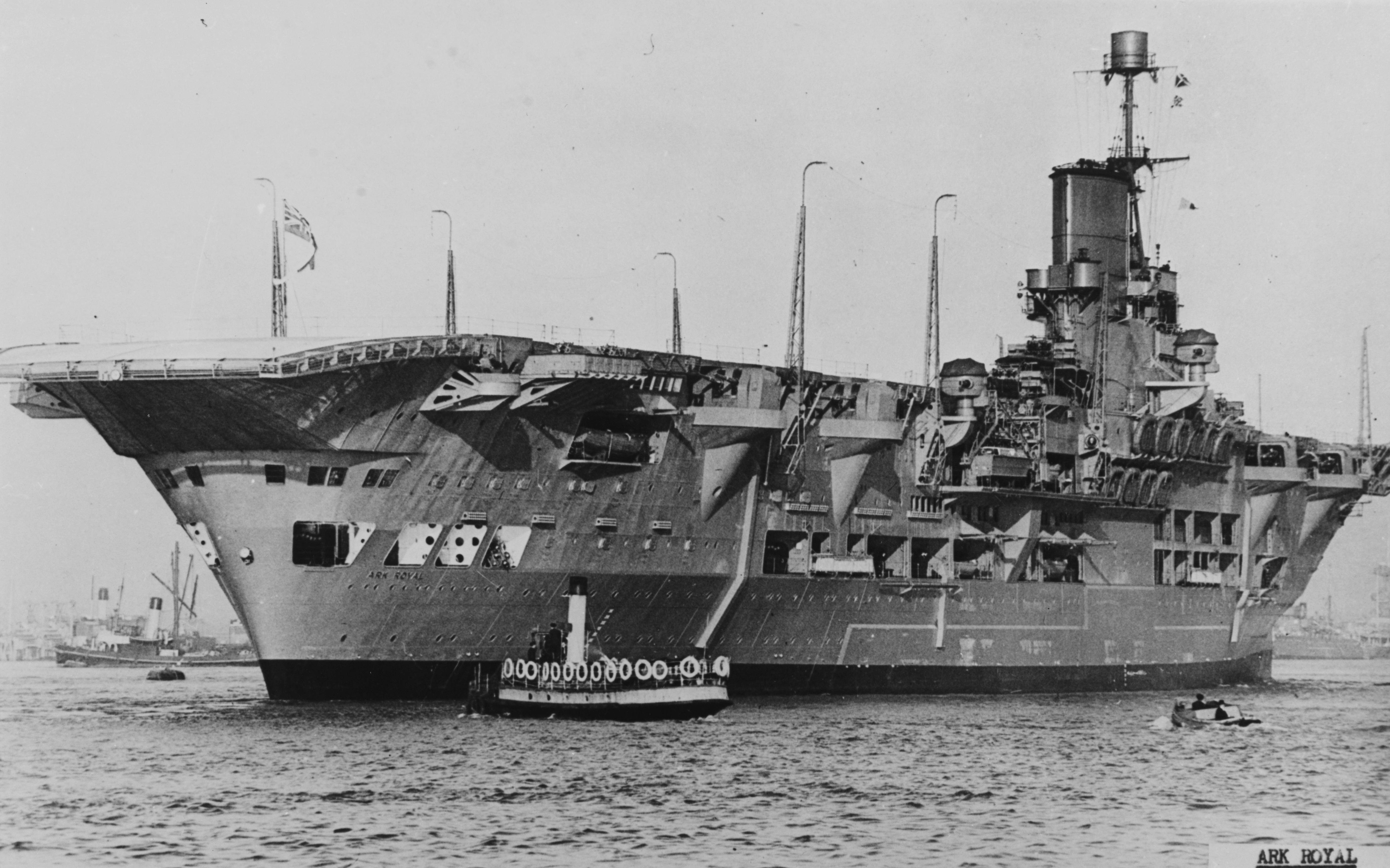
On the afternoon of November 13, 1941, a single torpedo from the German submarine U-81 struck HMS Ark Royal amidships, just thirty miles from the safety of Gibraltar. Thirteen hours later, the most famous aircraft carrier in the world rolled onto her side and slipped beneath the Mediterranean. She was barely four years old. In her short life, Ark Royal had hunted the Graf Spee in the South Atlantic, fought through the Norwegian campaign, crippled the Bismarck in one of the most dramatic naval chases in history, and almost single-handedly kept Malta alive. But the story of the Ark Royal is far more than the tale of one ship. It is the story of how a revolutionary new weapon — the aircraft carrier — was born, how it evolved through decades of trial and error, and how it ultimately overthrew the battleship as the undisputed ruler of the seas.
The Dawn of Naval Aviation
The dream of flight is as old as civilization itself, but its practical realization remained elusive until the turn of the twentieth century. The first crude airships appeared in the eighteenth century, and the earliest gliders took to the skies at the close of the nineteenth. True powered aircraft only emerged in the early 1900s, and even these pioneering machines could barely carry their own pilots a few meters off the ground. Aviation, for the moment, was little more than a fascinating curiosity. It was Louis Blériot's 1909 crossing of the English Channel that first signaled to perceptive observers that something momentous was afoot. The airplane had become a useful tool, and its military potential was beginning to be taken seriously.
Among those who took the keenest interest in the new invention was the Russian Imperial Navy. With the patronage of Grand Duke Alexander Mikhailovich, a cousin of the Tsar, seven Farman aircraft were purchased from France, and a pilot training school was established at Sevastopol. The Russians were driven to this step largely by desperation. In the disastrous war against Japan, virtually the entire Baltic Fleet had been lost, leaving St. Petersburg — a capital city accessible from the sea — almost defenseless against naval attack. In the grim financial and political aftermath of defeat, there was no hope of quickly rebuilding the fleet.
Assessing their limited options, the Russians decided to defend the Gulf of Finland with minefields and the guns of coastal fortifications on both shores and on the island fortress of Kronstadt. Effective defense, however, depended on reconnaissance — accurately tracking the movements and course of any approaching enemy fleet. The light cruisers normally used for this task had nearly all been lost in the Far East.
It was at this point that innovative Russian naval officers and engineers turned their attention to the airplane, which seemed to offer a cheap and effective solution to the reconnaissance problem. The limited range of contemporary aircraft was a concern, but the solution was breathtakingly simple: build a completely flat deck on a fast ship, from which airplanes could take off and on which they could land. This was the idea that the Russian naval architect Lev Makarovich Matsievich proposed to the Baltic Fleet command on October 23, 1909.
"The capabilities of aircraft make it possible to consider their employment in the naval service. If one or more aircraft are placed on a ship's deck, they may serve as reconnaissance planes, and also provide communication between ships or between ships and the shore. Moreover, a special reconnaissance vessel equipped with a large number of aircraft — as many as twenty-five — is entirely feasible."
Matsievich's ideas were supported by the highly respected naval architect Alexei Krylov, but overcoming bureaucratic resistance proved a nearly impossible task. Through persistent effort, Matsievich eventually won the backing of the Navy's deputy chief of staff, Vice Admiral Nikolai Yakovlev, and secured Grand Duke Alexander's patronage and nearly a million rubles in funding. Tragically, before he could begin his work, Matsievich was killed in an air show crash in St. Petersburg, when a structural failure caused his Farman aircraft to break apart at an altitude of nearly five hundred meters.
With Matsievich's death, the dream of the aircraft-carrying ship seemed to die as well. But barely six months later, a Black Sea Fleet officer and old friend of Matsievich, Commander Mikhail Kanokotin, submitted his own proposal to the naval ministry with essentially the same concept. Kanokotin planned to convert the retired 3,800-ton monitor Admiral Lazarev by removing its gun turrets and superstructure and building a full-length flight deck over the hull. The command bridge would be placed below the deck, and the funnels would be led out through the sides of the hull. The ship was to carry ten aircraft, stored disassembled in a hangar beneath the flight deck, and raised to the surface by two elevators. Landing aircraft would be arrested by ropes stretched across the deck, and a winch — essentially a catapult — was proposed to assist takeoff.
Matsievich and Kanokotin had, in principle, solved most of the technical problems that would occupy carrier designers for the next two decades: the full-length flight deck, the enclosed hangar, the aircraft elevators, the arresting gear, even the catapult. There is hardly another paper design in the history of naval warfare that so accurately predicted the future direction of development. Yet the plan came to nothing. Kanokotin was unexpectedly transferred to the Far East, and the project, in the terse language of the official files, "stopped of its own accord." Russia's loss would be Britain's gain.
Britain Takes to the Skies at Sea
The British, unaware of the Russian plans, had to find their own way to the aircraft carrier through years of trial and error. Copying the earlier American experiments of Eugene Ely, who had flown off the cruiser USS Birmingham in November 1910, the Royal Navy built a takeoff ramp on the bow of the battleship HMS Africa, and on January 10, 1912, Lieutenant Charles Samson made the first British flight from a warship in a Short Brothers seaplane. That May, Samson repeated the feat from HMS Hibernia — this time while the battleship was steaming at full speed in the open sea.
Like every other navy of the era, the Royal Navy considered seaplanes — aircraft fitted with floats — to be the most suitable flying machines for fleet use. The seaplane carriers that soon entered service carried these aircraft in hangars, launching them from ramps or lowering them into the water by crane. After completing their missions, the seaplanes landed on the sea and were hoisted back aboard. These carriers proved useful not only for reconnaissance and spotting for the guns, but increasingly for offensive operations as well. In August 1915, seaplanes from HMS Ben-my-Chree carried out the first successful aerial torpedo attacks against Turkish merchant ships in the Sea of Marmara.
Yet the limitations of seaplanes quickly became apparent. Their large floats made them far slower and clumsier than their wheeled counterparts, and they were ineffective even against Zeppelins. More critically, recovering them required the mother ship to stop — a dangerous and time-consuming operation that left the vessel vulnerable and unable to keep up with the fleet. In anything more than a moderate sea, launching and recovering seaplanes became impossible altogether.

The Aircraft Carrier Is Born
The problem became acute in 1917, when the Admiralty revived its plan to send the Royal Navy into the Baltic Sea to cut Germany's vital trade routes with Scandinavia. Operating close to the German coast, British ships would be exposed to attacks from shore-based aircraft, and the clumsy seaplanes were no match for German fighters. The solution was to equip the nearly complete battlecruiser HMS Furious with a flight deck capable of operating conventional wheeled aircraft.
Even now, the British could not bring themselves to build a full-length flight deck. Believing that the ship still needed heavy guns for self-defense, they retained Furious's rear turret and built only a 49-meter takeoff deck over the bow. This forward deck was intended to serve for landing as well, but the attempt proved suicidal. Of thirteen landing attempts, only three succeeded, and when the ship's air commander, Squadron Commander Edwin Dunning, was killed trying to land in August 1917, the experiments were abandoned.
Reluctantly sacrificing the rear turret as well, the Admiralty sent Furious back to the yard, where a 92-meter landing deck was built over the stern. But the landing deck, from which so much was expected, did not work either. Every attempt ended with the aircraft crashing, because the turbulent air created by the ship's superstructure, left standing between the two decks, made controlled landings impossible. The famous raid on the Zeppelin sheds at Tondern in July 1918 illustrated the problem perfectly: of the seven aircraft that took part, five were wrecked trying to land back on the ship, and the other two prudently diverted to neutral Denmark.
The lesson was learned just in time to be applied to the Royal Navy's next carrier. The half-built Italian liner Conte Rosso, purchased by the British in 1916, was originally planned with the same divided deck layout as Furious. But experience now dictated a radical change: the two decks were merged into a single flight deck running the full length of the ship. Commissioned in October 1918 as HMS Argus, the 173-meter, 20,000-ton vessel was the world's first true aircraft carrier in the modern sense — with a single, unobstructed flight deck from bow to stern.

Argus and Furious spent the following years as floating laboratories, testing solutions to the myriad problems of operating aircraft at sea. There was no shortage of challenges: launching and recovering aircraft safely, protecting hangars from fire, coordinating the complex work of the flight deck and hangars, and developing aircraft rugged enough to withstand the brutal stresses of carrier operations — particularly the violent deceleration of arrested landings.
The question of the ship's superstructure remained contentious. Argus's completely flush deck left no room for a proper command bridge, and her side-vented exhaust proved unsatisfactory. The solution was tested on HMS Eagle, a Chilean battleship hull converted into a carrier. Eagle received the now-familiar "island" superstructure on the starboard side of the flight deck, incorporating both the bridge and the funnel. The arrangement worked splendidly, and every major carrier built since has followed this pattern.
America and Japan Race Ahead
While Britain struggled with austerity, the other great naval powers were forging ahead. The United States Navy, facing the complex strategic problem of defending the Philippines against Japan across a vast ocean studded with fortified Japanese island bases, found in the aircraft carrier the perfect tool for the job. Carrier aircraft could neutralize enemy airfields and shore batteries without exposing precious battleships to the murderous fire that had characterized the Gallipoli campaign.
From the late 1920s, American carrier task forces produced startling results in exercises. In 1928, aircraft from USS Langley launched a surprise dawn "attack" on Pearl Harbor. The following year, Saratoga did the same to the Panama Canal, and in 1932, Pearl Harbor was "attacked" again. These simulated raids were repeated in subsequent years, and they always succeeded. American admirals patted their pilots on the back, but it never occurred to them that they might one day have to endure such attacks for real.

Japan, meanwhile, was developing the most sophisticated carrier doctrine in the world. Recognizing that they could never match American industrial capacity, the Japanese focused on quality over quantity, developing new weapons and tactics to offset the enemy's numerical superiority. Their first carrier, Hosho, entered service in 1922. After the Washington Naval Treaty, two unfinished capital ships, Akagi and Kaga, were converted into carriers, followed in the late 1930s by the formidable Shokaku and Soryu classes. Japanese carrier aircraft saw continuous combat from 1931 in Manchuria and China, giving their pilots invaluable combat experience.
Britain, by contrast, was forced to tighten its belt at every turn. The disbandment of the Royal Naval Air Service after World War I transferred the fleet's aircraft to the newly formed Royal Air Force, which treated naval aviation as a secondary concern. The consequences were predictable: with its most air-minded officers lost to the RAF, the Royal Navy fell firmly back under the sway of the big-gun admirals. Service on carriers was considered a career-killing assignment for ambitious officers. Not only did British carrier doctrine lag behind, but the ships and their aircraft fell far behind American and Japanese standards. By the outbreak of war, only Ark Royal could be considered a modern carrier, and even she went to war with aircraft that were, at best, a generation behind the competition.
The Ship
By the late 1920s, the Royal Navy had accumulated nearly a decade of operational experience with carriers, and the time had come to put that experience into practice. The committee convened to define the parameters of the new carrier first met on April 15, 1931. Its members — Rear Admiral Reginald Henderson and Captains Henry Brownrigg and Dashwood Moir — were all former carrier commanders. They studied not only the lessons of their own ships but also the American Lexington-class carriers, which were then indisputably the world's most powerful and modern carriers.
The Washington Naval Treaty allowed 27,000 tons for individual carriers, but the British voluntarily limited themselves to 23,000 tons, partly to set an example of restraint for other navies and partly to fit within the dimensions of the docks at Malta and Gibraltar. Speed had to match the escorting cruisers — at least 30 knots sustained, with 32 knots possible at full power. Henderson insisted on carrying the maximum possible number of aircraft, arguing that new arresting gear and catapults then being tested would allow much faster deck operations than previously thought possible.
After considerable debate, the committee chose the design designated "C" — a single full-length flight deck rather than the two-level arrangement of the Courageous class. The island superstructure was placed on the starboard side in the proven Eagle pattern. Three elevators were fitted instead of two, their width reduced to accommodate aircraft with folding wings. The original plans called for 60 aircraft; the final design pushed this to 72.
The Admiralty approved the final design on June 21, 1934. At the same session, the ship received her name. Originally to be called Mercury, she was ultimately christened Ark Royal — a name borne by warships of the English fleet since the days of the Spanish Armada. Her motto, which would prove eerily prophetic, was "Zeal Does Not Rest."
The contract was signed with Cammell Laird and Company on April 17, 1935, and construction began at the company's Birkenhead yard on September 16. The total cost came to £3.3 million — the Royal Navy's most expensive ship after its battleships.
Ark Royal was a genuinely modern warship that incorporated the accumulated lessons of a decade of carrier operations. About 65 percent of her hull structure was welded rather than riveted — a cutting-edge technique at the time — saving approximately 500 tons of weight. She was fitted with a two-level hangar beneath the flight deck, served by three two-level elevators that could move aircraft with folded wings between both hangars and the flight deck simultaneously. Her propulsion came from three Parsons turbines fed by six Admiralty boilers, producing 103,000 horsepower for a top speed of over 31 knots.

Technical Specifications
| Parameter | Value |
|---|---|
| Displacement (Standard) | 22,000 tons |
| Displacement (Full Load) | 28,160 tons |
| Length | 243.8 m (800 ft) |
| Beam | 28.9 m (94 ft 9 in) |
| Draught | 8.5 m (27 ft 9 in) |
| Propulsion | 3 × Parsons geared steam turbines, 6 × Admiralty boilers, 3 shafts |
| Power | 103,000 shp |
| Speed | 31.2 knots (57.8 km/h) |
| Range | 12,000 nmi at 14 knots |
| Aircraft Capacity | Up to 72 (typically 50–60 in wartime) |
| Armament | 16 × 4.5 in (114 mm) dual-purpose guns; 6 × 8-barrel 2-pdr pom-pom AA; 8 × quad .50 cal Vickers MG |
| Armour (Belt) | 114 mm (4.5 in) |
| Armour (Deck) | 63–87 mm |
| Complement | ~1,636 |
| Builder | Cammell Laird, Birkenhead |
| Laid Down | September 16, 1935 |
| Launched | April 13, 1937 |
| Commissioned | December 16, 1938 |
| Fate | Sunk by U-81 torpedo, November 14, 1941 |
Her armament was modern and well-considered. The 4.5-inch dual-purpose guns — sixteen of them, in eight twin turrets mounted on sponsons just below the flight deck — proved to be among the best medium-caliber naval anti-aircraft weapons of the war. The close-range defense was provided by six eight-barrel 2-pounder "pom-pom" mounts and eight quadruple .50-caliber Vickers machine guns, though these lighter weapons were already becoming obsolescent by the time the ship entered service.
For all her modernity, however, Ark Royal carried the seeds of her own destruction in several critical design compromises. Her hull was divided into only twelve watertight compartments — far fewer than a battleship of similar size — and the watertight bulkheads extended only to the lower hangar deck, just five meters above the waterline. All six boilers fed their exhaust into a single uptake leading to the funnel, creating a catastrophic single point of failure. And the two emergency diesel generators originally specified in the design had been deleted during construction as an economy measure — a decision that would prove fatal.
The elevators were a particularly innovative feature. They were two-level platforms: in their default position, the upper platform sat flush with the flight deck while the lower sat at the upper hangar level. When activated, both dropped one level, so the upper platform moved an aircraft from the upper hangar to the flight deck while the lower brought one from the lower hangar to the upper hangar. Though aircraft could not go directly from the lower hangar to the flight deck, the system was significantly faster overall, and aircraft could be stored on the lower platforms when not in transit.
The flight deck was equipped with two compressed-air catapults — the BH III type, capable of accelerating a 4.9-ton aircraft to 120 km/h. At the stern, eight arresting wires, stretched 7.6 to 15.2 centimeters above the deck, caught landing aircraft via tail hooks. The Mk. III hydraulic arresting gear could stop a 3.6-ton aircraft traveling at 110 km/h within 42 meters. A safety barrier net — nicknamed the "crash barrier" — was rigged amidships to prevent aircraft that missed all the wires from plowing into planes parked at the bow.
The Swordfish: An Unlikely Weapon
An aircraft carrier is only as good as the planes it carries, and here lay the Royal Navy's greatest weakness. The Fairey Swordfish torpedo bomber that equipped Ark Royal's squadrons looked like it had escaped from a World War I flying circus. With its biplane wings, fixed landing gear, open cockpit, and a top speed of just 230 km/h with a torpedo — slower than many contemporary bombers — it was routinely mocked by RAF pilots whenever one landed at their airfields.
Yet the Swordfish was far more capable than it appeared. Entering service only in 1936, it was not actually an old design. The three-seat aircraft was extraordinarily easy to fly — "idiot-proof," in the words of its pilots — forgiving of mistakes, and capable of operating from the shortest flight decks in the worst weather. Its rugged airframe and reliable Bristol Pegasus radial engine were practically indestructible; there were cases of Swordfish returning safely with two cylinders shot out of the engine. The aircraft could carry an 800-kg payload — torpedo, bombs, rockets, or mines — and its cavernous interior earned it the affectionate nickname "Stringbag."
Its greatest advantage was its ability to deliver torpedoes. The aerial torpedo was the one weapon that could inflict fatal damage even on the most heavily armored battleship, and the Swordfish proved devastatingly effective in this role. The Mk XII aerial torpedo carried by Ark Royal's Swordfish was 4.95 meters long, 45 centimeters in diameter, weighed 702 kilograms, and packed a warhead of 176 kg of TNT. Its range was 1,370 meters at 40 knots — short enough that attacking aircraft had to get dangerously close to their targets. Pilots typically approached at 1,500 meters altitude before diving steeply to the low-level release point, roughly 1,000 meters from the target.

Ark Royal's fighter complement was initially the Blackburn Skua, a machine that looked nothing like a fighter and barely performed like one. With a top speed of just 362 km/h, it was hopelessly outclassed by contemporary land-based fighters. It found its true calling as a dive-bomber, scoring the notable distinction of sinking the German cruiser Königsberg at Bergen in April 1940 — the first major warship sunk by dive-bombing in combat. The Skua was later supplemented and then replaced by the Fairey Fulmar, a two-seat fighter that at 438 km/h was a significant improvement but still no match for a Messerschmitt. The Fulmar's second crewman served as navigator and radio operator — the Admiralty believed a single pilot could not manage navigation on long overwater missions. Its eight wing-mounted .303 Browning machine guns provided respectable firepower, and its exceptional range of 1,260 km made it a capable reconnaissance platform.
The First Year of War
Ark Royal was launched on April 13, 1937 — barely nineteen months after her keel was laid. Her godmother was Lady Maud Hoare, wife of the First Lord of the Admiralty, Sir Samuel Hoare. The champagne bottle stubbornly refused to break on the bow until the fourth attempt, but the ceremony otherwise went without a hitch. The carrier then spent more than a year alongside the fitting-out berth while her superstructure was built, equipment installed, and initial sea trials conducted. The Navy accepted her on December 16, 1938, under the command of Captain Arthur John Power.
Crew training and the full program of sea trials were completed by the summer of 1939. King George VI visited the ship upon her return home. That summer the Skua and Swordfish squadrons came aboard — though the chronic aircraft shortage meant the full complement could not be filled, and only five squadrons embarked with 18 Skuas and 30 Swordfish. By August 1939, Ark Royal was fully operational and served as flagship of Vice Admiral Lionel Victor Wells, Commander of the British carrier force.
In the opening days of the war, the Admiralty organized its carriers into hunter-killer groups to seek out German U-boats. On September 14, 1939, Ark Royal responded to a distress call from the freighter Fanad Head, which had been stopped by U-30 some 200 miles away. While scrambling aircraft, the carrier was attacked by U-39, which fired two torpedoes. The carrier evaded, and her escorting destroyers depth-charged and sank the submarine — the first U-boat lost in the war. Two Skuas sent to assist Fanad Head were lost when they flew too low and were brought down by the blast of their own bombs. The two observers were killed; the pilots survived and were rescued by U-30 — becoming the Royal Navy's first prisoners of war.
The hunter-killer concept was quickly abandoned after U-29 torpedoed and sank HMS Courageous on September 17, killing 519 of her crew. Two torpedoes struck the old carrier, which sank in twenty minutes. The hunter-killer groups were dissolved immediately.
On September 26, while covering the return of a damaged submarine, Ark Royal's Skuas shot down a Dornier Do 18 flying boat — the Fleet Air Arm's first aerial victory. That same afternoon, four Ju 88 bombers of Luftwaffe bomber wing KG 30 attacked the British ships. Three were driven away by anti-aircraft fire, but the fourth pressed its attack. No hits were scored, but one bomb exploded just 30 meters off Ark Royal's starboard bow. When the carrier separated from the formation and sailed independently back to Scapa Flow, German reconnaissance could not find her, and Nazi propaganda triumphantly announced her sinking.
Churchill personally wrote to Roosevelt to assure him the ship was unharmed, and the British military attaché in Rome informed Mussolini of the same, lest the false report encourage Italy to enter the war. Two days after the attack, Churchill himself visited the safely returned Ark Royal.
In October, Ark Royal sailed south with the battlecruiser Renown as Force K, hunting the German pocket battleship Admiral Graf Spee in the South Atlantic. They narrowly missed the German supply ship Altmark — Wells decided not to divert his two capital ships to chase an unidentified tanker — and post-war analysis of ship logs revealed that on November 24, Force K and Graf Spee passed tantalizingly close to each other. Had the British not changed course, Ark Royal's aircraft would almost certainly have found the raider the next day.
When Graf Spee was eventually cornered at Montevideo after the Battle of the River Plate in December, the British bluffed brilliantly, spreading the false rumor that Force K was just hours away. The Germans fell for the deception, and Captain Langsdorff scuttled his ship on December 17. In reality, Force K was still refueling at Rio de Janeiro.
Norway: Baptism of Fire
When Germany invaded Norway on April 9, 1940, the Royal Navy rushed to intervene. Shore-based Skuas from northern Scotland could not provide continuous cover for ships operating off the Norwegian coast, and the carriers were urgently needed. Ark Royal and Glorious sailed from Scapa Flow on April 23 with two cruisers and five destroyers. Just after leaving port, the cruiser Curlew's radar — the only radar set in the force — detected unidentified aircraft. Six Skuas scrambled from Ark Royal, found the intruders to be Heinkel bombers, attacked, and forced them back. One damaged Heinkel crash-landed on reaching shore. This was the first time in history that fighters had been vectored onto a target by radar.
On April 25, Ark Royal's aircraft attacked the airfield at Vaernes, destroying 12 German aircraft on the ground and bombing two hangars. Trondheim harbor was also raided. The fighting was intense — four Swordfish were lost to anti-aircraft fire, and two damaged Skuas ditched at sea. Over the following days, Skuas claimed several German bombers. On May 1, Ju 87R Stukas — operating at greater range than the British had expected — attacked the carrier. Ark Royal escaped with only minor damage from near-misses, but the Stukas sank a destroyer and badly damaged the heavy cruiser Suffolk.
A command change took place on May 3 when Captain Cedric Swinton Holland relieved Power. The Norwegian campaign continued with Ark Royal's aircraft supporting the Allied forces around Narvik. The carrier's fighters shot down six German bombers and damaged eight more, losing five of their own. Among the dead was Lieutenant William Lucy, the Fleet Air Arm's most successful fighter pilot with six aerial victories, killed when his Skua was hit while attacking a German bomber and exploded.
The Allied withdrawal from Norway in June 1940 brought one of the war's worst naval disasters. HMS Glorious, sailing independently and inexplicably without air patrols, was caught and sunk by the battlecruisers Scharnhorst and Gneisenau on June 8, with the loss of over 1,500 lives.
Force H and the Mediterranean
The fall of France in June 1940 transformed the strategic situation in the Mediterranean overnight. The powerful French fleet, which had been counted on to control the western Mediterranean, was now in the hands of the Vichy regime — potentially available to Germany and Italy. With Italy's entry into the war on June 10, the Royal Navy found itself catastrophically outnumbered.
To meet this crisis, the Admiralty created Force H at Gibraltar under Vice Admiral James Somerville — a scratch force built around the battlecruiser HMS Hood, the battleship HMS Valiant, and Ark Royal. Somerville's first assignment was among the most agonizing in British naval history: the attack on the French fleet at Mers-el-Kébir.
Ark Royal's captain, Cedric Holland — a fluent French speaker and former naval attaché in Paris who knew the French commander, Admiral Marcel Gensoul, personally — was sent aboard the destroyer Foxhound to negotiate. The talks dragged on through the morning and into the afternoon of July 3. Gensoul refused to receive Holland personally, communicating only through intermediaries. Meanwhile, Ark Royal's Swordfish mined the harbor entrance with magnetic mines, further infuriating the French.
At 5:57 PM, Somerville reluctantly ordered his battleships to open fire. In ten terrible minutes, 144 heavy shells slammed into the French ships. The battleship Bretagne exploded and sank; Dunkerque and Provence were crippled and beached. But the fast battlecruiser Strasbourg and five destroyers escaped through the smoke. Ark Royal's Swordfish, armed with bombs rather than torpedoes, scored no hits on the fleeing ship. A second wave of six torpedo-armed Swordfish attacked in the gathering darkness — the first time in history that aircraft launched torpedoes against a maneuvering capital ship at sea — but again missed. One torpedo exploded in Strasbourg's wake just 25 meters astern, which the pilots mistakenly reported as a hit. The French ship reached Toulon safely the next day.
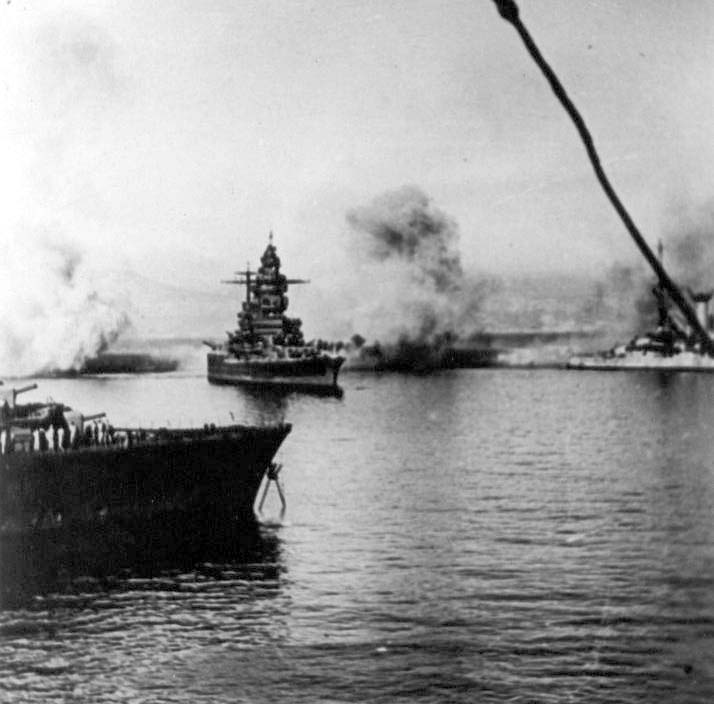
On July 6, Ark Royal returned for a second strike. Twelve Swordfish and nine Skuas attacked at dawn in three waves. Although pilots reported seven torpedo hits on the beached Dunkerque, none actually struck the ship. However, a nearby patrol vessel loaded with depth charges was hit and exploded alongside the battlecruiser, tearing a 40-meter gash in her hull with the force of roughly three tons of TNT. Dunkerque was permanently knocked out of the war. The two attacks at Mers-el-Kébir cost 1,297 French lives and hundreds wounded, and nearly caused Vichy France to declare war on Britain.
For the rest of 1940 and into 1941, Ark Royal and Force H became the linchpin of British naval power in the western Mediterranean. Somerville called the carrier his "blind man's dog" — without her, he was helpless. The carrier, the battlecruiser Renown, and the cruiser Sheffield became known as the "Mediterranean Trio," their aircraft, guns, and radar complementing each other perfectly. They attacked Italian airfields on Sardinia, fought off Italian and German air attacks, escorted convoys to Malta, and ferried desperately needed fighter reinforcements to the besieged island.
The September 1940 attack on Dakar — Operation Menace — was one of the low points. Conceived partly to establish General de Gaulle's authority over French West Africa, the operation was a shambles from start to finish. The Vichy French garrison, far from welcoming the "liberators," fought back fiercely. Over three days of confused fighting, British battleships fired hundreds of heavy shells without scoring a single significant hit on their main target, the battleship Richelieu. Ark Royal's aircraft failed to damage the French warship either, and six planes were shot down by French fighters and anti-aircraft fire. The battleship HMS Resolution was torpedoed by the French submarine Bévéziers and badly damaged. Ashore, De Gaulle's landing attempt at Rufisque was repulsed. The operation was an embarrassing failure that deeply humiliated the British and their Free French allies.
After the Dakar fiasco, Ark Royal finally received three weeks of emergency repairs at Liverpool in October — her first significant maintenance since the war began. In barely one year of war, the carrier had spent 301 days at sea and steamed 103,000 miles. She returned to Gibraltar in early November with Fulmar fighters replacing the last of her Skuas.
The Battle of Cape Spartivento on November 27, 1940, pitted Force H against an Italian force built around the battleships Vittorio Veneto and Giulio Cesare. Both admirals believed the other had the advantage and broke off — Campioni because his orders forbade engaging a force of equal or superior strength, and Somerville because he feared the Italian battleships' superior firepower. Ark Royal's eleven Swordfish launched a torpedo attack but scored no hits — the mostly novice pilots released from too great a distance. The British pilots reported a hit on the Vittorio Veneto after a torpedo exploded nearby, but post-war analysis confirmed it was a miss. Somerville faced yet another inquiry for his cautious conduct, but was acquitted when his officers stood by him.

In February 1941, Somerville launched one of his boldest operations: a bombardment of the Italian port of Genoa — Operation Grog. While Renown, Malaya, and Sheffield shelled the port from 19 kilometers, Ark Royal's sixteen Swordfish attacked La Spezia, the main Italian naval base, mining the harbor entrance and bombing the ships and oil refinery. The bombardment of Genoa lasted forty minutes: 276 heavy shells and over a thousand medium-caliber rounds struck the port, sinking two merchant ships and damaging harbor facilities. Tragically, many shells landed in residential areas, killing 114 civilians and wounding 242. The Genoa cathedral was hit, though the shell mercifully failed to detonate.
The return journey was hair-raising. Post-war records revealed that an Italian force of three battleships, three heavy cruisers, and ten destroyers under Admiral Iachino had been searching for Force H throughout the day, and at 3 PM passed within just 30 miles of Somerville's ships. If visibility had been better, the heavily outgunned British force would have been in grave danger. Somerville's decision to bring the slow battleship Malaya — capable of only 22 knots on a good day — looked, in retrospect, like reckless overconfidence.
The Hunt for the Bismarck
Ark Royal's greatest moment came in May 1941. On May 18, the German battleship Bismarck and the heavy cruiser Prinz Eugen sailed from Bergen, breaking out into the North Atlantic to attack Allied shipping. On May 24, in the Battle of the Denmark Strait, Bismarck's fifth salvo detonated HMS Hood's magazine, and the great battlecruiser — the pride of the Royal Navy — exploded and sank in three minutes, taking 1,415 men with her. The accompanying battleship HMS Prince of Wales was badly damaged and forced to withdraw.
The loss of Hood sent a shockwave through the British Admiralty. Every available warship was ordered to converge on Bismarck. Force H, including Ark Royal, sailed north from Gibraltar at full speed. But Bismarck had shaken off her pursuers, and by May 25 the German ship had vanished into the vastness of the Atlantic.
For thirty agonizing hours, the Royal Navy searched desperately. Then, at 10:30 AM on May 26, a Catalina flying boat relocated Bismarck roughly 690 miles west of Brest, heading for the safety of Luftwaffe air cover. The pursuing British battleships were still too far away to intercept her before she reached French waters. The only hope was Ark Royal.
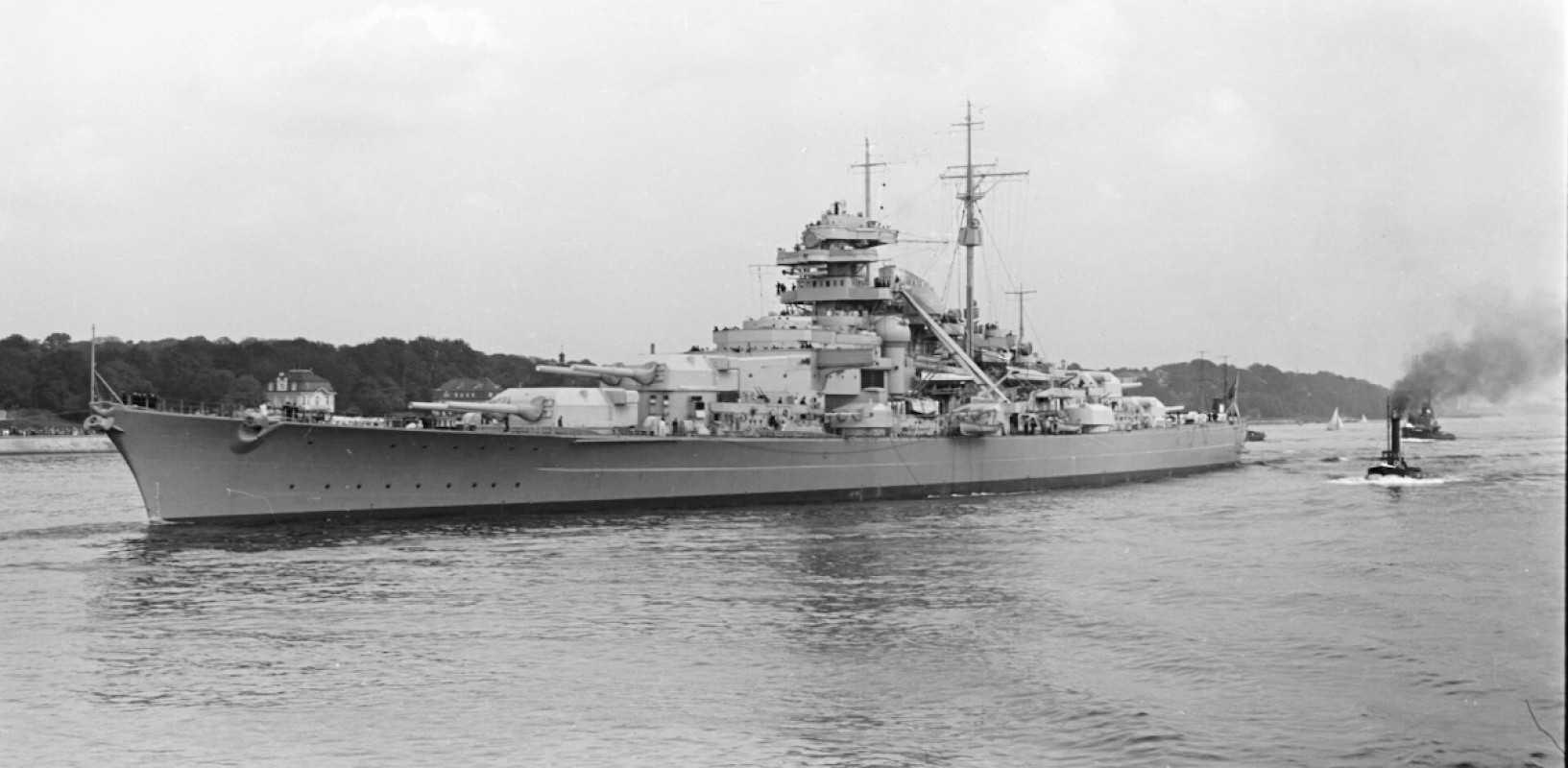
In appalling weather — a Force 8 gale with mountainous seas — Ark Royal turned into the wind and launched fifteen Swordfish of 810 and 818 Naval Air Squadrons, armed with torpedoes. The flight deck was pitching through 17 meters, waves were breaking over the bow, and aircraft were rising and dropping violently on the heaving deck. It was, by any standard, an insane thing to attempt. The first strike, however, nearly ended in disaster: attacking through the murk, the Swordfish mistakenly targeted the cruiser HMS Sheffield, which was shadowing Bismarck. Fortunately, the magnetic detonators on the torpedoes malfunctioned, and Sheffield escaped unharmed. The torpedoes were hastily re-armed with contact detonators for the second attempt.
A second strike of fifteen Swordfish was launched at 7:15 PM. This time the pilots found the right target. Pressing home their attack through a curtain of anti-aircraft fire, the Swordfish scored three hits. Two detonated forward of the engine rooms, causing moderate flooding but no critical damage. The third — the one that changed history — struck the starboard steering compartment, jamming Bismarck's rudder at 15 degrees to port. The mighty battleship, unable to steer, began circling helplessly in the heavy seas. She could no longer run for France.
That single torpedo hit sealed Bismarck's fate. Through the night, British destroyers harassed the crippled ship, and the next morning the battleships HMS King George V and HMS Rodney closed in and reduced her to a blazing wreck. Bismarck sank at 10:40 AM on May 27, 1941, taking over 2,000 men with her. It was Ark Royal's Swordfish — ancient, slow, and hopelessly outdated — that had delivered the blow that doomed the most powerful battleship in the Atlantic.
Malta Convoys and the Final Months
After the Bismarck chase, Ark Royal returned to the grinding routine of Mediterranean operations. Malta, the tiny island fortress astride the Axis supply lines to North Africa, was under constant siege, and its survival depended on a lifeline of convoys and fighter deliveries that only the carriers could provide. In operation after operation through the summer and autumn of 1941, Ark Royal ferried Hurricane fighters to Malta and escorted convoys through waters patrolled by Italian submarines, surface warships, and increasingly effective German and Italian aircraft.
In late April, Captain Loben Edward Harold Maund relieved Holland as Ark Royal's commanding officer — Holland had requested his own relief, citing nervous exhaustion after months of nearly continuous operations. Under Maund, the last Skuas were replaced by Fulmars, and by midsummer Ark Royal carried 24 of the type — the strongest fighter complement of any British carrier afloat.
In May, Ark Royal escorted a crucial convoy carrying 295 tanks and 53 fighters to the hard-pressed Egyptian front. Italian torpedo bombers attacked in two waves, escorted by agile Fiat CR.42 biplanes whose archaic appearance deceived the British fighters into close combat — with painful results. The Fulmar squadron commander, Rupert Tillard, was shot down and killed in the first minutes, along with his navigator, Mark Somerville — the admiral's nephew. The escort fighters held, however, and the convoy passed through safely.
The summer brought Operation Substance in July — a major convoy to Malta. Italian SM.84 torpedo bombers, flying at wave-top height beneath the radar coverage, penetrated the defensive screen and torpedoed the cruiser HMS Manchester and sank the destroyer Fearless. Italian gunners shot down three Fulmars and damaged several more. Yet the convoy's merchant ships reached Malta intact with their vital cargo. On the return trip, a bizarre accident occurred: a 16-kilogram armed fragmentation bomb hung up on a returning Swordfish, and when the aircraft landed and the arresting wire jerked the plane to a stop, the bomb broke free, struck the deck, and exploded. It blew a hole in the flight deck, killed the Swordfish's observer and four deck crew — the only bomb hit Ark Royal ever received in her career.
The Halberd convoy of late September 1941 was one of the largest Mediterranean operations of the war. Nine merchant ships sailed from Gibraltar under the protection of three battleships — Nelson, Rodney, and Prince of Wales — plus Ark Royal, five cruisers, and eighteen destroyers. The Italian fleet sortied with two battleships under Admiral Iachino, but lacking reliable intelligence and forbidden to engage a superior force, he turned back. Italian torpedo bombers hit Nelson in the bow, causing serious damage. Ark Royal's 27 Fulmars — the strongest fighter screen she ever put up — fought off most of the attacks, though friendly fire from the fleet's own anti-aircraft guns downed two of the British fighters alongside the Italian bombers. The convoy got through, delivering 85,000 tons of supplies that secured Malta's survival for the rest of the year. The only merchant ship lost was sunk on the final leg by Italian torpedoes and motor torpedo boats.
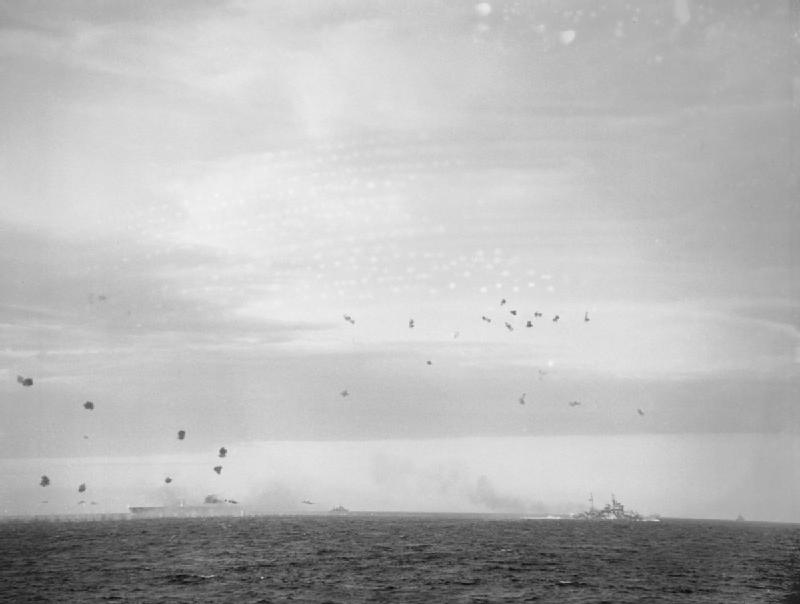
By October, Ark Royal was exhausted. In just over two years of war, she had steamed more than 200,000 miles with only the most minimal maintenance. Her engines were in poor condition — one propeller shaft's seals had been leaking since the summer of 1940, requiring constant pumping — and her crew was worn out. She received emergency engine work at Gibraltar, but a proper dockyard refit remained impossible. The fleet simply could not spare her.
The End of HMS Ark Royal
On November 10, 1941, Ark Royal and the old carrier Argus sailed from Gibraltar on yet another ferry run, delivering 37 fighters to Malta. The mission was uneventful, and the ships turned back for Gibraltar. On the return voyage, Somerville received a warning that German U-boats had been detected near the Spanish coast. He ordered heightened vigilance. Six Swordfish maintained a continuous anti-submarine patrol overhead.
At 4:15 AM on November 13, a torpedo from U-205, commanded by Korvettenkapitän Franz Georg Reschke, exploded in the wake of the destroyer Legion, close behind Ark Royal. Reschke had fired three torpedoes at the carrier; two detonations were heard aboard the submarine, and the Germans were initially convinced they had scored hits. In fact, all three torpedoes missed.
But another U-boat was approaching from the direction of Gibraltar. The U-81, commanded by Oberleutnant Friedrich Guggenberger, had just transited the Strait and stumbled directly into the returning Force H. At 3 PM, the submarine's crew observed the British ships and carefully maneuvered into attack position. At 3:40 PM, Guggenberger fired four torpedoes at what he identified as a large warship at approximately 3,500 meters. U-81 dove deep immediately after firing and did not observe the results, but heard one explosion at the expected time, and another shortly after. He reported damaging a battleship.
The carrier, making 19 knots, had just altered course and swung directly into the torpedoes' path. One struck her starboard side beneath the island superstructure. The torpedo, running deeper than its five-meter setting, probably hit the bilge keel at a depth of eight or nine meters, detonating beneath rather than against the hull. The upward blast ruptured the torpedo protection bulkhead — designed to resist a lateral impact, not a force from below — and the explosion lifted the entire ship. On the flight deck, torpedo-laden Swordfish momentarily bounced into the air.

The damage was devastating. A roughly 40-by-9-meter section of hull plating was torn open or deformed. Water poured into the starboard boiler room, electrical switchboards, and the central control station. The starboard generators failed immediately, cutting power to much of the ship. The telephone system and radios went dead. Ark Royal took a ten-degree list to starboard, but continued moving for about ten minutes before she could be stopped — the communications failure meant the order to halt engines had to be carried by runner to the engine rooms. By the time the ship was finally halted, the list had reached 18 degrees.
Captain Maund, remembering how quickly Courageous had sunk, ordered all non-essential personnel to evacuate. The destroyer Legion came alongside the carrier's port quarter, and nearly 1,500 men crossed over — ten times the destroyer's own crew. But the evacuation was chaotic: many critical engineers and technicians were among those who left, and for nearly an hour, no effective damage control work was carried out while men were being sorted on the flight deck.
The fatal design flaw now revealed itself. All six boilers exhausted through a single shared uptake to the funnel. As the list increased, seawater flooded into this uptake and cascaded down into the center and starboard boiler rooms. The feed water pumps failed, water levels in the boilers dropped below critical thresholds, and by 5 PM steam production ceased entirely. Without steam, the turbogenerators stopped. Without generators, the ship lost all electrical power. Without diesel backup generators — deleted from the design to save money — there was nothing to fall back on. The pumps stopped. The lights went out.
The destroyer Laforey came alongside and connected her electrical supply to Ark Royal's grid. Pumps restarted, and counter-flooding reduced the list from 18 to 14 degrees. Tugs from Gibraltar — the Thames and the St. Day — arrived and took the carrier in tow at two knots. By late evening, one boiler was relit and two turbogenerators restarted. Power was partially restored, pumps were running, and the crew began preparing to restart the port engine. Everyone believed the worst was over.
At 2:15 AM on November 14, with Ark Royal just 30 miles from Gibraltar, a short circuit sparked a fire in the sole operational boiler room. It had to be evacuated. The list surged past 20 degrees. Water again flooded the uptakes, drowning the last boilers. The damage control teams fought on for ninety more minutes, but they could only slow the flooding, not stop it. At 4:00 AM, with the list at 27 degrees, Captain Maund gave the order to abandon ship. By 4:30 AM, the evacuation was complete. He was the last man off.
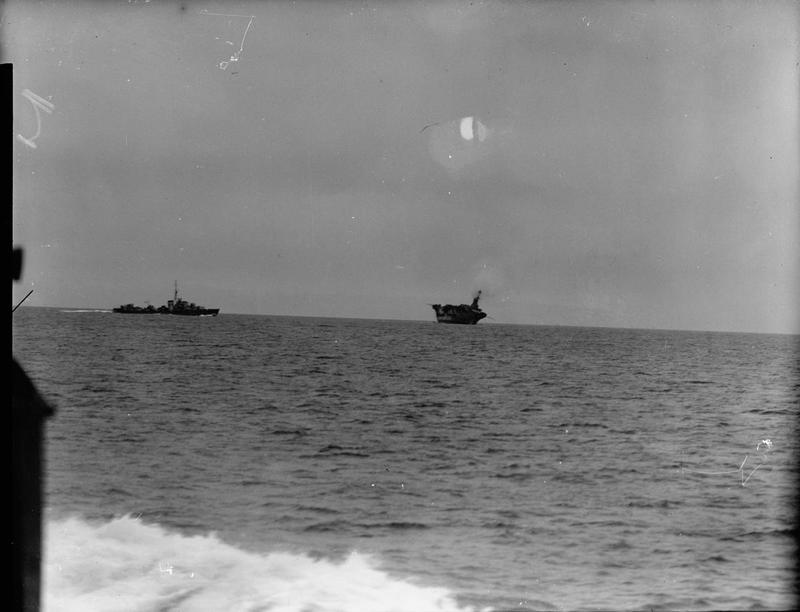
At 6:13 AM, HMS Ark Royal rolled completely onto her starboard side, her flight deck rising vertically above the water. She hung there for a few eerie moments. Then, at approximately 6:19 AM, thirteen hours after the torpedo hit, she broke in two. The aft section sank within a couple of minutes, followed by the bow. Of her crew of over 1,500, only one man — Able Seaman Edward Mitchell, aged 44 — had been killed.
Aftermath and Legacy
Captain Maund was court-martialed in February 1942 and found guilty of negligence for ordering the evacuation too early and failing to ensure the continuity of damage control. The court noted, in mitigation, that he had acted out of concern for his crew's safety. Maund received no further sea commands and was placed on the reserve list in July 1943, but was recalled to active duty barely a month later and posted to Bombay. He retired in 1946 with the rank of rear admiral.
The Board of Inquiry was equally critical of the ship's design flaws. The absence of emergency diesel generators was judged the most serious deficiency, but the vulnerability of the single exhaust uptake, the weakness and poor placement of internal bulkheads, and the inadequate extent of watertight subdivision were all condemned. These deficiencies were retroactively corrected in the Illustrious and Implacable class carriers then building or already in service.
Ark Royal's loss was a severe blow to the Gibraltar-based fleet, which lost its only modern carrier at a moment when the Mediterranean war was reaching a crisis. Her replacement, the elderly HMS Eagle, was a poor substitute. In the weeks that followed, the Royal Navy suffered a cascade of disasters: Italian frogmen sank the battleships Queen Elizabeth and Valiant at Alexandria; Japanese bombers destroyed Prince of Wales and Repulse off Malaya; and Singapore fell in February 1942. The Royal Navy was stretched to breaking point.
Yet Ark Royal had done what she was built to do. She had held the line, virtually alone, until her successors could take her place. In her brief career of barely two years, she participated in almost every major naval operation in the Atlantic and Mediterranean: the hunt for the Graf Spee, the Norwegian campaign, Mers-el-Kébir, Dakar, the Cape Spartivento action, the Genoa bombardment, the Bismarck chase, and countless Malta convoys and fighter ferry runs. Her pilots shot down more than 40 enemy aircraft. The Malta lifeline she helped sustain was critical to the entire Allied war effort in the Mediterranean. And it was her Swordfish that crippled the Bismarck — arguably the single most important act of British naval aviation in the entire war.
No other British carrier achieved such fame or served with such distinction in so short a time. The "Royal Bark" had lived up to her motto: Zeal Does Not Rest.
The Wreck
In December 2002, the wreck of HMS Ark Royal was discovered by C&C Technologies Inc., a subsea survey company working for the BBC documentary series on famous British naval victories. The search had taken longer than expected because the carrier did not lie where official reports indicated — she had actually drifted some 15 kilometers east of the recorded sinking position before going under.
The wreck rests at a depth of approximately 1,000 meters. The bow section, roughly the first twenty meters, broke off during the sinking and lies inverted on the seabed nearby. The main hull, however, sits upright. The island superstructure has separated from the flight deck. A large debris field surrounds the wreck, containing structural elements, equipment, and aircraft that fell from the hangars as the ship rolled over.
HMS Ark Royal is designated as a protected place under the Protection of Military Remains Act 1986. She rests undisturbed, a silent memorial to the men who served on her and to the age of naval warfare she helped to create.
Frequently Asked Questions
What sank HMS Ark Royal?
A single torpedo from the German submarine U-81, commanded by Oberleutnant Friedrich Guggenberger, struck Ark Royal on November 13, 1941. The torpedo detonated beneath the hull rather than against it, rupturing the torpedo protection system and flooding the boiler rooms. Design flaws — particularly the single shared exhaust uptake and the absence of diesel backup generators — meant the ship lost all power and could not be saved. She sank the following morning, just 30 miles from Gibraltar.
How many crew were killed when Ark Royal sank?
Remarkably, only one crew member was killed — Able Seaman Edward Mitchell, aged 44. The relatively slow sinking (about 13 hours from torpedo hit to loss) and the proximity to Gibraltar allowed the orderly evacuation of almost the entire crew of over 1,500 men to the destroyer HMS Legion and other rescue vessels.
Did Ark Royal sink the Bismarck?
Not directly, but Ark Royal's Swordfish torpedo bombers delivered the critical blow. On May 26, 1941, a torpedo hit jammed Bismarck's rudder at 15 degrees to port, leaving the German battleship unable to steer. This allowed the British battle fleet to catch and destroy Bismarck the following morning. Without Ark Royal's intervention, Bismarck would almost certainly have escaped to the safety of French ports and Luftwaffe air cover.
Why was the Swordfish so effective against Bismarck?
The Swordfish was so slow — under 200 km/h at attack speed — that Bismarck's anti-aircraft fire directors, calibrated for much faster modern aircraft, consistently led the biplanes too far, firing ahead of them. The aircraft's fabric-and-tube construction also meant that many shells passed straight through without detonating, as there was insufficient material to trigger the proximity fuses.
Was Ark Royal's captain blamed for her loss?
Yes. Captain Loben Maund was court-martialed in February 1942 and found guilty of negligence for ordering the evacuation too early, which left the ship without enough skilled personnel for effective damage control. However, the inquiry also identified serious design defects — particularly the lack of diesel backup generators and the vulnerable single exhaust uptake — as major contributing factors.
Where is the wreck of HMS Ark Royal?
The wreck was discovered in December 2002 at a depth of approximately 1,000 meters, about 30 nautical miles from Gibraltar — roughly 15 kilometers east of the position recorded in official reports. The hull sits upright on the seabed, though the bow section and island superstructure have separated. The site is protected under British law as a military grave.
How many aircraft carriers named Ark Royal has the Royal Navy had?
Five ships of the Royal Navy have borne the name Ark Royal. The original was the flagship of the English fleet against the Spanish Armada in 1588. The most famous is the World War II carrier (1938–1941) described in this article. The name was carried by two more carriers: the Audacious-class carrier commissioned in 1955 and the Invincible-class carrier that served from 1985 to 2011.