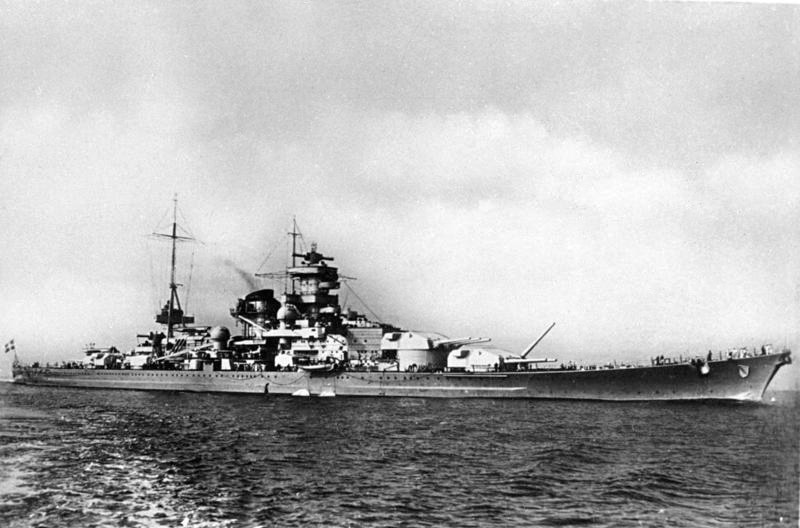
In the late 1930s, the German Navy designed three warships that perfectly encapsulated every contradiction, every delusion, and every strategic dead end of the Third Reich's naval ambitions. The O-class battlecruisers — designated O, P, and Q — were to be 35,000-ton commerce raiders armed with the same 38cm guns that equipped the Bismarck, yet protected by armor barely thicker than a heavy cruiser's. They were designed to terrorize Atlantic convoys, destroy their escorts, and force the Royal Navy to disperse its capital ships across the ocean. They were approved by Hitler in early 1940, assigned to shipyards, and given a construction supervisor. Then the war intervened, and not a single rivet was driven. The O class joined the long and melancholy list of German warships that existed only on paper — and in retrospect, that was probably the smartest decision the Kriegsmarine ever made. This is the story of the ships that were never built, and why building them would have been an act of colossal waste.
The Anglo-German Naval Agreement and Its Consequences
The 1935 Anglo-German Naval Agreement transformed Germany's naval prospects overnight. Under its terms, Germany was permitted to build a surface fleet up to 35 percent of the Royal Navy's total tonnage, and accepted the Washington Naval Treaty's limits — 35,000 tons maximum displacement and 406mm maximum gun caliber for capital ships. Compared to the humiliating restrictions of the Treaty of Versailles, which had capped German warships at a ludicrous 10,000 tons, this was an enormous step forward.
The Germans immediately abandoned the pocket battleship program. Instead of building two more Deutschland-class ships, they began work on the 26,000-ton Scharnhorst and Gneisenau, and started designing what would become the Bismarck class. The initial euphoria, however, quickly faded. Even with the new agreement's generous limits, the German Navy would still be hopelessly outnumbered by the Royal Navy — and even by the French fleet. Germany's continental geography forced it to prioritize the army and air force, leaving no realistic prospect of matching the British in sheer numbers of warships. The old answer suggested itself once more: compensate for numerical inferiority with qualitative superiority.
The P-Class Cruisers: A Stillborn Design
In 1937, the naval staff returned to the pocket battleship concept — updated and enlarged for the new era. The strategy remained the same: fast, heavily armed ships that could overpower any cruiser, shrug off cruiser-caliber shells, and outrun anything they couldn't outfight. The classic commerce-raiding doctrine — attack the weak, flee the strong. As Hitler himself put it: "On land I am a hero, but at sea I am a coward." He was not, characteristically, speaking about his personal feelings. He was describing Germany's military strategy in the first person singular, as dictators do: aggressive blitzkrieg on land, evasive raiding warfare at sea.
The Navy drew up the following requirements for the new P-class cruisers:
- 20,000-ton displacement
- 34–35 knots maximum speed
- 15,000 nautical miles range at 19 knots
- Six 283mm guns as main armament, with 150mm secondary guns and 105mm anti-aircraft guns
- Armor sufficient to resist 203mm heavy cruiser shells
Starting from these requirements — and frequently deviating from them — German engineers produced nearly two dozen study designs. Besides the 20,000-ton version, they drew up plans for 30,000-ton ships armed with 38cm guns. The engineers preferred diesel propulsion for its fuel economy and range, but the enormous diesel engines demanded a wider hull, which meant a longer ship, heavier armor, and therefore more displacement — which demanded even more powerful engines. The designers were trapped in the familiar vicious circle of warship design: every solution created a new problem. If they switched to steam turbines, the increased fuel consumption ate into range. If they carried more fuel, the ship grew larger. No matter how they juggled the numbers, they could not meet the requirements within 20,000 tons.
The armor was equally problematic. The Navy proposed a 145mm belt and 60mm deck armor — 100mm over the magazines — which represented a major improvement over the pocket battleships. But closer calculations showed even this would not provide adequate protection against 203mm guns. Strengthening the armor further meant enlarging the hull, which triggered another cascade of weight increases.
The P class was almost certainly a stillborn project. The designers simply could not meet the stated requirements within the given displacement. Something had to give. Practical prospects were also dimming. The original plan called for twelve ships to be built within three years, but the shipyards were already fully committed to ongoing construction of battleships, cruisers, and destroyers. There was simply no capacity left for the P class.

From P to O: The Birth of the Battlecruisers
The naval staff was increasingly dissatisfied with the 283mm guns. Development of a new 305mm weapon was underway, but it would take years. In the meantime, only two heavy-caliber options were available: the 28cm and the 38cm.
The two German battlecruisers, Scharnhorst and Gneisenau, had been built from the outset with provision for replacing their triple 28cm turrets with twin 38cm turrets. The refit was originally planned for the winter of 1940, and the necessary guns and turrets had already been ordered from Krupp in 1938. But with the political situation deteriorating — the Anschluss and the Czechoslovak crisis had raised the specter of war with Britain — the Navy was reluctant to put both battlecruisers into dry dock simultaneously. Sometime in late 1938, someone suggested using the already-ordered guns for the P-class cruisers instead.
The idea was not entirely new. Plans for a 38cm-armed version of the P class had been drawn up the previous year but rejected. Now those sketches were pulled from the files and completely reworked into a new ship class. Work on the P-class designs was halted. The new class was planned as a trio, designated O, P, and Q. In the literature, they are known as the O-class battlecruisers.
The Navy's requirements for the new ships were:
- 30,000-ton displacement
- 34 knots maximum speed
- 15,000 nautical miles range at 19 knots
- Six 38cm guns as main armament, with dual-purpose secondary guns
- Armor sufficient to resist 203mm heavy cruiser shells
Apart from the firepower, the ships represented no particular advance over the P class. Their mission was the same: attack merchant shipping and the cruisers escorting it. Their thin armor made them unsuitable for anything else. The 38cm guns gave them far greater hitting power, though the rationale for this was questionable — convoy escorts were cruisers and destroyers, against which such firepower was wildly excessive. The official justification was that the heavy armament would force the British to assign battleships to convoy duty, thereby weakening the Home Fleet. This reasoning was rather dubious, since even the 28cm-armed ships already posed enough of a threat to require battleship escorts for valuable convoys.
Plan Z and the Logic of Delusion
The O-class battlecruisers were integral to Plan Z, the Kriegsmarine's grandiose fleet-building program. Under Plan Z, the battlecruisers would attack convoys in the open Atlantic, luring Royal Navy capital ships out of home waters. Two task forces, each centered on three H-class super-battleships and an aircraft carrier, would then engage and destroy the dispersed British forces.
Behind this confused strategic thinking lurked an even more delusional concept: Tirpitz's risk theory, recycled a quarter-century later. Hitler almost certainly believed that a strong and dangerous German fleet would discourage the British from fighting, and that they would instead seek a diplomatic compromise on terms favorable to Germany. The Germans, in other words, were trying to refight the First World War — twenty-five years after losing it.
Many historians suspect that the shift from pocket battleships to ever-larger designs was ultimately Hitler's idea, or at least inspired by him. Like most dictators, the Führer was fascinated by large warships. They satisfied his megalomania and served as impressive symbols of the Reich's — and its Leader's — greatness.
The Navy's own officers and engineers were considerably less enthusiastic. The project generated skepticism from the start. Even the engineers designing the ships did not think much of them. The officer corps was particularly unhappy with the inadequate armor. Within the Kriegsmarine, the battlecruisers were derisively nicknamed "Ohne Panzer Quatsch" — roughly translating to "Without Armor Nonsense," a play on the ships' letter designations O, P, and Q. The opinions of junior officers, naturally, interested no one in the upper leadership.

The Design: Specifications and Construction Plans
The parameters were finalized by September 1939, and after working out the details, the plans were submitted for approval. Hitler and Raeder approved them in early 1940. Ship O was to be built at the Deutsche Werke shipyard in Kiel, Ship P at the Kriegsmarine Werft in Wilhelmshaven, and Ship Q at the Germania Werft in Kiel. Admiral Werner Fuchs was assigned to supervise the construction.
The battlecruisers — referred to in German documents mostly as "fast battleships" — would have been 248.15 meters long overall, 30 meters in beam, with a maximum draft of 8.8 meters. The hull depth at the main frame was 15.5 meters, giving a freeboard of 6.7 meters even at maximum load — an excellent figure by German standards. By comparison, the Scharnhorst had only 4.1 meters of freeboard at full load, and the Bismarck just 4.8 meters. Greater freeboard meant a stronger hull, better seakeeping, and — crucially — greater reserve buoyancy, allowing the ship to absorb more flooding damage before sinking.
The metacentric height at full load was 3.63 meters — less than the Bismarck's 4.4 meters but far superior to the Scharnhorst's 2.5 meters. This would have given the battlecruisers excellent stability. The hull featured an unusual shallow V-shaped bottom, perhaps for better hydrodynamic performance. The block coefficient of 0.512 was the lowest of any large German warship.
The hull was divided into twenty watertight compartments, meticulously subdivided in the typical German fashion to minimize flooding in the event of damage. The ship would have been approximately 95 percent welded, saving significant weight compared to riveted construction — a technique the Germans pioneered for major warships, though most other navies at the time still preferred riveting.
Standard displacement — without fuel and water — was 28,857 tons. Maximum displacement would have reached 35,367 tons. The hull structure accounted for 30 percent of the total weight, while armor accounted for only 27.5 percent — immediately revealing what kind of ship this was. On the Bismarck, armor made up 40 percent of the total weight.
Armor: The Achilles' Heel
The most criticized aspect of the O-class design was its thin armor — barely heavier than what had been planned for the P-class cruisers. Weak armor is the defining characteristic of all battlecruisers, of course; it is the price paid for high speed. These ships were never intended to fight battleships. But the O class's protection was thin even by battlecruiser standards, which made them particularly notorious within the German Navy, which traditionally placed great emphasis on heavy armor.
The main belt was 190mm thick — scarcely more than a good heavy cruiser. Above the main belt, the Germans armored the hull all the way to the upper deck with a 90mm secondary belt. This distributed protection across a larger area, in line with the German philosophy of minimizing damage rather than trying to create an impenetrable barrier. The bow received a narrow 60mm belt at the waterline, while the stern was left unarmored.
The horizontal protection was considered even weaker than the belt. In typical German fashion, the armor was split between two decks rather than concentrated on one. The upper deck was 30mm thick across the full length of the ship. The main armored deck was 60mm thick on the flat sections, with 80mm slopes angling downward to meet the lower edge of the belt at the waterline. This "turtleback" arrangement provided additional protection to the waterline — necessary given the thin belt. The armored deck continued aft beyond the citadel to protect the steering gear and propeller shafts, with the slopes increasing to 110mm in this area.
The forward conning tower had relatively strong protection: 200mm sides, 80mm roof, and 30mm floor. The communication tube connecting it to the central fire-control station below the armored deck was 80mm thick. The aft conning tower was much more lightly protected, at 30–50mm.
The main battery turrets had 220mm cemented face plates, 180mm sides and rear, but only 50mm roofs — leaving them vulnerable to plunging shells and bombs. The barbettes were 180mm above the upper deck and 145mm below, except for the aft C turret, whose barbette was reduced to 80mm on the side facing the armored transverse bulkhead behind it. Inside each barbette, a second inner cylinder of 20mm plate was installed to catch splinters and spall from the inner face of the armor. The 15cm turrets received only token 14mm splinter protection, with their barbettes left entirely unarmored.
Torpedo Protection
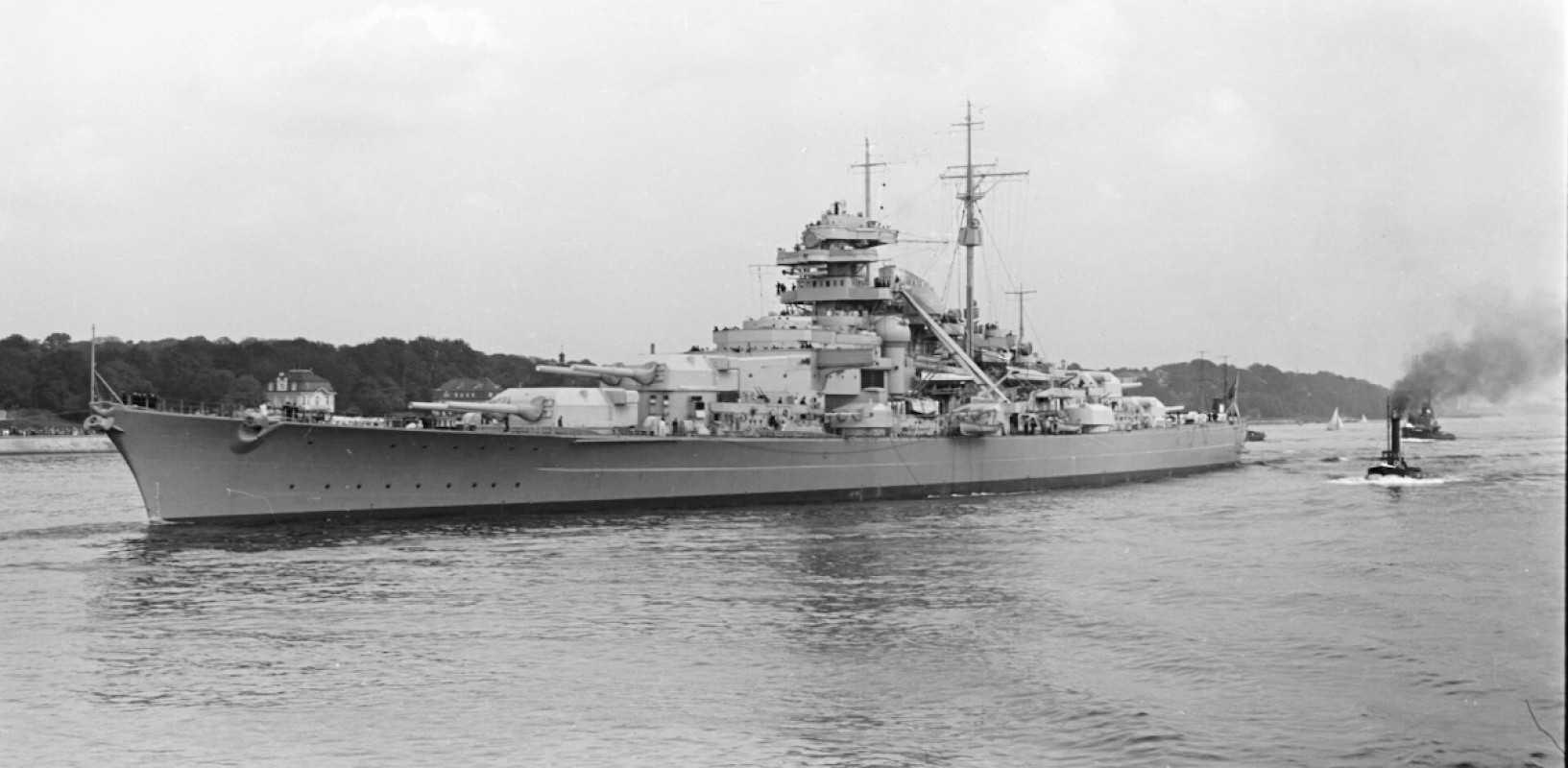
The torpedo defense system followed the same layout as earlier German capital ships, but the narrower, more streamlined hull meant less depth was available. The torpedo protection system depth was only 4.2 meters at the main frame — already marginal — dropping to 2.6 meters at the B turret, 1.8 meters at the A turret, and a mere 1 meter at the C turret aft, where the propeller shafts consumed much of the available space.
The designers tried to compensate for the shallow depth by making the inner torpedo bulkhead thicker than usual: 45mm in the machinery spaces and 60mm over the magazines, using flexible homogeneous armor plate designed to absorb the shock wave of an underwater explosion. They also adopted the French Bourrage, or Ebonite Mousse — a mixture of foamed rubber and resin, cast into brick-sized blocks and packed into the empty voids of the torpedo protection system. This material, already in widespread use on French warships, increased the system's resistance and reduced flooding after damage. The ship would have used approximately 150 to 200 tons of the material, though it was omitted from the bow and stern to save weight. The double bottom was 1.7 meters deep at its maximum.
Propulsion: The Diesel-Steam Compromise
High speed and long range were primary design requirements: 34 knots and 14,000 nautical miles at 19 knots. These two demands pulled in opposite directions. High speed required long, slender hulls and powerful engines. Long range required fuel-efficient diesel engines. But the diesels were enormous and far heavier than steam turbines of equivalent power. The all-diesel H-39 battleship's machinery weighed 4,828 tons, compared to just 2,800 tons for the Tirpitz's equally powerful 162,000-horsepower steam plant — a 70 percent weight penalty. In exchange, the H-39 would have had nearly double the range: 16,000 nautical miles versus the Tirpitz's 8,870.
An all-diesel arrangement was quickly ruled out for the O class. The 63,000-ton H-39 was large enough to absorb the weight and volume of the massive diesel engines without difficulty. On the smaller battlecruisers, the diesels would have consumed too much space and displaced too much weight. But steam turbines alone could not deliver the required range. The compromise was a hybrid propulsion system: diesel engines on the two outer shafts, and a steam turbine on the center shaft. This shortened the armored citadel by nine meters compared to the all-diesel variant.
The MAN VZ42/58 diesel engines — originally ordered for the P-class cruisers — were 24-cylinder, V-configuration, two-stroke units producing 15,300 horsepower each at 450 rpm. Four diesels were coupled to each outer shaft through reduction gearboxes, arranged in pairs across two engine rooms per shaft, with a third compartment housing the gearbox itself. A special hydraulic coupling corrected for rpm differences between engines on the same shaft. MAN completed and tested one engine after the project was cancelled; it performed flawlessly through 300 hours of continuous operation.
The center shaft was driven by a set of Brown, Boveri & Cie turbines originally ordered for the aircraft carrier B — the planned sister ship of Graf Zeppelin, which reportedly would have been named Peter Strasser. Repurposing these turbines saved construction time. The turbines were the most powerful units yet used by the German Navy, capable of delivering 60,000 horsepower at full load. Four Wagner high-pressure boilers operating at 55 atmospheres and superheating steam to 460°C supplied the turbine. Unusually for a German warship, all four boilers were housed in a single boiler room — a vulnerability dictated by space and weight constraints. Two auxiliary boilers were placed above the armored deck behind the forward funnel, an exposed position justified by the fact that they were primarily used in port.
Total maximum output across all three shafts was 175,136 horsepower, driving three 4.8-meter diameter, three-bladed manganese bronze propellers to a design speed of 33.5 knots. The ships would have had three rudders — one behind each propeller — almost certainly inspired by the Italian Littorio class. This arrangement, also planned for the H-class battleships, would have significantly improved survivability and prevented a repetition of the Bismarck's fatal rudder jam.
Electrical Power
Maximum electrical demand in combat conditions was estimated at 2,760 kilowatts. German Navy regulations required double this capacity as a damage reserve. The engineers, characteristically, exceeded even this standard. Two 460 kW turbogenerators and six 920 kW diesel generators provided a total capacity of 7,360 kW — comfortably above requirements. Two additional 460 kW diesel generators supplied 110-volt AC power for equipment requiring alternating current, while the main ship's network ran on 220-volt DC. Because the installed generating capacity so greatly exceeded demand, the German Navy dispensed with the emergency backup generators that were standard practice in other navies.
Main Armament: Bismarck's Guns
The battlecruisers would have carried the 38cm/52 SK C/34 gun — the same weapon used on the Bismarck class, and the largest gun ever mounted on a German warship. The 19.63-meter, 110.7-ton guns had the highest rate of fire of any contemporary large-caliber naval gun: a theoretical 18 seconds between salvos, though in practice — once the ready-use ammunition in the turret was expended and higher barrel elevations were needed — the rate dropped to 25–30 seconds. The guns could only be reloaded at a fixed 2.5-degree elevation, requiring the barrels to be lowered and raised between shots at longer ranges. Barrel life was rated at 242 rounds.
Three types of 800-kilogram shells were available. The armor-piercing round (Panzersprenggranate) carried only 18.8 kg of explosive, with most of the shell's weight devoted to a thick, hardened casing designed to punch through heavy armor before detonating on a 0.035-second delay fuse. This delay sometimes meant the shell passed entirely through lightly armored targets without detonating. The base-fused high-explosive shell (Sprenggranate Bodenzünder) had a 32.6 kg bursting charge for use against cruisers and other moderately armored targets. The nose-fused high-explosive shell (Sprenggranate Kopfzünder) carried 64.2 kg of explosive for use against unarmored merchant ships and destroyers, detonating on impact.
The propellant was loaded in two parts: a 99.5 kg fore charge in a silk bag, and a 112.5 kg main charge in a brass cartridge case that sealed the breech against gas leakage. This produced a muzzle velocity of 820 meters per second and a maximum range of 36,520 meters at full elevation. The turrets were fitted with 10.5-meter baseline optical rangefinders, and all three turrets would have retained them — an improvement over the Scharnhorst and Bismarck, where the forward turret's rangefinder had been removed after sea trials because spray made it unusable at speed.
Secondary and Anti-Aircraft Armament
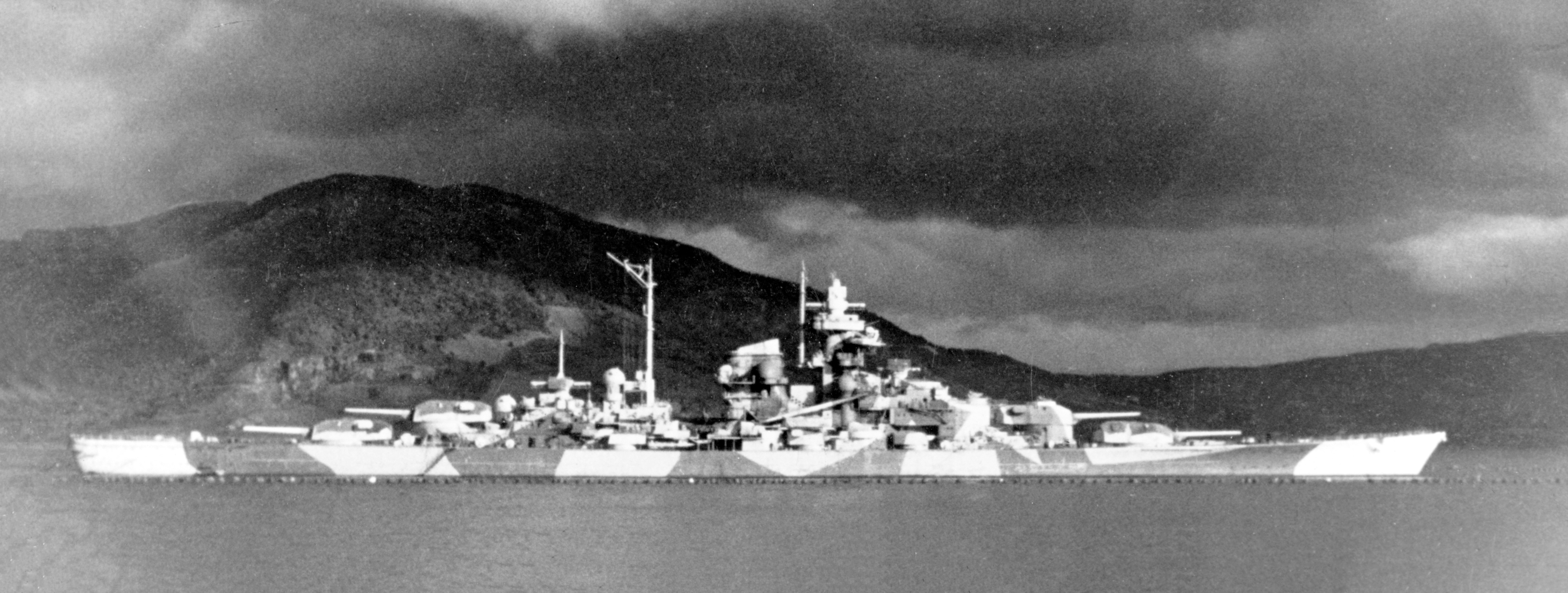
The secondary battery consisted of six 15cm/48 Tbts KC/36T guns in three twin turrets — a lighter, shorter-barreled weapon originally developed for destroyers, entering service in 1942. Two turrets were positioned on either side of the forward superstructure, and the third was mounted aft, superfiring over the C main battery turret. The aft turret had an excellent arc of fire — nearly 330 degrees — while the forward turrets were limited to about 170 degrees by the superstructure.
The designers seriously considered adopting dual-purpose guns for the secondary battery, but no suitable weapon was available. The 127mm gun then under development was years away from service. The naval staff also disliked dual-purpose weapons, believing their lighter shells would be ineffective against destroyers and cruisers. As Vice Admiral Karl Witzel explained: "We faced an enemy with a vast numerical superiority in destroyers. We therefore needed secondary guns capable of delivering rapid, effective fire to keep massed destroyer attacks at bay. After thorough testing, we concluded that 150mm guns were essential against enemy destroyers and merchant ships. The American 127mm and British 134mm dual-purpose guns would not have met our requirements."
The heavy anti-aircraft armament consisted of eight 10.5cm SK C/33 guns in four enclosed twin mounts — a significant upgrade from the open mounts used on earlier ships, which exposed crews and electrical equipment to weather and splinters. The enclosed mounts were heavier (44 tons versus 27), but featured improved traverse and elevation rates of 10 and 12 degrees per second respectively. The guns fired a 15.1 kg shell at 900 meters per second to an effective ceiling of 12,500 meters.
Light anti-aircraft armament comprised eight 37mm guns in four twin mounts and twenty 20mm guns in ten twin mounts. Both types were manually aimed and hand-loaded — a persistent German deficiency. The 37mm guns' theoretical rate of 80 rounds per minute dropped to about 40 in practice due to manual loading, while the hand-cranked traverse speed of barely 4 degrees per second was inadequate even by heavy AA standards. The 20mm guns suffered from a 20-round magazine that required constant changing, and a breech mechanism prone to jamming. Had the ships actually been built, the twin 20mm mounts would almost certainly have been replaced by the far more effective quadruple Vierling mount introduced in 1940.
Torpedoes and Aircraft
Despite being designed from the outset as commerce raiders — for which torpedoes were the most efficient weapon for sinking captured merchantmen — torpedo armament was initially omitted from the specifications. It was added during the design process, but finding space for the tubes proved difficult. Deck-mounted launchers, the standard arrangement, could not be accommodated. Underwater tubes created weight and protection problems. The solution was to install twelve fixed 533mm torpedo tubes inside the hull, above the waterline, on the armored deck between the two funnels — six on each side, with a torpedo magazine between them. The arrangement was vulnerable, protected only by the thin upper belt and upper deck, but no better alternative existed.
For reconnaissance — essential for a lone raider on the open ocean — the ships carried four Arado Ar 196A floatplanes in hangars arranged similarly to the Bismarck's: a main two-aircraft hangar behind the forward funnel and two single-aircraft hangars flanking the aft funnel. A fixed compressed-air catapult was mounted on the main deck between the hangars. The hangars were given 14mm splinter protection. The aircraft and their crews, as on all German warships, belonged to the Luftwaffe rather than the Navy.
Fire Control and Radar
The source text and subsequent analyses highlight a recurring failure in German naval technology: the neglect of radar and automated fire control. Germany was actually a pioneer in radar development — Christian Hülsmeyer patented a radio-based detection device as early as 1904, and the first operational naval radar, the Seetakt, was installed on the pocket battleships in 1937. But early success bred complacency. The German leadership concluded that their existing equipment was as good as radar could get, and failed to invest in further development. Meanwhile, British radar research, which only began in 1935, quickly caught up and then surpassed the German effort. By 1943, Allied radar was orders of magnitude more capable.
The Germans used radar only for search and navigation, never for fire control, preferring their traditional optical rangefinders. Commanders routinely switched off their radars in operational areas, fearing the emissions would betray their position. Officers received no training in radar employment, and tactical manuals contained no instructions for its use until March 1945.
The failure to develop centralized fire control for the light anti-aircraft weapons was equally baffling. By the late 1930s, the Italians and Japanese had solved the problem of centrally directing small-caliber AA guns, while the Soviets were planning fully automated, remotely controlled AA batteries for their battleships. The Germans — otherwise at the forefront of military technology — relied on manual aiming with ring sights throughout the entire war.

Cancellation and Assessment
Although the O-class plans were approved in early 1940 and preparations for construction were made, the actual work never began. The worsening war situation — severe shortages of high-grade steel, dockyard labor diverted to U-boat production — made the project impossible. The orders were cancelled a year later.
The general verdict is that the Germans lost nothing by not building them, and the ships have had uniformly bad press ever since. Critics focus on the thin armor, the shallow torpedo protection, and the weak light AA armament. These criticisms are not entirely unfounded, but a fair comparison with contemporary battlecruisers suggests the O class was not as egregiously bad as commonly portrayed.
The belt armor, at 190mm, was thin — but the Dunkerque's was 225mm, the Kronstadt's and Alaska's 230mm, and the World War I-vintage Renown's only 152mm. All of these ships used inclined belts, which increased effective thickness. The O class's 80mm armored deck slopes provided additional waterline protection. The Kronstadt and Alaska had no sloped deck armor at all. Postwar Soviet battlecruiser designs — informed by wartime experience — used belt armor of only 180mm, suggesting the Soviets at least agreed that belt thickness was less critical than had been assumed in the 1930s. Internal subdivision and effective damage control mattered more for survival than raw armor thickness.
The anti-aircraft armament, judged by 1939 standards rather than the anachronistic comparisons some Anglo-American writers indulge in — comparing Bismarck's 1940 outfit to American ships' 1944 configurations — was reasonably adequate. The Dunkerque carried sixteen 130mm dual-purpose guns, five 37mm guns, and eight 13.2mm machine guns. The Kronstadt would have had eight 100mm AA guns and twenty-four 37mm guns. By these standards, the O class's eight 10.5cm and the substantial light AA battery was competitive.
The torpedo protection, constrained by the narrow hull, was shallow but compensated by the thick inner bulkhead and the Bourrage filling. Calculations suggest the system would have been nearly as effective as the Scharnhorst's — which was far from negligible. The Alaska's torpedo defense, by comparison, was considerably weaker, with only three meters of depth at the widest point and no armored inner bulkhead.
The Real Question: Did Germany Need Battlecruisers?
The technical merits of the O class, however, are beside the point. The real question is not whether the design was adequate, but whether battlecruisers of any kind served Germany's strategic needs — and by 1940, the answer was clearly no.
Battlecruisers had originally been designed for three roles: fleet reconnaissance, engaging an enemy fleet's advance guard, and hunting down enemy commerce raiders. The Germans added a fourth: raiding enemy commerce themselves. But fleet reconnaissance had been taken over by naval aviation even before the end of the First World War. The Germans had abandoned any pretense of building a fleet to match the Royal Navy, so there was no enemy advance guard to engage. And German merchant shipping was too limited to require capital-ship protection.
That left commerce raiding — and here the fundamental question was whether 35,000-ton ships armed with 38cm guns were the right tool for the job. The official argument was that these ships could fight their way past the battleships escorting major convoys. This was obvious nonsense. Fighting battleships required not 38cm guns but heavy armor, and the O class's 190mm belt would have made them easy prey for any battleship afloat. Against heavy cruisers — the targets their armor was actually designed to resist — the 38cm guns were absurdly overpowered. For the actual commerce-raiding mission, the much cheaper and smaller P-class cruisers would have been equally effective.
The O class was, in the end, a case of designing the coat to fit the button. Just as the British built the Vanguard around surplus 15-inch guns they had in storage, the Germans designed three battlecruisers around surplus 38cm guns they had already ordered for the Scharnhorst refit. In hindsight, they would have been far better off accepting the six-month delay to rearm Scharnhorst and Gneisenau as originally planned, giving Germany two powerful, well-armored fast battleships, and building three P-class cruisers with the surplus 28cm guns.

By the 1940s, surface commerce raiding itself had become obsolete. The spread of radar and long-range maritime patrol aircraft made it impossible for surface warships to remain undetected for extended periods. The only effective tool for the tonnage war against merchant shipping was the submarine. The Germans should have known this — they had tried and failed with surface raiders in the First World War, and had achieved spectacular success with U-boats. Yet they repeated the same mistake, sending out capital ships one by one to be hunted down by the British. The Scharnhorst herself was lost on just such a raiding sortie in December 1943.
It would have been far more sensible to invest Germany's limited shipbuilding capacity in submarines and ocean-going destroyers. But even the most optimized fleet composition could not have changed the fundamental reality. In the five years between the Anglo-German Naval Agreement and the outbreak of war, Germany had no realistic prospect of building a navy capable of challenging the Royal Navy. The army and air force consumed the lion's share of industrial capacity. A 1938 calculation showed that full implementation of Plan Z would have required more oil annually than Germany's entire national consumption. By 1939, military spending already devoured 54 percent of the national budget. Adding a massive fleet-building program on top of that would likely have collapsed the German economy.
And even if every ship in Plan Z had been completed, it would not have equalized the balance. The plan called for 68 German destroyers. At the outbreak of war, the Royal Navy had 184 in service and 52 under construction. Like the great fleet-building program before the First World War, Plan Z — and the O-class battlecruisers with it — would have been nothing more than a gigantic waste of German resources.
Frequently Asked Questions
Were the O-class battlecruisers ever actually built?
No. Although the designs were approved by Hitler and Raeder in early 1940 and contracts were assigned to three shipyards, no keels were ever laid. The project was cancelled in 1941 due to wartime material shortages and the diversion of shipyard labor to U-boat construction. The ships existed only on paper.
Why were they called "Ohne Panzer Quatsch"?
The nickname — meaning "Without Armor Nonsense" — was a sardonic play on the ships' letter designations O, P, and Q. It reflected the widespread dissatisfaction within the Kriegsmarine over the ships' thin armor, which was considered inadequate for vessels carrying battleship-caliber guns. Even the engineers who designed the ships were reportedly unenthusiastic about the project.
How did the O class compare to other battlecruisers?
By the standards of contemporary battlecruisers, the O class was roughly comparable. Its armor was thinner than the French Dunkerque (225mm belt) or the American Alaska (230mm belt), but heavier than the British Renown (152mm). Its 38cm guns were the most powerful of any battlecruiser design. Its main weakness relative to competitors was the thin deck armor and the reliance on manually aimed light anti-aircraft weapons without centralized fire control.
What happened to the guns and turbines ordered for the O class?
The 38cm turrets were never completed. The 15cm twin turrets, already in production, were finished and installed on new destroyers from 1942 onward — including the Z-24 and Z-25. The Brown, Boveri & Cie turbines originally ordered for the aircraft carrier B were never used. MAN completed and tested one of the diesel engines, which performed successfully in trials.
Could the O class have changed the outcome of the war at sea?
Almost certainly not. By the time the ships could have been completed — 1943 at the earliest — radar and long-range patrol aircraft had made surface commerce raiding effectively obsolete. The ships would have been expensive targets, requiring enormous resources to build and operate, while achieving far less than the same investment in submarines would have produced. The Bismarck and Scharnhorst demonstrated the futility of sending surface raiders against a Royal Navy that could bring overwhelming force to bear against any lone capital ship.