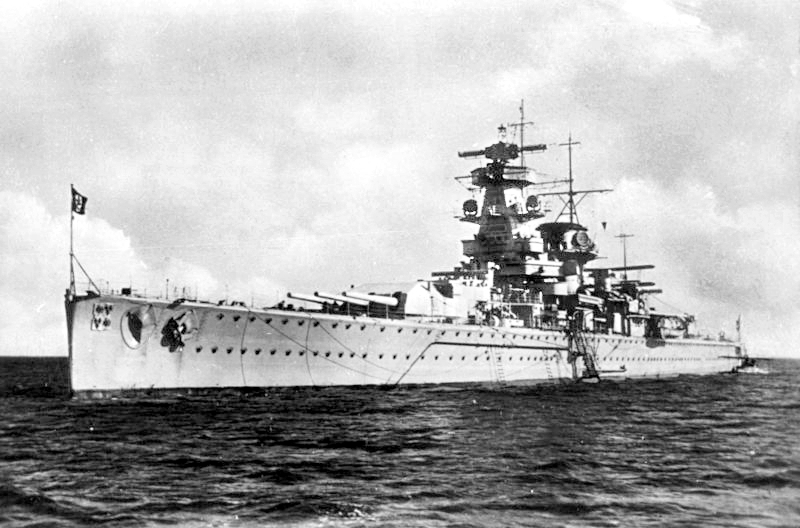
In 1929, the defeated and disarmed German Navy laid down the keel of a warship that would send shockwaves through every admiralty in Europe. It wasn't particularly large — the Treaty of Versailles forbade that — but it carried six 28cm guns that could destroy any cruiser afloat, diesel engines that gave it a cruising range greater than most battleships, and enough speed to outrun anything it couldn't outfight. The British press, groping for a term to describe this new category of warship, called it a "pocket battleship." Three were built — the Deutschland, the Admiral Scheer, and the Admiral Graf Spee — and they represented one of the most innovative, most controversial, and ultimately most disappointing chapters in modern naval history. They were supposed to be Germany's answer to the Royal Navy's command of the seas. Instead, one was scuttled by its own crew in a South American harbor, one capsized under British bombs in a German dockyard, and the third spent most of the war limping from one repair yard to another. This is their story — from the drawing board to the bottom of the sea.
The Treaty of Versailles and German Naval Ambitions
The Treaty of Versailles, imposed on Germany after the First World War, left the once-mighty Imperial Navy a shadow of its former self. Part V of the treaty permitted Germany to retain just six old pre-dreadnought battleships, six light cruisers, twelve destroyers, and twelve torpedo boats. No submarines, no aircraft, no warships exceeding 10,000 tons. The crushing reparations — set at 132 billion gold marks — and the loss of territory and population ensured that Germany would remain, at least for a time, a second-rate power on land and at sea.
The six battleships Germany was allowed to keep were already obsolete relics of the pre-dreadnought era. Three were Braunschweig-class ships — Braunschweig, Elsass, and Hessen — commissioned between 1904 and 1906. Three more were of the Deutschland class — Schlesien, Schleswig-Holstein, and Hannover — which entered service between 1907 and 1908. With their 14,000-ton displacement, four 28cm guns, and maximum speed of 18 to 19 knots, these vessels were hopelessly outclassed even by the standards of 1919, let alone the 1930s. Two more ships of each class — Lothringen and Preussen — were initially retained as well but were soon struck from the rolls as surplus.
The treaty stipulated that these battleships could be replaced only after they were twenty years old, and any replacement could not exceed 10,000 long tons. This was meant to prevent Germany from building anything more dangerous than a coastal defense ship. But the treaty's drafters had underestimated German engineering ingenuity — and the loopholes they had left open. Crucially, the treaty set no limit on gun caliber.

Designing the Pocket Battleship
The oldest of the retained battleships, Preussen, had been laid down in 1902, which meant she could legally be replaced as early as 1922. Design studies for her successor began in 1920, though the economic crisis and hyperinflation in the early Weimar years delayed any serious work. The designers faced a seemingly impossible task: create a warship within the 10,000-ton limit that could fulfill a useful military role.
Two basic approaches presented themselves. The first was a slow, heavily armored coastal defense ship — essentially a floating battery for harbor defense, similar to the Scandinavian models the Allies assumed Germany would build. The second was a fast, lightly armored cruiser-type vessel optimized for operations on the open ocean. The Reichsmarine's leadership, including Admiral Hans Zenker, who became head of the Navy in October 1924, strongly favored the second approach. Zenker, a veteran of the Battle of Jutland who had commanded the battlecruiser Von der Tann, understood that Germany's strategic situation demanded not a defensive posture but the ability to threaten an enemy's maritime commerce.
Between 1923 and 1928, the design staff produced a bewildering succession of proposals. Some featured four 38cm guns on a heavily armored but slow hull. Others mounted eight 20.5cm guns on a fast cruiser hull. Still others explored intermediate calibers — 30cm and 28cm — in various configurations. The proposals evolved through at least seven major iterations, each trying to balance the irreconcilable demands of firepower, protection, speed, and endurance within a 10,000-ton envelope.
The breakthrough came when the designers settled on two key innovations. First, they would use welding instead of riveting for the hull construction, saving approximately 15 percent of the structural weight. Second, they would install diesel engines for main propulsion instead of the steam turbines universal in every other navy's warships. Diesel engines were lighter, more fuel-efficient, and gave vastly greater range — though no navy had ever attempted to power a major warship entirely with diesels. These two innovations, combined with the decision to arm the ship with six 28cm guns in two triple turrets, produced a design that was, on paper, a minor miracle: a ship within the 10,000-ton limit that could outgun any cruiser and outrun any battleship.

The political battle over the new ship was nearly as fierce as anything the vessel would face at sea. The Social Democrats bitterly opposed the project, campaigning under the slogan "Food, not Panzerkreuzer" — bread, not battleships. The Communist Party attempted to organize a referendum against the construction. In the May 1928 Reichstag elections, the question of whether to build the ship was a central issue. Enough votes were secured — aided, ironically, by twelve seats won by Adolf Hitler's still-marginal Nazi Party — and the first ship was authorized in November 1928. The keel was laid at the Deutsche Werke shipyard in Kiel on February 5, 1929.
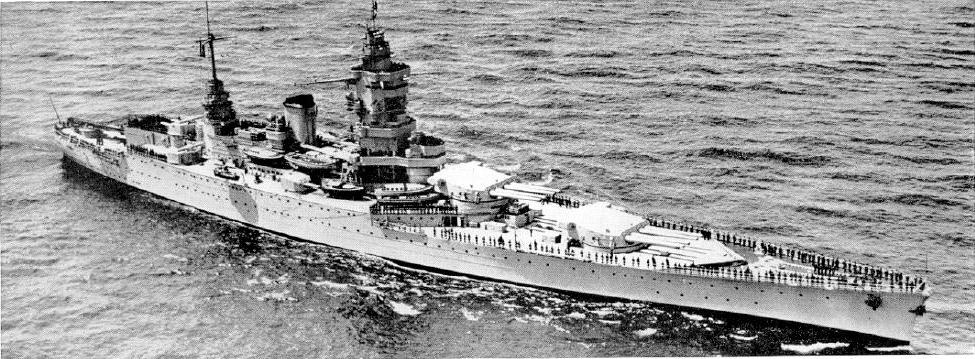
The reaction abroad was immediate and alarmed. The French, who had been Germany's most watchful naval rival, regarded the new ship as a direct threat to their maritime communications with North Africa. Their response would eventually take the form of the fast battlecruiser Dunkerque — a 26,500-ton ship armed with eight 33cm guns, designed specifically to hunt down and destroy the German pocket battleships. The Dunkerque in turn provoked Germany into building larger ships, beginning the familiar escalatory spiral that would culminate in the great battleships of the Second World War.
Hull and Construction
The three Deutschland-class ships varied slightly in their dimensions, as improvements were incorporated during construction. All three shared a waterline length of 181.70 meters and an overall length, as built, of 186 meters. The Deutschland had a beam of 20.69 meters, the Admiral Scheer's was 21.34 meters, and the Admiral Graf Spee's 21.65 meters. Standard displacement grew with each successive ship: 10,600 long tons for Deutschland, 11,550 for Scheer, and 12,340 for Graf Spee. Full-load displacement was considerably higher — 14,290, 13,660, and 16,020 tons respectively — meaning the ships substantially exceeded their nominal 10,000-ton treaty limit. The Germans simply lied about the figures.
The hulls were subdivided into twelve watertight compartments and fitted with a double bottom extending over 92 percent of the keel length. The use of electric welding in place of riveting was one of the most revolutionary aspects of the design. Over 90 percent of the hull was welded — an unprecedented proportion for a major warship — saving roughly 15 percent of structural weight compared to a conventionally riveted hull. This weight saving was directly translated into heavier armament and thicker armor than would otherwise have been possible. The technique was not without risk: welding technology in the late 1920s was still in its infancy, and the long-term behavior of welded joints under the stresses of naval combat was unknown.
The Deutschland, as the lead ship, used a somewhat more conservative approach, with a mix of welding and riveting in the lower hull sections and full welding above the waterline and in the superstructure. The later ships were more extensively welded. In service, the welded hulls proved generally satisfactory, though vibration from the diesel engines caused persistent cracking in some structural members — a problem that would plague the ships throughout their careers.
As built, the ships' complement comprised 33 officers and 586 enlisted men. After 1935, as the ships took on additional roles and equipment, the crew was dramatically increased to over 1,000 men. When serving as a squadron flagship — as the Deutschland frequently did — additional officers and staff were embarked.
Armor Protection
Within the severe weight constraints of the 10,000-ton limit, the designers had to make painful trade-offs between armor, speed, and armament. The armor scheme they devised was clever but inevitably thin, designed primarily to protect against the 20.3cm (8-inch) guns carried by the heavy cruisers that were the pocket battleships' most likely opponents.
The main armor belt, running along the waterline, was 80mm thick on the Deutschland and Scheer, increased to 100mm on the Graf Spee. Unusually, the belt was installed at an inward slope of about 12 degrees from the vertical, which increased its effective thickness against flat-trajectory shells. Behind the belt, a 40mm torpedo bulkhead provided a measure of protection against underwater explosions, though the narrow beam of the ships limited the depth of this protective system.
The armored deck was 40mm thick on the flat sections, increasing to 70mm where it sloped downward to meet the lower edge of the belt. On the Graf Spee, the flat portion was increased to 45mm. An upper deck of 17–20mm steel provided a first layer of defense to trigger fuses and slow incoming shells before they reached the main armored deck below.
The main turrets were protected by 140mm face plates, 75mm sides, and 85mm roofs on Deutschland and Scheer. The Graf Spee received somewhat heavier turret armor, with 160mm faces. The conning tower had 150mm sides on all three ships. The barbettes — the armored cylinders protecting the turret machinery below deck — were 100mm thick.
This level of protection was adequate against 20.3cm cruiser shells at typical combat ranges, but it offered no meaningful defense against the 33cm guns of the French Dunkerque or the 15-inch guns of British battleships. The pocket battleships' survival against such opponents depended entirely on their speed — their ability to flee rather than fight. This was a sensible philosophy for commerce raiders, but it meant the ships could never stand in a battle line, and their commanders were under standing orders to avoid engagement with superior forces.

The Diesel Revolution
Perhaps the single most innovative feature of the pocket battleships was their propulsion system. Every other major warship in the world used steam turbines; the Deutschland class was the first — and, until much later, the only — to rely entirely on diesel engines for main propulsion. The decision was driven by a simple calculation: diesel engines were roughly 40 percent more fuel-efficient than steam turbines, which translated directly into vastly greater cruising range. For ships designed to roam the Atlantic as commerce raiders, operating thousands of miles from home with no access to friendly ports, this was an enormous advantage.
The development of the massive diesel engines fell to MAN (Maschinenfabrik Augsburg-Nürnberg), which had been at the forefront of diesel technology since Rudolf Diesel himself had developed his engine in the company's workshops in the 1890s. The German Navy had experimented with diesel propulsion for capital ships before the First World War, but the engines of that era were too heavy and unreliable for the purpose. In the 1920s, MAN made a breakthrough with the development of the double-acting two-stroke diesel — a type in which combustion occurs on both sides of the piston, effectively doubling the power output per cylinder without a proportional increase in weight.
Each pocket battleship was fitted with eight nine-cylinder MAN M9Z 42/58 double-acting two-stroke diesels, arranged in pairs, with each pair driving one of the ship's two propeller shafts through a reduction gearbox. The total power output was approximately 54,000 horsepower, giving the ships a maximum speed of 26 to 28 knots — faster than any battleship then afloat, though slower than most heavy cruisers. At an economical cruising speed of 10 knots, the diesel engines gave the ships a staggering range of approximately 20,000 nautical miles — enough to cross the Atlantic and back several times without refueling.
The diesels, however, were not without problems. They were complex, difficult to maintain, and prone to vibration that transmitted through the hull and caused persistent cracking in the engine mountings. The noise levels in the engine rooms were brutal, and the engines produced distinctive exhaust smoke that could betray the ship's position. Starting and reversing the engines was a slow process compared to steam turbines, which made the ships less maneuverable in close-quarters situations. Perhaps most critically, the engines were difficult to repair at sea, and the ships frequently had to return to port for major overhauls of their propulsion systems.
Despite these issues, the diesel propulsion concept was vindicated by the extraordinary range it provided. The Admiral Scheer's epic 161-day raiding voyage in 1940–1941 covered over 46,000 nautical miles — a distance that would have been impossible for a conventionally powered ship of similar size without frequent refueling stops.
Main Armament: The 28cm Guns
The pocket battleships' main armament consisted of six 28cm (11-inch) SK C/28 guns, mounted in two triple turrets — one forward and one aft. These were the same caliber as the guns carried by the old pre-dreadnought battleships Germany was replacing, but they were far more powerful modern weapons. The decision to use 28cm guns was partly pragmatic — larger calibers would have been too provocative and too heavy for the 10,000-ton hull — and partly strategic. Six 28cm guns gave the pocket battleships a decisive advantage over any 20.3cm-armed heavy cruiser, which was their most likely opponent.
The guns themselves were impressive weapons. Each barrel was 14.8 meters long — 52.35 calibers — and weighed approximately 25.5 tons. They could fire a 300-kilogram armor-piercing shell to a maximum range of 36,475 meters at the maximum elevation of 40 degrees. The muzzle velocity was 910 meters per second, and the rate of fire was approximately two to three rounds per minute per gun. The barrel life was rated at around 300 rounds per gun.
The triple turrets — designated Drh LC/28 — were complex mechanisms weighing approximately 590 tons each, including the barbette. They could train through 300 degrees and elevate from -10 to +40 degrees. The turret rotation speed was about 7.5 degrees per second, and the elevation rate was approximately 6 degrees per second. Each turret crew consisted of 75 men. The ammunition supply was approximately 105 rounds per gun — a relatively modest outfit, as the ships were not expected to fight prolonged gun duels but rather to use their main armament sparingly and decisively.
Three types of ammunition were provided: armor-piercing shells with a base fuse, high-explosive shells with a nose fuse, and high-explosive shells with a base fuse. The armor-piercing shell could penetrate 194mm of face-hardened armor at 20,000 meters — more than enough to defeat any cruiser's protection and to inflict serious damage even on larger warships at longer ranges. The fire-control systems, described in a later section, were of a sophistication normally associated with full-sized battleships rather than cruisers.
Secondary and Anti-Aircraft Armament
The secondary battery consisted of eight 15cm (5.9-inch) SK C/28 guns mounted in single shielded mounts, four on each side of the ship. These were positioned amidships, two forward and two aft of the superstructure on each beam. The guns could elevate to 35 degrees, giving a maximum range of approximately 25,000 meters, with a rate of fire of six to eight rounds per minute. Each gun was served by a crew of eight to ten men.
The 15cm battery was a formidable weapon in its own right — eight guns firing 45-kilogram shells could inflict devastating damage on destroyers and light cruisers. However, the German Navy made the puzzling decision not to provide these guns with their own dedicated fire-control system. The centralized fire-control arrangement was designed almost entirely around the 28cm main battery, and the 15cm guns were effectively relegated to local control. This was a significant tactical error that reduced the effectiveness of what was otherwise a powerful secondary armament.
The anti-aircraft armament evolved considerably over the ships' careers. When first commissioned, Deutschland carried obsolete 8.8cm/45 guns dating from the First World War. These were quickly replaced by more modern 8.8cm/78 SK C/31 guns in twin mounts — three twin mounts per ship. These in turn were replaced from 1938 onward by the excellent 10.5cm/65 SK C/33 dual-purpose guns, also in twin mounts. The 10.5cm gun fired a 15.1-kilogram shell at 900 meters per second and could engage aerial targets at altitudes up to 12,500 meters. The twin mounts were equipped with sophisticated stabilization systems, though their open design left the crews and the delicate equipment vulnerable to weather and splinter damage.
Light anti-aircraft armament initially consisted of four 3.7cm twin mounts. As the war progressed and the threat from aircraft intensified, the number of light AA guns was steadily increased. By war's end, the surviving ships bristled with 20mm single and quadruple (Vierling) mounts — as many as 28 to 32 barrels. The effectiveness of the light AA armament was hampered, however, by the complete absence of centralized fire control. Unlike the French, Italians, and even the Soviets, who were already developing automated, remotely directed light AA systems in the 1930s, the Germans relied throughout the war on manual aiming with simple ring sights — a surprising blind spot for a nation otherwise at the forefront of military technology.
Torpedoes and Aircraft
Unlike most capital ships of the era, which had abandoned torpedo armament, the pocket battleships retained torpedo tubes. This reflected their intended role as commerce raiders rather than battle-line units. Torpedoes were far more efficient than gunfire for sinking captured merchant ships quickly and quietly — without the prolonged noise and smoke of an artillery bombardment that might attract unwanted attention.
The torpedo tubes were mounted on the low quarterdeck in two quadruple trainable mounts. Deutschland originally carried older 50cm torpedoes, but these were soon replaced by the standard 53.3cm torpedoes used on the other two ships from the outset. The G7 torpedoes weighed approximately 1.5 tons, were 7.2 meters long, and carried a 280-kilogram warhead. The T1 variant had a range of 14,000 meters at 30 knots or 6,000 meters at 44 knots. The torpedo mounts were protected by light 10mm splinter shields to guard against blast from the aft 28cm turret firing over them.
For reconnaissance — essential for a commerce raider operating alone on the open ocean — each ship carried a catapult-launched floatplane. The catapult was installed amidships, between the bridge and the funnel on Deutschland, or abaft the funnel on the other two ships. The ships initially operated the Heinkel He 60 biplane, a reliable but slow aircraft with a maximum speed of 240 km/h and a range of 945 kilometers. From 1939, these were replaced by the much more capable Arado Ar 196A monoplane — a robust, all-metal design with a 960-horsepower BMW engine, a top speed of 320 km/h, a range of 1,070 kilometers, and armament of two wing-mounted 20mm cannon and a rear-firing twin 7.9mm machine gun. The aircraft and their crews were technically part of the Luftwaffe rather than the Navy.

Fire Control and Radar
The fire-control systems installed on the pocket battleships were remarkably sophisticated for ships of their size — more comparable to those of full battleships than of cruisers. The system was built around three fire-control stations: one on the forward command bridge, one on the aft bridge, and one atop the foremast. The aft station and the foremast station were equipped with 10.5-meter baseline optical rangefinders, while the forward station had a 7-meter rangefinder. Two armored computing stations below the armored deck processed the range data using analog fire-control computers and transmitted firing solutions to the turrets.
This arrangement gave the pocket battleships a genuine ability to fight effectively at long range, but it had a significant limitation: it could only direct the fire of two groups of weapons simultaneously — the 28cm main battery and the anti-aircraft guns. The 15cm secondary battery was left without centralized fire control, a deficiency that significantly reduced its effectiveness. Adding "dual purpose" capability to the secondary armament would have solved this problem, but the German Navy never pursued this option for the pocket battleships.
The pocket battleships also played a pioneering role in naval radar. The world's first operational naval radar set, the Seetakt, was installed on Graf Spee in 1936. This was soon succeeded by the improved FuMO 22, which was fitted to all three ships. The FuMO 22 operated at 82cm wavelength (382 MHz) with 8 kilowatts of power and could theoretically detect large ships at 25 kilometers, though practical ranges were more like 14 to 15 kilometers. The accuracy was poor — about ±5 degrees — making it useless for fire control. The Germans used it only for search and navigation.
The Scheer later received the more accurate FuMO 27, which reduced bearing errors to just 0.3 degrees. Even this improved radar, however, was never integrated with the fire-control system. German commanders routinely switched off their radars in operational zones, fearing that the emissions would betray their position to the enemy. Officers received no training in radar use, and the tactical manuals contained no instructions for employing it until March 1945. At the war's start, German radar was roughly comparable to its British and American counterparts; by 1943, the Allies had pulled so far ahead that the gap could never be closed.
Later Designs: The Unbuilt Successors
The German Navy originally planned to build eight pocket battleships, completing the last by 1940. After the first three, however, Hitler's rise to power in 1933 freed the designers from the pretense of adhering to the Versailles restrictions, while simultaneously imposing new constraints dictated by the Führer's diplomatic calculations. Hitler authorized an increase in displacement to 20,000 tons but refused to allow larger-caliber guns, fearing a confrontation with Britain.
The fourth and fifth ships — designated "D" and "E" — were planned as substantially enlarged versions of the original design. At 210 meters long, 25.5 meters beam, and 20,000 tons displacement, they would have been nearly twice the size of their predecessors. The most significant change was in propulsion: the available diesel engines could not have driven these larger hulls at acceptable speed, so the designers reverted to conventional steam turbines producing 125,000 horsepower for a top speed of 29 knots. The armament remained two triple 28cm turrets, but the eight 15cm guns were now mounted in four twin turrets — two on each side — rather than in single mounts. The armor was dramatically increased, with a 220mm main belt designed to resist the 33cm guns of the French Dunkerque. The first ship's keel was laid on February 14, 1934, at the Wilhelmshaven naval yard.
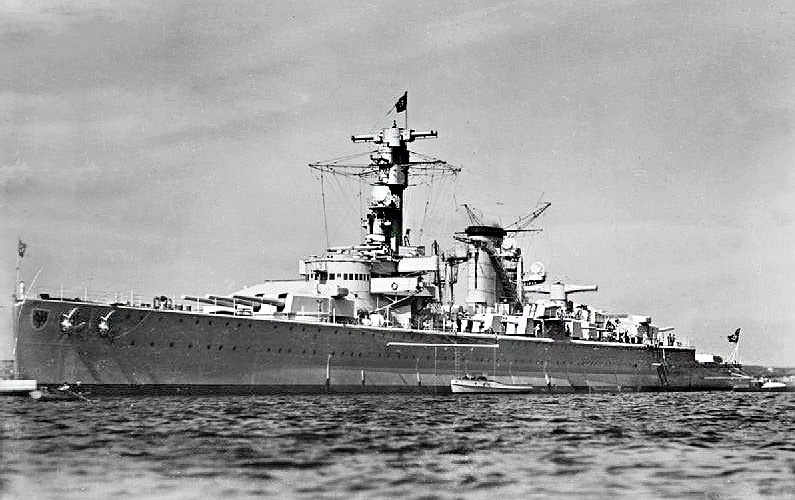
The D-class ships were never completed. The Navy's leadership convinced Hitler that a third 28cm turret was essential, and in July 1934, construction was halted while the design was completely reworked. The result was the Scharnhorst class — nominally 26,000-ton ships that actually displaced over 32,000 tons — carrying nine 28cm guns in three triple turrets with vastly heavier armor. The pocket battleship lineage was broken.
The concept was briefly revived in 1937 with the "P" class design — twelve 23,700-ton vessels with two triple 28cm turrets, diesel propulsion giving 33 knots and an astounding 25,000-nautical-mile range, and armor reduced to levels appropriate for a commerce raider rather than a battle-line ship. The design was sound, but the Kriegsmarine's leadership — forever chasing their rivals — condemned it for having insufficient armor and firepower, and in 1939 replaced it with the "O" class battlecruiser design: 30,000-ton ships with six 38cm guns and only 190mm of armor. These satisfied nobody. The beosztott officers and the design engineers themselves considered them useless — too weakly armored to fight capital ships despite carrying capital-ship guns, too large and expensive for commerce raiding. None were ever laid down. The entire line of development, which had begun so promisingly with the original pocket battleships, ended in futility.
Assessment: The Ships That Could Have Been
The abandonment of the pocket battleship concept was arguably one of the Kriegsmarine's worst prewar decisions. The three original ships, for all their faults, were well suited to Germany's actual strategic needs and capabilities. As the previous war had demonstrated — or should have demonstrated — Germany's geographic position and limited resources made it impossible to build a fleet capable of challenging the Royal Navy in open battle. The French or the Russians posed no naval threat worth answering with capital ships. Germany's realistic naval objectives were limited to defending its own coastline and disrupting enemy maritime commerce. For coastal defense, the essential tools were mines, torpedo boats, coastal batteries, and aircraft. For commerce raiding, the key assets were submarines — and, before the advent of long-range maritime patrol aircraft and radar, fast surface raiders.
The pocket battleships excelled at the raider role. They could catch and destroy merchant ships and their weak escorts, outgun any cruiser foolish enough to engage them, and outrun any battleship. Their diesel propulsion gave them the range to operate independently for months in the deep ocean. For these missions, large battleships were unnecessary, expensive, and vulnerable. Everything the Germans actually used their battleships for during the war — sinking merchant ships, skirmishing with cruisers, and fleeing from superior forces — the pocket battleships could have done equally well, at a fraction of the cost.
The pocket battleships were, however, appallingly expensive for their size. The advanced technology and high engineering standards came at a premium: each ship cost over 70 million Reichsmarks — nearly four million pounds sterling — more than half the cost of a 38,000-ton British King George V-class battleship. The three British cruisers that fought the Graf Spee at the Battle of the River Plate had a combined construction cost only 20 percent higher than the single German ship they were fighting.

The logistics of supporting lone raiders on the open ocean were also expensive and risky. Despite their extraordinary range, the pocket battleships still needed supply ships for fuel, ammunition, food, and spare parts during extended operations. These support vessels were themselves vulnerable to interception. And the permanent risk of losing an irreplaceably expensive warship hung over every operation.
By the middle of the war, the entire concept of surface commerce raiding had become obsolete anyway — not because of fast battleships, but because of radar and long-range maritime patrol aircraft, which by 1943 could cover virtually the entire Atlantic. There was no longer any realistic prospect of a surface raider remaining undetected for extended periods. The role passed almost entirely to submarines, which were far cheaper, far more numerous, and far harder to find.
The Deutschland's Troubled Career
The Deutschland — the first pocket battleship and the symbol of Germany's naval rebirth — was launched on May 19, 1931, in a ceremony attended by President Paul von Hindenburg and christened by Chancellor Heinrich Brüning. Or rather, Brüning attempted to christen her. The ship began sliding down the slipway while the Chancellor was still in the middle of his speech, launching herself before anyone was ready. It was not a good omen.
Commissioned on April 1, 1933, Deutschland spent her early years on peacetime cruises and exercises. In 1935, she made a long voyage to the Caribbean and South American waters. During the Spanish Civil War, she participated in the international non-intervention patrols — nominally neutral operations that in practice increasingly favored Franco's Nationalists while blockading the Republican side.
On May 29, 1937, while moored at the island of Ibiza, Deutschland was attacked by two Soviet-crewed SB-2 bombers flying for the Spanish Republican air force. Two 50-kilogram bombs struck the ship. The first hit near the bridge, penetrated the upper deck, and exploded inside the ship, starting serious fires. The second struck near a starboard 15cm gun mount, and splinters punctured the fuel tank of the floatplane on the catapult. The burning aviation fuel set the aft superstructure ablaze. Worse, the ready-use ammunition stacked beside the forward starboard 15cm guns detonated half an hour after the attack, compounding the destruction. The upper decks had been crowded with sailors rushing to their battle stations when the bombs hit, and the fires and explosions took a terrible toll: 31 men were killed and 74 wounded. Temporary repairs were carried out at Gibraltar, where the dead were buried — only to be exhumed ten days later on Hitler's orders and returned to Germany.
In retaliation, Hitler ordered Admiral Scheer to bombard the Republican-held port of Almería. On May 31, 1937, the pocket battleship shelled the port for about twenty minutes from a range of ten kilometers, firing some 200 rounds. The attack killed 19 to 20 civilians and wounded 50, but achieved little of military value — the Republican battleship Jaime I, supposedly the target, was actually in Cartagena, not Almería. The British and French governments, to whom the Republican government protested, declared the German action justified.
When war broke out in September 1939, Deutschland was already stationed in the Atlantic, south of Greenland, waiting for orders to begin raiding Allied commerce. Hitler, still hoping for a negotiated peace with Britain, did not authorize attacks until late September. Over the next two months, Deutschland sank only two small merchant ships totaling 6,962 GRT — an embarrassingly meager result that did not even cover the cost of the fuel she had consumed. The seizure of the American freighter City of Flint, carrying contraband, created a diplomatic incident with the United States. In early November, Deutschland was recalled to Germany.
On her return, the ship was immediately renamed Lützow. Hitler had decided that having a warship named "Deutschland" — Germany — was an unacceptable propaganda risk: its sinking would be a gift to enemy morale. The renaming took effect on November 15, 1939, before the loss of Graf Spee in December. Sailors' superstition holds that renaming a ship brings bad luck, and Lützow's subsequent career did little to contradict the belief.
During the April 1940 invasion of Norway, Lützow was assigned to the force attacking Oslo. In the narrow Drøbak Sound, Norwegian coastal guns and torpedoes sank the flagship Blücher and hit Lützow three times with 15cm shells, killing six men and disabling her forward turret. On April 11, while returning to Germany for repairs, the British submarine Spearfish torpedoed her, blowing off virtually the entire stern section. The wrecked stern was held on only by the deck plating. Tugs towed the crippled ship back to Kiel over two agonizing days, and the rebuilt stern took nearly a year to complete.
In June 1941, Lützow set out for another Atlantic raid but was torpedoed again — this time by British aircraft — receiving a hit amidships that flooded half her engine rooms. She limped back to Kiel on a single propeller. In July 1942, she ran aground on an uncharted rock while deploying against convoy PQ-17. In December 1942, she participated in the disastrous Battle of the Barents Sea, where despite closing to firing range of the convoy, her gunners fired over a hundred 28cm rounds without scoring a single hit before being ordered to withdraw.
By late 1944, with her machinery worn out, Lützow was reduced to using her guns as floating artillery against the advancing Soviet forces on the Eastern Front. On April 16, 1945, RAF heavy bombers attacked her anchorage near Swinemünde with six-ton Tallboy bombs. Near-misses caused fatal flooding, and the ship settled onto the shallow harbor bottom. Her turrets remained operational, and she continued firing at Soviet positions until May 4, when her crew detonated demolition charges to destroy her. The Soviets later raised the hull and used it as a target ship before sinking it for the last time on July 22, 1947.
The Admiral Scheer: Germany's Most Successful Raider
The second pocket battleship, Admiral Scheer, was commissioned on November 12, 1934. Like her sister, she served on the non-intervention patrols during the Spanish Civil War. Following the bombing of Deutschland at Ibiza, it was Scheer that carried out the retaliatory bombardment of Almería. Captain Otto Ciliax, Scheer's commanding officer, knew perfectly well that the Jaime I was not in Almería as his orders stated, but in the tradition of good German officers, he did not question the orders he received.
At the outbreak of war, Scheer was undergoing a major refit at Wilhelmshaven and missed the opening operations. On September 4, 1939, RAF Blenheim bombers attacked the ship in the Schillig roadstead. One bomb struck the deck but failed to explode; two near-misses caused minor damage. The refit continued into mid-1940, during which the ship received a new raked clipper bow, a lighter bridge structure, upgraded radar, and had her 8.8cm AA guns replaced with 10.5cm weapons.
Scheer sailed on her first combat sortie on October 28, 1940, under Captain Theodor Krancke. Passing through the Denmark Strait on October 31, she broke into the open Atlantic. On November 5, her Arado floatplane located convoy HX-84, sailing from Halifax. The convoy's sole escort was the armed merchant cruiser HMS Jervis Bay, commanded by Captain Edward Fegen. Fegen immediately ordered the convoy to scatter and turned his ship — an armed liner with obsolete guns — to engage the pocket battleship.
Scheer's first salvo knocked out Jervis Bay's bridge and radio equipment. Within 22 minutes, the burning hulk was sinking. Fegen was killed in the action and was posthumously awarded the Victoria Cross. But his sacrifice had bought precious time. In the gathering darkness, all but five of the convoy's 37 ships escaped. It was a bittersweet result for the Germans — a tactical victory, but the bulk of the convoy had gotten away.
Krancke then took Scheer south, roaming the central and southern Atlantic before crossing into the Indian Ocean in February 1941, where she operated in the waters around Madagascar and the Seychelles in cooperation with the auxiliary cruiser Atlantis. In March, she turned for home, slipping back through the Denmark Strait and reaching Kiel on April 1, 1941. In the course of her 161-day voyage, Scheer had steamed over 46,000 nautical miles and sunk seventeen merchant ships totaling 113,223 GRT. It was the most successful commerce-raiding cruise by any German capital ship in the entire war.
The remainder of Scheer's war was less glorious. Deployed to Norway in 1942, she took part in the aborted operations against convoys PQ-17 and JW-51B, neither of which produced results. In August 1942, she was sent into the Arctic waters of the Kara Sea to attack Soviet coastal shipping — Operation Wunderland — but found few targets, sinking only the icebreaker Sibiryakov before being driven away from the port of Dikson by unexpectedly strong coastal defenses.
From early 1943, Scheer served as a training ship in the Baltic before returning to combat duty in late 1944 to support the evacuation of German civilians and troops from the Eastern Front. Her worn-out guns were in the process of being relined at Kiel when, on the night of April 9, 1945, 300 RAF bombers attacked the port. Scheer took five bomb hits and capsized at her berth. After the war, the wreck was partially demolished and the dock filled with rubble. Today, a park and a parking lot cover the remains of the Admiral Scheer.

Frequently Asked Questions
Why were they called "pocket battleships"?
The term was coined by the British press to describe warships that carried battleship-caliber guns (28cm/11-inch) on a hull small enough to be classified as a cruiser. The Germans officially designated them as "Panzerschiffe" (armored ships) and later reclassified the surviving two as heavy cruisers in February 1940. The name "pocket battleship" stuck in popular usage because it neatly captured the ships' paradoxical nature — the firepower of a much larger vessel crammed into a treaty-compliant hull.
Could the pocket battleships really outrun battleships and outgun cruisers?
In theory, yes. Their six 28cm guns were vastly more powerful than the 20.3cm guns carried by treaty-limited heavy cruisers, and their top speed of 26–28 knots exceeded that of most battleships of the early 1930s. In practice, however, newer fast battleships like the British King George V class could make 28 knots, and the French Dunkerque could manage over 30 — eliminating the pocket battleships' speed advantage. Against these opponents, the pocket battleships were outgunned and could not reliably escape.
How many ships did the pocket battleships sink?
Deutschland/Lützow sank only two merchant ships (6,962 GRT) during her entire career. Admiral Scheer sank seventeen ships (113,223 GRT) during her Atlantic and Indian Ocean raiding voyage, plus additional targets. Admiral Graf Spee sank nine merchant ships (50,089 GRT) before being scuttled after the Battle of the River Plate. By comparison, roughly 25 individual German U-boats each achieved comparable or greater tonnage figures.
What happened to the Admiral Graf Spee?
Admiral Graf Spee was damaged in the Battle of the River Plate on December 13, 1939, by three British cruisers — HMS Exeter, HMS Ajax, and HMNZS Achilles. She put into the neutral port of Montevideo, Uruguay, for repairs. Believing (incorrectly) that a vastly superior British force was waiting outside the harbor, her captain, Hans Langsdorff, ordered the ship scuttled on December 17. Langsdorff shot himself three days later.
Were the pocket battleships a good investment for Germany?
That depends on the standard of comparison. They were revolutionary in design but astronomically expensive for their size — each costing more than half the price of a full-sized British battleship. Their combat record was mixed at best. The Scheer's Atlantic raid was a genuine success, but Deutschland/Lützow was an almost total failure, and Graf Spee was lost on her first and only mission. The money might have been better spent on submarines, which proved far more effective at disrupting Allied shipping. On the other hand, the pocket battleships tied down disproportionate Allied naval resources simply by existing — a "fleet in being" effect that had strategic value regardless of how many ships they actually sank.