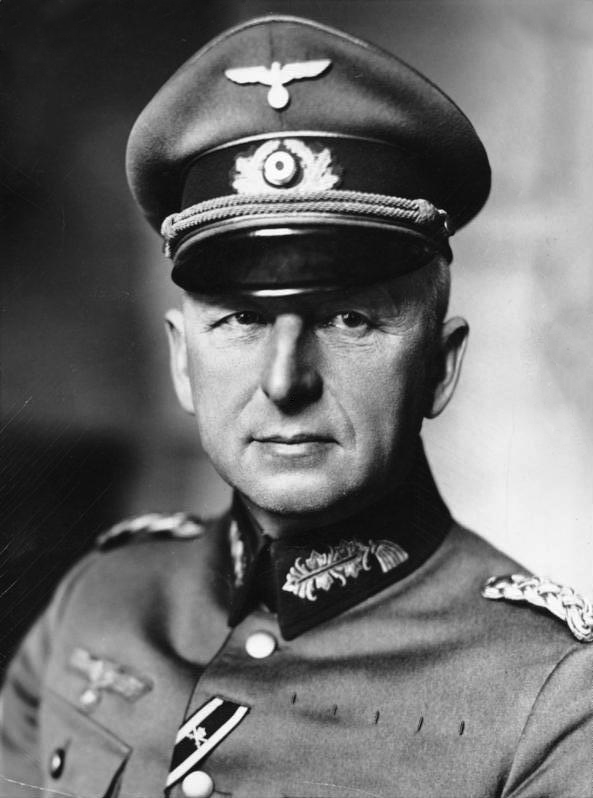
Walk into any professional war college on the planet—West Point, Sandhurst, pick your favorite—and sooner or later you'll study a German field marshal's 1943 counteroffensive that destroyed an entire Soviet army group while outnumbered three to one. The instructor will explain the maneuver with something close to admiration: trading space for time, letting the enemy overextend, then striking concentrated armor at the hinge point. Students will take careful notes. Then comes the part nobody enjoys: the same field marshal whose operations you're dissecting was convicted of war crimes. His armies collaborated with SS death squads. He signed orders that led to the murder of tens of thousands.
That's the problem of Erich von Manstein. He was almost certainly World War II's most gifted operational commander—the man who designed the plan that knocked France out in six weeks, who captured the fortress of Sevastopol, who pulled off the "Backhand Blow" at Kharkov that military textbooks still treat as gospel. He was also complicit in genocide, and his memoirs conveniently forgot to mention any of it. Reconciling those two facts is the challenge. Let's try.
Prussian Roots
Manstein was born Fritz Erich Georg Eduard von Lewinski on November 24, 1887, in Berlin. The von Lewinski family was minor Polish-Prussian nobility—military people, but not top-tier aristocrats. The trajectory of his life changed early when he was adopted as an infant by his uncle Georg von Manstein and his wife Hedwig. This wasn't unusual among Prussian families; childless relatives adopted within the clan to keep the name alive. And the Manstein name carried real weight—a great-uncle had been a Prussian field marshal.
He entered the cadet corps at 13, was commissioned as a lieutenant at 18 in the prestigious Third Foot Guards Regiment, and was selected for the Kriegsakademie—the gateway to the General Staff—by 1913. Everything about his upbringing pointed toward high command. The Prussian officer code—duty, obedience, professional competence above all else—was absorbed from childhood, and it showed in everything he did afterward, for better and for worse.
World War I and the Interwar Years
Manstein went to war in August 1914 with his regiment and was seriously wounded by shrapnel in Poland that November. After recovery, his intellectual talents got him routed into staff work rather than frontline command. He spent the rest of the war in various staff positions on both the Eastern and Western Fronts—watching, learning, absorbing how large-scale operations were planned and where they broke down.
The Eastern Front left the deepest mark. While the West was frozen in trench warfare, the East still offered the possibility of real maneuver—breakthroughs, encirclements, armies sweeping across open ground. Those operations, not the grinding attrition of Verdun and the Somme, became the template for Manstein's thinking about how wars should be fought.
After the war, he was one of the 4,000 officers retained in the tiny Reichswehr—a testament to recognized ability, since competition for those spots was ferocious. He completed General Staff training in Seeckt's camouflaged "Truppenamt," rose steadily through the ranks, and by 1935 held the position of Deputy Chief of the General Staff. He was, by any measure, among the German army's sharpest operational thinkers.
The Plan That Changed Everything
After conquering Poland in September 1939, Germany turned west. The Army High Command (OKH) dusted off what was basically a warmed-over Schlieffen Plan—a massive right hook through Belgium, swinging down into northern France. The problem was obvious to anyone paying attention: the French and British expected exactly this. They'd meet the German attack in Belgium, and the result would be another 1914—grinding attrition that Germany couldn't afford.
Manstein, then serving as Chief of Staff to Army Group A on the central German line, saw the flaw immediately and proposed something genuinely radical. Forget the main thrust through Belgium. Instead, drive the bulk of Germany's Panzer divisions through the Ardennes Forest—terrain everybody "knew" was impassable for armor—smash through at Sedan on the Meuse River, and race west to the English Channel. If it worked, every Allied army that had moved north into Belgium would be cut off and trapped.
The plan, later called Sichelschnitt (Sickle Cut), was a colossal gamble. If the French detected the Panzer columns in the forested Ardennes and hit them from the flanks, the whole offensive could collapse. If the Meuse crossing failed, the tanks would be stuck in the woods. OKH rejected the proposal repeatedly—too risky, too unconventional. Manstein kept resubmitting it with more detail. Eventually, the High Command got tired of his persistence and "promoted" him to a corps command to get him away from the planning table.
But before he left, Manstein got a meeting with Hitler. He laid out his ideas. Hitler, always drawn to bold strokes, was hooked. He ordered a wargame of the plan. The results were promising. Hitler overruled OKH and adopted Manstein's concept.

France Falls in Six Weeks
On May 10, 1940, the invasion began. Army Group B attacked through Belgium and the Netherlands as planned—the bait, designed to draw Allied forces north. And it worked perfectly. French and British mobile forces rushed into Belgium to meet the attack.
Meanwhile, seven Panzer divisions pushed through the Ardennes. They moved faster than anyone thought possible. On May 13, German forces crossed the Meuse at Sedan under a storm of dive-bomber support. French counterattacks failed. By May 15, German armor was racing through open country, and French command structures were paralyzed—generals trained for set-piece World War I battles simply could not process how fast things were moving.
On May 20, just seven days after the Meuse crossing, German tanks reached the English Channel at Abbeville. Every Allied army in Belgium was now trapped. France surrendered on June 22. The whole campaign lasted six weeks.
Manstein wasn't commanding during the execution—he'd been shuffled off to a corps. But everyone in the German military knew whose idea it was. His reputation was made.
Sevastopol: Methodical Destruction
When Germany invaded the Soviet Union in June 1941, Manstein first commanded a Panzer corps driving toward Leningrad with Army Group North. He performed well—fast advances, successful encirclements—but the real assignment came in September 1941, when he was given command of the Eleventh Army in Crimea. His mission: take the peninsula and its fortress city of Sevastopol.
Sevastopol was a nightmare. One of the world's most heavily fortified cities, defended by over 100,000 Soviet troops, built around a deep-water harbor, supplied by sea. Initial German assaults in late 1941 bounced off the concrete. Manstein realized brute force wouldn't work and settled in for a methodical siege.
He spent months assembling the heaviest artillery concentration the Eastern Front had ever seen: over 1,300 guns including the monstrous 800mm Dora railway gun—the largest piece of artillery ever built. Dora weighed 1,350 tons, required 500 men to operate, and lobbed seven-ton shells that could punch through nine meters of concrete. Soviet troops called it the "earthquake gun." It fired 48 rounds at Sevastopol. Each one obliterated everything within a hundred meters of impact.

The final assault began on June 7, 1942, and ground on for 27 brutal days. Soviet defenders fought with desperate courage—surrender usually meant death. When organized resistance collapsed on July 4, the city was rubble. German casualties exceeded 75,000. Soviet losses were catastrophic—roughly 150,000 dead, wounded, or captured, plus thousands of civilians.
Hitler promoted Manstein to Field Marshal on July 1, making him one of the youngest in German history at 54. The promotion recognized not just Sevastopol but his entire record. Whether the siege was worth the resources—troops, ammunition, and months of time that might have been used elsewhere while the main offensive was stalling at Stalingrad—remains a fair question.
Stalingrad: The One That Got Away
In November 1942, the Soviet encirclement of Sixth Army at Stalingrad created a crisis that would define the war's trajectory. Hitler handed Manstein a new command—Army Group Don—and ordered him to break through to the trapped 300,000 men.
Manstein assembled what he had and launched Operation Winter Storm on December 12. Fourth Panzer Army drove toward Stalingrad against fierce resistance. By December 19, the relief force was just 48 kilometers from Sixth Army's perimeter—close enough for radio contact. Manstein urged Sixth Army's commander, Friedrich Paulus, to break out toward the relieving force. Together, they might have punched through. But Paulus wouldn't move without Hitler's explicit permission, and Hitler wouldn't give it. He insisted Sixth Army hold Stalingrad.
The window closed. Soviet counterattacks threatened to encircle the relief force itself. On December 23, Manstein ordered withdrawal—losing Fourth Panzer Army would have meant the collapse of the entire southern front. Sixth Army was doomed. By February 1943, 91,000 survivors marched into captivity. Most never came home.
Manstein spent the rest of his life blaming Hitler's rigidity and Paulus's excessive obedience for the disaster. There's truth to that. But critics have pointed out that Manstein himself could have acted more decisively—pushed harder, taken risks he didn't take. It's the kind of "what if" that historians never tire of arguing about.
The Backhand Blow: Kharkov 1943
What happened next is the operation military academies can't stop teaching, and it's worth understanding why.
After Stalingrad fell, the Soviets launched massive offensives across the entire southern front. By mid-February 1943, the situation was close to total collapse. Soviet forces had advanced over 400 kilometers in some sectors. Kharkov—Ukraine's second-largest city—fell on February 15 when the SS Panzer Corps commander disobeyed Hitler's orders and evacuated rather than be encircled. German divisions were at 30–40% strength. Some units were in outright rout, abandoning equipment and wounded as they fled. The front was disintegrating.
The numbers were brutal. Manstein's Army Group South had roughly 350,000 exhausted troops and maybe 500 operational tanks spread across 700 kilometers of front. Facing them were over a million Soviet soldiers with 1,500 to 2,000 tanks, riding high on weeks of successful advances. By any conventional assessment, Army Group South should have retreated to the Dnieper River and written off eastern Ukraine.
Manstein saw something different. The Soviets, he realized, were overextended. They'd advanced so fast that their logistics couldn't keep up. Tanks were running dry. Infantry was exhausted. Supply lines stretched hundreds of kilometers through wrecked territory with terrible roads. The spearheads that looked so threatening on a map were actually isolated and vulnerable—if someone hit them from the flanks.

The Concept: Elastic Defense
Manstein's approach was something he called "mobile defense," and it ran directly counter to everything Hitler believed about holding ground at all costs. The logic went like this: let the enemy advance. Trade space—which you can recapture—to preserve forces, which you can't rebuild. As the enemy pushes deeper, their flanks get longer, their supply lines more fragile, their units more isolated. Wait for the moment when their momentum stalls. Then hit them with everything you've got, concentrated at the weakest point.
It sounds simple on paper. In practice, it requires steel nerves. You're deliberately giving up territory—including cities—while your own side screams at you to counterattack. Most commanders lack the nerve to let a situation get worse before making it better. Manstein didn't.
The Counterstroke
His striking force was the II SS Panzer Corps, freshly arrived from France: three elite divisions—Leibstandarte, Das Reich, and Totenkopf—with roughly 45,000 men and 300–350 tanks including some Tigers. He combined them with XLVIII Panzer Corps and elements of First Panzer Army for a total counter-attacking force of 70,000–80,000 troops and around 600 tanks. Still outnumbered overall, but concentrated at the decisive point.
On February 19, the SS Panzer Corps struck northward from Dnepropetrovsk into the exposed southern flank of the Soviet advance. The attack achieved complete surprise—Soviet commanders, focused on their own offensive, didn't expect a major counterattack from a force they assumed was beaten. Within days, multiple Soviet units were encircled or fleeing. Communications collapsed. XLVIII Panzer Corps joined from another axis, and suddenly Soviet formations were being hit from directions that made no sense to them.
By early March, Manstein's forces had destroyed or crippled at least nine Soviet divisions and four tank corps. Soviet losses ran to 70,000–90,000 casualties, 1,200–1,500 tanks destroyed or captured, and over 3,000 guns. German casualties were around 20,000—painful, but a fraction of Soviet losses.
Then came phase three: Kharkov itself. Rather than assault the city head-on, Manstein swung his forces around it, cutting escape routes before the assault began. The SS divisions attacked from multiple directions on March 14. The fighting was savage—house-to-house, street-by-street urban combat. Soviet defenders knew retreat was nearly impossible. By March 18, Germany held Kharkov again.
Why It Still Matters
The Third Battle of Kharkov gets taught in staff colleges because it illustrates a cluster of principles that don't go out of date. Operational patience—waiting for the right moment instead of reacting emotionally. Deliberate trading of space for time. Concentration of force at the decisive point despite overall inferiority. Flanking attacks against overextended enemies instead of frontal assaults against strength. And relentless tempo once the counteroffensive began—never letting the enemy recover their balance.
It's worth noting, though, that for all its tactical brilliance, Kharkov didn't change the war's strategic trajectory. Germany was still losing. The resources expended wouldn't be replaced. The Soviets would rebuild faster than Germany could. Brilliant operations can't substitute for strategic reality—a lesson Manstein himself never quite accepted.
Kursk and the Long Retreat
After Kharkov, the obvious next target was the Kursk salient—a massive Soviet-held bulge in the German line. Manstein wanted to attack immediately, in May 1943, before the Soviets could dig in. Hitler kept delaying, waiting for new Tiger and Panther tanks. Each week of delay meant deeper Soviet minefields, more anti-tank guns, thicker defensive belts.
Operation Citadel finally launched on July 5, 1943. Manstein's southern forces made decent progress—30-plus kilometers in some sectors—but the northern attack stalled. Prokhorovka, on July 12, became the largest tank battle in history, inconclusive and bloody. On July 13, Hitler cancelled the offensive. Allied landings in Sicily demanded reinforcements. Germany's last major offensive in the East was over.
For the next eight months, Manstein commanded Army Group South in a fighting retreat across Ukraine, practicing the elastic defense he'd demonstrated at Kharkov—trading ground to preserve forces, counterattacking when the Soviets overextended. He clashed with Hitler constantly. Manstein wanted freedom to maneuver; Hitler demanded every position be held. Manstein argued for concentrating forces; Hitler dispersed them. The relationship turned toxic.
On March 30, 1944, Hitler summoned Manstein and relieved him of command—dressed up as "medical leave" for his developing cataracts, but permanent. At 56, his military career was finished. He spent the rest of the war in retirement, watching Germany's defeat from the sidelines.
The Part the Memoirs Left Out
Now we need to talk about the part that Manstein's defenders spent decades trying to downplay, and that modern scholarship has made impossible to ignore.
After the war, German generals—Manstein prominent among them—promoted what historians now call the "Clean Wehrmacht" myth: the idea that the regular army fought honorably according to the rules of war while the SS committed the atrocities. The myth was comfortable, politically useful during the Cold War (NATO needed German military expertise against the Soviets), and almost entirely false.
The documentary evidence, much of it from the German Federal Archives (Bundesarchiv) and opened to researchers after the Cold War, is damning. Manstein's Eleventh Army received and implemented the Commissar Order—the directive to execute captured Soviet political commissars without trial, in direct violation of the laws of war. His forces conducted brutal "anti-partisan" operations that were, in practice, campaigns of mass murder against civilians. Villages were burned. Populations terrorized. Jewish civilians killed en masse under the thin pretense of security operations.
Worst of all, Wehrmacht units under Manstein's command provided logistical support to SS Einsatzgruppen—the mobile killing squads that followed the army murdering Jews, Roma, and others. They shared intelligence on Jewish populations. They cordoned off areas during mass executions. In some cases, they participated directly.
The single most incriminating document is Manstein's own Order of the Day, issued November 20, 1941, to the Eleventh Army. Preserved in German military archives and available through the Avalon Project's Nuremberg documents collection, it speaks of "the necessity of harsh measures against the Jewish-Bolshevik system" and calls Jews "the spiritual bearer of Bolshevik terror." This wasn't a private letter—it was an official order to his entire army, providing ideological cover for the persecution and murder of civilians. There's no ambiguity here.
The Trial
Manstein was tried by a British military court in Hamburg in 1949. The charges included executing Soviet POWs, mistreatment of prisoners and civilians, permitting or failing to prevent the murder of Jews, collective punishment, and deportation of civilians for forced labor.
His defense—funded partly by former Wehrmacht officers and British sympathizers, with contributions from Winston Churchill—argued that he'd opposed Nazi ideology privately, hadn't personally ordered specific killings, was unaware of Einsatzgruppen activities, and was following orders from above. The prosecution countered with the archival evidence.
On December 19, 1949, the court convicted Manstein on nine of seventeen charges, including failing to prevent the murder of Jews and civilians, permitting mistreatment of prisoners, and collective punishment. He was sentenced to 18 years. He served four. Deteriorating health and political lobbying got him released in 1953. He spent his remaining years writing memoirs, quietly advising NATO, and defending his reputation.
"Lost Victories"
In 1955, Manstein published Verlorene Siege—"Lost Victories"—and it became one of the most influential military memoirs of the twentieth century. As a work of operational analysis, it's genuinely excellent. The descriptions of campaigns are clear, detailed, and insightful. The critique of Hitler's strategic errors is sharp. Military historians still reference it for its technical content.
As a work of moral accounting, it's a disgrace. The book contains no mention of the Holocaust. Not a word about Wehrmacht collaboration with Einsatzgruppen. Nothing about the November 1941 order. Nothing about civilian casualties. Nothing about his war crimes conviction. It's selective memory refined to an art form—the military story carefully separated from everything ugly, as if they happened on different planets.
For decades, particularly during the Cold War, this sanitized version of events was largely accepted in the West. Former Wehrmacht officers were consulted on Soviet military capabilities, and questioning their wartime conduct was seen as impolite at best. It wasn't until the 1990s, when historians gained access to previously sealed German and Soviet archives, that the "Clean Wehrmacht" narrative collapsed under the weight of documentary evidence.
The Uncomfortable Duality
So where does that leave us with Manstein? Modern scholarship—works like Mungo Melvin's Manstein: Hitler's Greatest General (2010) and Benoît Lemay's Erich von Manstein: Hitler's Master Strategist (2010)—has settled on something like a consensus: both things are true simultaneously. The operational brilliance was real. The moral culpability was also real. Neither cancels the other.
His operations are still taught because they demonstrate principles that genuinely don't go out of date—concentration of force, operational patience, exploiting enemy overextension. The Kharkov counteroffensive remains a textbook case. But responsible military education now includes the moral context alongside the tactical analysis. Cadets study what Manstein got right on the battlefield while confronting the fact that those same operations served a genocidal regime, conducted by armies actively participating in mass murder.
Manstein died in 1973, never having expressed remorse for Wehrmacht crimes. He maintained to the end that the army fought with honor. The archives say otherwise. His legacy will always carry that tension—a reminder that tactical genius and moral failure can coexist in the same person, and that studying one without acknowledging the other is its own kind of dishonesty.
Frequently Asked Questions
What was the Manstein Plan and why did it work?
It was the strategy for invading France in 1940—officially called Sichelschnitt
(Sickle Cut). Instead of the main thrust going through Belgium where everyone expected it,
Manstein proposed pushing the bulk of Germany's Panzer divisions through the Ardennes
Forest and breaking through at Sedan. The Allies took the bait, moved their best forces
into Belgium to meet a secondary attack, and the Panzers cut them off by racing to the
Channel coast. France fell in six weeks. It worked because it achieved total surprise,
concentrated overwhelming force at a single unexpected point, and moved faster than Allied
commanders could process.
How did the "Backhand Blow" at Kharkov actually work?
In February–March 1943, Manstein let Soviet forces advance deep into Ukraine until they
outran their supply lines. When their momentum stalled, he hit exposed flanks with
concentrated Panzer forces—mainly the SS Panzer Corps—encircling and destroying multiple
Soviet armies before recapturing Kharkov. Soviet losses were around 80,000 casualties and
over 1,200 tanks; German losses roughly a quarter of that. It's the definitive textbook
case of mobile defense and operational-level counterattack.
Was Manstein actually complicit in the Holocaust?
Yes, and the evidence isn't ambiguous. His November 1941 Order of the Day explicitly
endorsed the persecution of Jews, calling them "spiritual bearers of Bolshevik terror."
Units under his command provided logistics and security for Einsatzgruppen mass executions,
implemented the criminal Commissar Order, and conducted "anti-partisan" operations that
were really civilian massacres. He was convicted on nine war crimes charges by a British
military court in 1949. The German Federal Archives contain extensive documentation proving
his knowledge and complicity.
How reliable are his memoirs?
Militarily, they're quite good—detailed, analytical, and generally accurate about
operations. Morally, they're a whitewash. "Lost Victories" says nothing about the
Holocaust, nothing about war crimes, nothing about his conviction. It's a work of
self-rehabilitation, and it successfully shaped his reputation for decades until archival
research in the 1990s exposed what was missing.
Why do military academies still study a convicted war criminal?
Because the operational principles his campaigns demonstrate—mobile defense, concentration
of force, exploiting overextension, flank attacks—remain militarily valid regardless of who
executed them. The Kharkov counteroffensive is taught the same way medical schools study
anatomy research with troubled origins: the knowledge has value, but the context matters
and should never be hidden. Modern curricula increasingly pair the tactical lessons with
explicit discussion of Wehrmacht complicity in genocide.