
Most people think precision-guided weapons are a modern invention — something born in the Gulf War era, maybe Vietnam at the earliest. They'd be wrong by about fifty years. In 1943, a German bombardier sat in the belly of a twin-engine bomber over the Mediterranean, watching a bright flare fall toward a 44,000-ton Italian battleship, and steered a 1,500-kilogram bomb straight through her deck using nothing more than a joystick and a radio link. The ship — the Roma, one of Italy's newest and most powerful warships — was gone within half an hour, along with over 1,300 of her crew.
That weapon was the Fritz X, and the story behind it is one of those corners of WWII history that deserves more attention than it usually gets. It's a story about engineering brilliance, terrible timing, and a tragedy that killed hundreds of men who were, at the moment of their deaths, trying to stop fighting.
The Accuracy Problem
Here's something that might surprise you about World War II bombing: it was, for the most part, spectacularly inaccurate. We see footage of bombs leaving aircraft and buildings exploding, and our brains fill in a story about precision that simply didn't exist. A bomber at 20,000 feet, dealing with wind, airspeed, temperature gradients, and the general chaos of combat, was doing well to put bombs within a quarter-mile of the target. Against a factory or a rail yard, that was often good enough — you could compensate for bad accuracy with sheer volume. Throw enough explosives at a general area and something important gets wrecked.
Ships were a different problem entirely. Ships move. They turn. They're relatively small targets surrounded by a great deal of ocean. And when ships know they're being attacked, they maneuver evasively — which is a polite way of saying they dodge. A destroyer at flank speed, throwing its rudder back and forth, is a nightmare target for a high-altitude bomber. Even a battleship, which can't exactly dance, becomes very difficult to hit from four miles up when her captain is paying attention.
Early war statistics bore this out in depressing fashion. It sometimes took hundreds of sorties to score a single hit on a warship. Dive bombers improved the odds dramatically — getting close to the target makes accuracy much easier — but dive bombers had to fly low and slow, which meant anti-aircraft guns ate them alive. By 1941-42, the calculus was ugly: you could bomb accurately and lose your planes, or bomb safely and miss.
The solution, when you think about it, is obvious. What if you could release the bomb from safe altitude and then steer it? What if the bombardier could watch the bomb fall and nudge it left, right, steeper, shallower — correcting in real time until it hit?
It sounds simple. Getting it to actually work was anything but.
Max Kramer's Bomb
Several German engineers tackled the guided-weapon problem in the late 1930s, but the one who cracked it — at least for heavy anti-ship weapons — was Dr. Max Kramer at the Ruhrstahl company. Kramer started work around 1938-39, and his approach was refreshingly practical. He didn't try to build something revolutionary from scratch. Instead, he took a weapon that already existed — the PC 1400, a 1,400-kilogram armor-piercing bomb that the Luftwaffe already manufactured in quantity — and asked: what's the minimum I need to add to make this thing steerable?

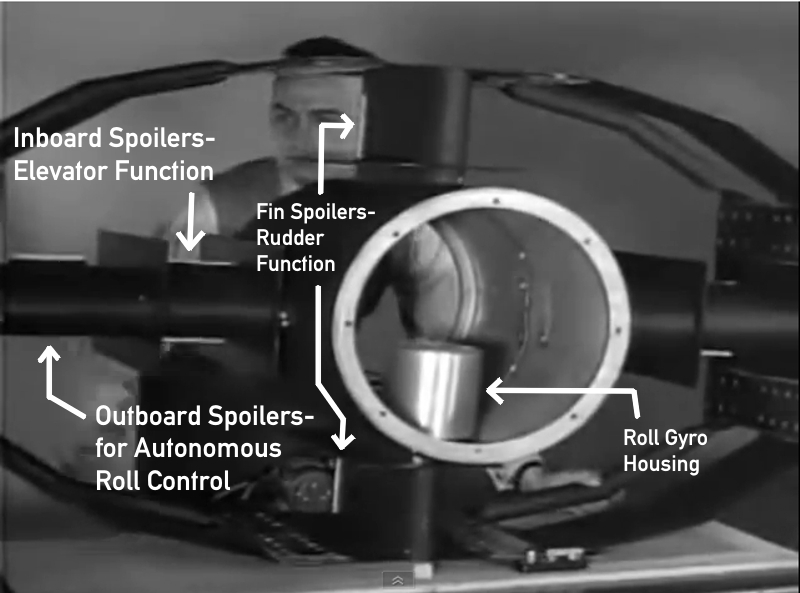
The answer turned out to be surprisingly compact: four small wings near the tail for steering, a gyroscope to keep the thing stable, a radio receiver to pick up commands, and a bright magnesium flare in the tail so the bombardier could actually see where the bomb was going. That last detail is easy to overlook, but it was absolutely critical. There were no cameras, no infrared sensors, no GPS. The bombardier tracked a falling light against the backdrop of the sea and the target, and steered by eye. All of it done in roughly 35 seconds of fall time from 20,000 feet.
The official designation was Ruhrstahl SD 1400 X, but everyone called it the Fritz X. "Fritz" was just a common German given name — it's the equivalent of calling a weapon "Joe" or "Pete." Nothing more dramatic than that.
How It Actually Worked
The mechanics of a Fritz X attack went something like this. A Dornier Do 217K bomber — a twin-engine medium bomber that had the altitude performance for this kind of work — would approach the target at around 18,000 to 20,000 feet. That altitude mattered a lot. Too low and the bomb didn't have enough fall time for meaningful corrections. Too high and the bombardier couldn't see well enough to guide it.

At the release point, the bombardier dropped the Fritz X and immediately picked up the tail flare — a bright white light falling against the darker ocean below. He then used a joystick controller (the Kehl transmitter, designated FuG 203) to send radio commands on the 48-50 MHz band. Left, right, steepen, flatten. That's essentially it. Four commands, transmitted as audio tones, received by the Straßburg unit in the bomb, translated into servo movements that adjusted the tail fins.
Eighteen different radio channels were available to prevent interference when multiple aircraft attacked simultaneously, which was a smart touch — the last thing you want is two bombardiers accidentally steering each other's weapons.
The whole engagement, from release to impact, lasted about 35 to 42 seconds. That's not a lot of time to acquire a falling object, judge its position relative to a moving ship thousands of feet below, and make smooth corrections. Overcorrect and the bomb swings past the target. Undercorrect and you miss on the other side. The best bombardiers developed an intuitive feel for it — something like the instinct a good basketball player has for leading a moving target with a pass. You can teach the theory, but the instinct either develops or it doesn't.
The washout rate during training was significant. Roughly a third of bombardier candidates never got good enough. This wasn't a point-and-forget weapon. It demanded genuine skill, which meant the pool of operators was always limited.
The Technical Stuff (For Those Who Want It)
The Fritz X weighed 1,570 kilograms all-in — the base bomb plus guidance hardware. The warhead carried 320 kilograms of Amatol explosive inside a heavily reinforced steel casing designed to punch through deck armor before detonating. Terminal velocity was around 1,000 km/h, which put it right near the speed of sound. At that speed and weight, the thing could penetrate about 130mm of armor plate — enough to go through the deck of any battleship afloat.
And here's the part that made it truly dangerous to capital ships: the fuse was delayed. The bomb didn't explode on contact with the deck. It punched through, kept going into the guts of the ship — the magazines, the machinery spaces, the boiler rooms — and then detonated. A conventional bomb that explodes on the deck does surface damage. A Fritz X that detonates three decks down does catastrophic damage, the kind that sinks ships.
The design attacked ships from the top — plunging down at steep angles onto deck armor, which was always thinner than belt armor on the sides. This was the same principle as long-range naval gunnery: shells fired at extreme range arrive at steep angles and hit the deck rather than the belt. Kramer's weapon exploited the same geometric weakness, except with far better accuracy than any gun.
Testing and Training
Prototypes went through trials from 1939 to 1942 using inert warheads against land targets and anchored hulks. The accuracy numbers were encouraging — bombardiers were putting practice rounds within 10 to 20 meters of the aim point from 20,000 feet. For context, conventional unguided bombing from that altitude might scatter bombs across a quarter-mile circle. The improvement was dramatic.
The Luftwaffe formed specialized units for guided-weapon attacks, with II/KG 100 becoming the primary Fritz X outfit. Crews trained on instrumented ranges for months. It was serious, methodical preparation — Germany didn't rush this weapon into service half-baked, which is one reason it worked as well as it did when it finally saw combat.
Production ramped up through 1942 into 1943. Roughly 1,400 Fritz X bombs were built in total, which isn't a huge number — but guided weapons weren't meant to be used like conventional bombs. You didn't carpet-bomb with these. Each one was aimed at a specific ship, guided by a trained operator. The idea was quality of hits, not quantity of drops.
Italy Switches Sides
To understand what happened to the Roma, you need a bit of context about September 1943. Italy was done. The Allies had taken Sicily, landed on the mainland, and Mussolini had been overthrown in July. The new Italian government under Marshal Badoglio secretly negotiated an armistice with the Allies, which was publicly announced on September 8.
Part of the deal required the Italian fleet to sail to Allied-controlled ports and surrender. This was a big deal — Italy still had powerful modern battleships, and nobody wanted those ships falling into German hands. The main battle fleet at La Spezia included three battleships: the Roma, the Vittorio Veneto, and the Italia (which had been renamed from Littorio — apparently the old Fascist-era name wasn't a great look anymore). Along with cruisers and destroyers, this was a formidable force that the Allies very much wanted out of the war.
The Germans, naturally, had other ideas. They knew an armistice was coming — Italian security wasn't exactly watertight — and they prepared accordingly. Luftwaffe units equipped with Fritz X weapons were put on alert. If the Italian fleet tried to reach Allied harbors, they'd have to pass through waters within reach of German bombers based in southern France.
The Roma

A few words about the ship herself, because she deserves them. The Roma was a Littorio-class battleship, one of the finest warships Italy ever built. Commissioned in June 1942, she was barely a year old when she was sunk. She displaced over 45,000 tons fully loaded, carried nine 15-inch guns in three triple turrets, could make 30 knots, and wore armor up to 350mm thick on her belt and 207mm on the main deck. By any measure, she was a first-rate capital ship — beautifully designed, powerfully armed, and very modern.
She'd also spent most of her short career sitting at anchor. Fuel shortages plagued the Italian Navy throughout the war, and the Roma rarely sortied. She'd been lightly damaged in an Allied air raid on La Spezia in June 1943, but repairs were completed quickly. By September, she was operational and serving as the flagship of the fleet, carrying Admiral Carlo Bergamini.
Her crew numbered around 1,920 men. They were about to take their big, expensive, nearly new battleship on what they expected to be an inglorious but survivable voyage — sailing to surrender. The irony of what happened next is almost unbearable.
September 9, 1943
The fleet left La Spezia in the early hours — around 03:00 — heading northwest toward the strait between Corsica and Sardinia. Three battleships in line, screened by cruisers and destroyers, making good speed. The mood aboard was reportedly grim. These were professional naval officers sailing their ships to the enemy. Nobody was happy about it, but the alternative — civil war or German seizure of the fleet — was worse.
German reconnaissance found them almost immediately. Luftwaffe observers tracked the Italian fleet and transmitted position reports. At air bases in southern France, eleven Do 217K bombers of II/KG 100 were scrambled, each carrying a single Fritz X. The weather was clear, the sea calm, visibility excellent. Perfect conditions for the weapon — and the worst possible conditions for the targets.
The bombers arrived over the fleet at around 15:00, climbing to attack altitude of roughly 20,000 feet. They approached from the northwest, out of the sun — a classic tactical choice that made them harder to spot. Below, Italian lookouts saw aircraft but hesitated. Were they friendly? German? In the confusion of the armistice, with Italy's air force in disarray and Allied fighters unable to reach this far north, nobody was quite sure what was overhead.
That confusion cost them time they didn't have.
The Attack
Attack runs began at 15:35. The bombardiers powered up their Fritz X systems, checked the tail flares and radio links, and settled into their sights. The aircraft held steady on approach — a requirement of the guidance system that also made them vulnerable, though at 20,000 feet, the Italian anti-aircraft guns were largely ineffective. The 90mm and 37mm batteries put up a barrage, but hitting anything four miles overhead is more hope than marksmanship.
The first Fritz X was released at approximately 15:42, aimed at the Roma. The bombardier acquired the falling flare, judged its path against the massive battleship below, and began making corrections with his joystick. Down on the Roma, someone spotted it — a bright light descending from the sky, falling but not quite falling naturally, adjusting its path in ways that unguided bombs don't.
The Roma's captain ordered evasive action, but 45,000 tons of steel doesn't exactly jink. The ship heeled into a turn, her massive hull resisting the rudder. It wasn't nearly enough.
First Hit — 15:44
The bomb struck near the forward turret on the starboard side, punching through the deck armor and detonating deep inside the forward machinery spaces. The explosion wrecked boilers, ruptured bulkheads, and knocked out electrical power forward. Fires broke out immediately. The ship shuddered — survivors described a tremendous jolt that threw men off their feet — and took on a slight list as flooding began in the damaged compartments.
Bad, certainly. Serious damage. But the Roma was a big, well-built ship, and warships are designed to absorb punishment. Damage control parties moved forward, fighting fires and trying to contain the flooding. Admiral Bergamini, on the bridge, ordered damage reports and kept the fleet heading south. A single bomb hit, however bad, shouldn't sink a modern battleship.
He was right about that, in general. But six minutes later, "in general" stopped mattering.
Second Hit — 15:50
The second Fritz X hit further aft, near the ship's centerline. The bombardier who guided it — and we don't know his name with certainty, which feels wrong somehow — placed it almost exactly where it would do the most damage imaginable. The bomb penetrated the deck and detonated at or near the forward main magazine.
What happened next took seconds but decided the fate of over a thousand men. The magazine — containing hundreds of tons of propellant charges and 15-inch shells for the forward turrets — detonated in a catastrophic secondary explosion. Descriptions from witnesses on other ships sound almost surreal: a blast that dwarfed anything they'd seen, a column of smoke and fire climbing hundreds of feet into the sky, the Roma's forward section simply ceasing to exist.

The forward turrets — each weighing hundreds of tons — were hurled into the air. The bridge, the superstructure, the forward funnel — gone. The bow section separated from the rest of the hull. Everyone forward of the first funnel was killed instantly. That includes the bridge crew, the admiral and his staff, and every man in the forward gun turrets, magazines, shell rooms, and handling spaces.
Sinking — 16:12
What was left of the Roma — essentially the aft two-thirds of a battleship with her forward section blown open — flooded rapidly. She listed heavily to starboard. Internal communications failed with the power out, so damage control became a matter of individual compartments doing what they could without coordination. It wasn't enough. It couldn't have been.
At 16:12, roughly twenty-two minutes after the second hit, the Roma capsized and sank. She went down bow-first — what remained of the bow, anyway — with her stern rising briefly before the whole mass disappeared beneath the Mediterranean. She took 1,393 men with her, including Admiral Bergamini. Only 596 of the nearly 1,920 crew survived.
Destroyer escorts pulled survivors from the water over the following hours. Many were horribly burned or injured. Some had been swimming through burning fuel oil. The rescue effort was rushed — the remaining ships needed to clear the area before more bombers arrived.
The Italia Gets Hit Too
The Roma wasn't the only casualty. During the same attack, a Fritz X struck the Italia (the third battleship in the formation) near her bow. The bomb penetrated the deck and detonated in the forward section, causing serious flooding and fires.
Unlike the Roma, though, the Italia's hit was in a location forward of the main armored citadel — bad, but not in the critical zone around the magazines and machinery. Her damage control parties managed to contain the flooding, suppress the fires, and keep the ship moving. She took about 50 killed and over 100 wounded, but she survived. The Italia, along with the undamaged Vittorio Veneto and the escorts, limped south and surrendered to the British at Malta on September 10. The Italia served in the post-war Italian Navy until the 1950s.
What They Hit Next
The Roma was the most dramatic Fritz X success, but it wasn't the last. The weapon continued to prove itself over the following weeks, mostly during the Salerno landings.
USS Savannah — September 11, 1943

Just two days after the Roma, a Fritz X hit the American light cruiser USS Savannah during fire-support operations off Salerno. The bomb went through the deck, passed through three internal decks, and detonated in the lower handling room of the forward turret. The explosion killed 197 men, blew the forward turret off its mounts, and came close to sinking the ship outright. Heroic damage control — and some genuine luck — kept the Savannah afloat, but she had to be towed to safety and then shipped back to the United States for major repairs. She was out of the war until 1944.
HMS Warspite — September 16, 1943

A week after the Roma, the veteran British battleship HMS Warspite — which had fought at Jutland in 1916 and had more battle honors than most navies — took a Fritz X off Salerno. This one did something almost unbelievable: it punched completely through the ship, exiting through the hull bottom before detonating underwater beneath the keel. The resulting explosion flooded multiple compartments, destroyed the starboard boiler room, and left the Warspite without propulsion. She had to be towed to Malta and took months to repair. The grand old lady of the Royal Navy was effectively crippled by a single guided bomb.
Others
HMS Uganda, a British cruiser, was hit on September 13 off Salerno — serious damage, months of repairs. The USS Philadelphia caught a near-miss the same day — splinter damage but nothing fatal. HMS Spartan was sunk off Anzio in January 1944, though whether her killer was a Fritz X or a conventional bomb is debated.
In total, the Fritz X had an operational record that any weapon designer would envy. Under ideal conditions, hit rates reached 30 to 40 percent — compared to 2 to 5 percent for conventional high-altitude bombing against maneuvering ships. The problem for Germany was that "ideal conditions" became increasingly rare.
Why It Stopped Working
The Fritz X's effectiveness peaked in September-October 1943 and declined rapidly afterward. Several factors conspired to blunt the weapon.
Radio jamming was the most direct countermeasure. Once the Allies figured out the Fritz X was radio-guided — which didn't take long after they fished fragments out of damaged ships — they developed jammers that broadcast noise on the 48-50 MHz control frequencies. When jamming worked, the bombardier's commands never reached the bomb, and it reverted to an unguided ballistic trajectory. Early jammers were crude, but they improved quickly. By late 1943, most major Allied warships carried some form of anti-Fritz X jamming equipment.
Weather was an inherent limitation. The bombardier needed to see the bomb's tail flare and the target simultaneously for the entire 35-40 seconds of guided flight. Cloud cover, haze, smoke screens — anything that obscured the view made guidance impossible. In the Mediterranean in September, the weather cooperated. Over the English Channel or the North Sea in winter, it frequently didn't.
Fighter interception became the biggest killer. The Do 217K was a medium bomber — not fast, not particularly maneuverable, and deeply unhappy about meeting Allied fighters at altitude. As Allied air superiority grew through 1944, daylight Fritz X attacks became increasingly suicidal for the bomber crews. The weapon needed a stable platform flying straight and level during the guidance phase — which is exactly what a fighter pilot dreams of finding when he's looking for a target.
By mid-1944, the window for effective Fritz X employment had essentially closed. The Luftwaffe was being ground down across all fronts, fuel was short, and experienced crews were irreplaceable. The weapon that had terrorized the Mediterranean fleet in September 1943 was, within a year, more or less neutralized.
What It All Meant
Here's what sticks with me about the Fritz X. It was right. The idea was absolutely, fundamentally correct. Precision-guided weapons would go on to transform warfare — not in World War II, where the Fritz X arrived too late and in too few numbers to matter strategically, but in every conflict since.
"The Fritz X didn't change the outcome of the war. But it proved a concept that changed every war after it."
Every laser-guided bomb dropped in Vietnam, every JDAM that hit a target in Iraq, every Hellfire missile fired from a drone — all of them trace their ancestry, in some meaningful way, back to Max Kramer's steerable armor-piercing bomb. The technology evolved beyond recognition: radio control gave way to TV guidance, then laser designation, then inertial navigation, then GPS. But the core insight — that a weapon you can steer after release is vastly more effective than one you can't — was proven over the Mediterranean in September 1943.
Germany couldn't exploit the idea fully. They didn't have enough bombers, enough trained operators, enough Fritz X bombs, or enough time. The Allies adapted faster than the Germans could escalate. And crucially, the strategic situation was against Germany — no amount of clever engineering could offset the overwhelming material advantage the Allies enjoyed by 1944.
But the weapon worked. On its own terms, as a piece of engineering solving a specific tactical problem, the Fritz X was a genuine achievement. That has to be acknowledged alongside the tragedy it inflicted.
The Roma Today
The wreck of the Roma lies on the seabed north of Sardinia, in deep water. She's an official war grave — over 1,300 men are still aboard, or scattered around the wreck site. Italian authorities protect the site from salvage or disturbance.
There's something particularly bitter about the circumstances of her loss. The men aboard the Roma weren't fighting. They were sailing to surrender — following legitimate orders from their government, trying to do the right thing in a terrible situation. They were killed by an ally-turned-enemy using a weapon they'd never encountered and couldn't defend against. The whole episode has a senselessness to it that, even eighty years later, is hard to sit with.
The Fritz X sits in various museums now — there's one at the Smithsonian, others in European collections. Visitors walk past it and most probably don't register what they're looking at. It doesn't look like much. A bomb with some extra fins. But it represents something enormous: the moment when precision replaced volume as the dominant logic of air-delivered weapons. The age of smart bombs started right there, with a German bombardier steering a falling light toward an Italian ship that was trying to stop being his enemy.
That's the kind of story this war produced. Technological brilliance and human tragedy, intertwined so tightly you can't separate them.
Quick Reference
| Specification | Fritz X (SD 1400 X) |
|---|---|
| Total weight | 1,570 kg (3,460 lbs) |
| Warhead | 320 kg Amatol |
| Length | 3.26 m (10.7 ft) |
| Fin span | 1.35 m (4.4 ft) |
| Terminal velocity | ~1,000 km/h (620 mph) |
| Armor penetration | ~130 mm deck armor |
| Guidance | Radio command (Kehl-Straßburg) |
| Control frequency | 48–50 MHz, 18 channels |
| Drop altitude | 18,000–20,000 ft optimal |
| Fall time | ~35–42 seconds |
| Carrier aircraft | Dornier Do 217K |
| Total produced | ~1,400 units |
| Hit rate (ideal) | 30–40% |
Frequently Asked Questions
Could the Roma's crew have done anything differently?
Honestly, not much. The Fritz X was a weapon they'd never seen, against which they had no countermeasures, no warning doctrine, and no jamming capability. The ship's anti-aircraft guns couldn't effectively reach bombers at 20,000 feet, and evasive maneuvers meant nothing against a bomb that could be steered to follow a turning ship. They were in an impossible position. If you want to assign blame, it belongs to the broader situation — the lack of fighter cover, the delayed recognition of the aircraft as hostile — rather than to any failing of the Roma's crew.
How does the Fritz X compare to modern guided weapons?
It's a bit like comparing the Wright Flyer to a 747 — the principle is the same, but the execution is worlds apart. Modern JDAMs use GPS and inertial guidance, need no operator input after release, work in any weather, and can't be jammed in the same way. The Fritz X needed clear weather, a skilled operator, a stable aircraft platform, and was vulnerable to radio jamming. But it proved the concept that made everything since possible. You can draw a direct line from Kramer's workshop to the precision weapons of today.
Why didn't Germany use more of them?
Three reasons, mainly. They only built about 1,400 — not a huge stockpile. The specialized crews needed to operate them were limited and hard to replace. And Allied countermeasures, especially radio jamming and fighter interception, rapidly narrowed the window in which the weapon could be used effectively. By mid-1944 the Luftwaffe was fighting for survival, not launching precision attacks against warships. The Fritz X was a weapon that worked, but Germany couldn't build the conditions for it to keep working.