
In 1920, the German army was a wreck. The Treaty of Versailles had hacked it down to 100,000 men—no tanks, no planes, no heavy guns, no conscription. Allied inspectors roamed German military facilities making sure the rules stuck. By any reasonable measure, Germany was done as a military power. Fifteen years later, it fielded one of the most lethal fighting forces the world had ever seen. The man most responsible for bridging that gap was General Hans von Seeckt, and his methods were anything but conventional.
Seeckt didn't just keep a small army alive through the lean years. He turned every restriction Versailles imposed into a hidden advantage. He built an officer corps trained far beyond its nominal rank, developed military doctrine a decade ahead of its time, and—most audaciously—cut a secret deal with Soviet Russia to train German pilots and tank crews on Russian soil, hundreds of kilometers from the nearest Allied inspector. It's one of the stranger stories of the twentieth century: ideological enemies cooperating in the shadows to build military capabilities both were forbidden to possess.
The Man Behind the Monocle
Hans von Seeckt was born in 1866 in Schleswig, into the kind of family where a military career wasn't really a choice—it was more like gravity. His father was a Prussian general, and young Hans followed the expected path: officer cadet at 19, Kriegsakademie graduate by 31, steady peacetime promotions through a system that rewarded competence and punished individuality.
Colleagues found him formal to the point of coldness. He wore a monocle that became something of a trademark—an affectation that perfectly captured the stiff Prussian officer culture he embodied. But behind that rigid exterior was a genuinely sharp mind, one that would prove far more creative than anyone expected.
World War I is where Seeckt made his name, though not as a frontline hero. He was a staff officer —the guy behind the maps and timetables. His finest moment came in May 1915, when he planned the Gorlice-Tarnów Offensive on the Eastern Front under General August von Mackensen. The operation shattered Russian lines and drove them back hundreds of kilometers. It was a genuine breakthrough at a time when the Western Front had devolved into trench-bound slaughter, and it left a lasting mark on Seeckt's thinking. Mobility worked. Maneuver won battles. Sitting in trenches didn't.
He finished the war as chief of staff to the Turkish army, and when Germany collapsed in November 1918, Seeckt returned to a country he barely recognized—defeated, revolutionary, and facing a future no one could predict.
A Nation Stripped Bare
The Treaty of Versailles, signed in June 1919, wasn't just a peace agreement. It was designed as a straitjacket. The Allies—especially France, which had lost a generation of young men on its own soil—wanted to make absolutely certain Germany could never threaten anyone again. The military restrictions were punishingly specific:
The army was capped at 100,000 men, split into seven infantry and three cavalry divisions. No more. Officer strength couldn't exceed 4,000. Conscription was abolished—only long-service volunteers. Tanks were outright banned, as were military aircraft of any kind. Heavy artillery above 105mm caliber was forbidden. Even the General Staff, the intellectual heart of the Prussian military machine, was dissolved on paper. Allied Control Commissions would show up unannounced to inspect German bases and count every rifle, every machine gun, every shell.
The intent was straightforward: reduce Germany to permanent military irrelevance. Even if the political will to rearm existed someday, it would take decades to rebuild from scratch. Or so the reasoning went.
Seeckt Takes the Reins
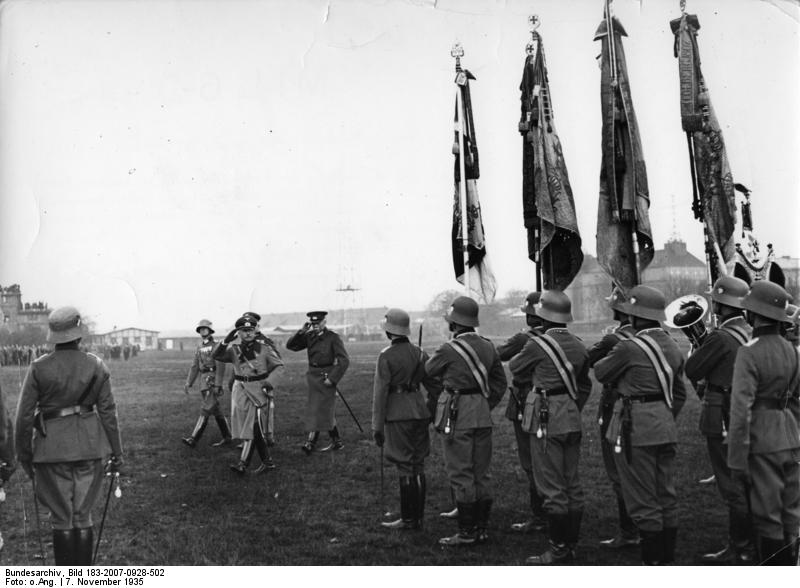
Seeckt's path to the top was characteristically dramatic. In March 1920, during the Kapp Putsch—a botched right-wing coup attempt—he was asked to order the army to crush the rebels. He refused. "Reichswehr does not fire on Reichswehr," he declared, a phrase that would follow him for the rest of his career. It was a pragmatic call—he feared that ordering soldiers to shoot fellow soldiers would fracture the already fragile army—but it also signaled something unsettling about the Reichswehr's loyalty to democracy. Or lack thereof.
The coup failed on its own, and in its aftermath, Seeckt was appointed Chief of the Army Command. The title was a deliberate downgrade from "Commander-in-Chief," which Versailles forbade, but the power was real. At 54, he effectively controlled what remained of the German military, and he negotiated himself remarkable freedom from civilian interference. The Weimar government needed the army's loyalty badly enough to give him what he wanted.
Seeckt wasted no time. He articulated a vision that would guide German military thinking for the next decade: "The whole future of warfare appears to me to lie in the employment of mobile armies, relatively small but of high quality, and rendered distinctly more effective by the addition of aircraft." Keep in mind, he wrote this in 1921—Germany didn't have a single military airplane to its name. But Seeckt wasn't building for today. He was building for a future he fully expected to arrive.
Every Private a Future Officer
If Versailles limited quantity, Seeckt would pursue quality to an almost obsessive degree. His core idea—often called the "army of leaders" concept—was straightforward but radical in practice: train every soldier to perform at least one rank above his own. Every private learned the skills of an NCO. Every NCO got the education of a junior officer. Every officer trained to command formations much larger than anything he'd actually lead in the tiny Reichswehr.
The logic was coldly practical. The 100,000-man army wasn't the real army. It was a seed. When the opportunity came to expand—and Seeckt never doubted that it would—Germany would need a huge pool of trained leaders to absorb masses of new recruits. If your peacetime private could step into an NCO role overnight, and your NCOs could immediately lead platoons, you could scale up fast. Very fast.
Recruitment was ruthlessly selective. Physical standards were extreme, intelligence tests demanding. Enlisted men served 12-year terms, officers 25 years—long enough to build deep expertise, and also a workaround for the ban on reserves. A soldier who left after 12 years had enough training to serve as an instructor for any future mobilization.
The training itself went far beyond target practice and marching drills. Soldiers studied combined-arms tactics—how infantry works with artillery, how cavalry screens for infantry, how (hypothetical) air support would change things on the ground. Officers learned foreign languages, economics, international relations. Seeckt wanted men who could think, not just men who could follow orders. This emphasis on intellectual flexibility would prove devastating when these officers finally got modern equipment in the 1930s.
The Great Deception
Versailles abolished the General Staff. So Seeckt renamed it. The "Truppenamt"—Troop Office—did exactly what the old General Staff had always done: strategic planning, doctrine development, officer education, mobilization schedules. The officers didn't wear the General Staff's distinctive crimson trouser stripes anymore, and the department names were shuffled around, but the substance was identical. Allied inspectors knew it, too. They just couldn't prove it cleanly enough to force action.
The industrial side was equally devious. German factories couldn't openly produce military hardware, but they could be designed so that converting from civilian to military production would take weeks instead of years. A tractor plant could become a tank factory with minor retooling. A commercial aircraft factory could pivot to fighters. Seeckt cultivated close, secret relationships with firms like Krupp, Junkers, and Daimler-Benz—companies that maintained hidden military design bureaus and quietly developed prototypes that would never see German soil until rearmament began.

Secret Deals with Soviet Russia
This is where the story gets genuinely strange. In the early 1920s, Germany and Bolshevik Russia were two of Europe's biggest outcasts—one defeated and shackled, the other revolutionary and isolated. They had virtually nothing in common ideologically. Seeckt personally despised communism. But both countries needed something the other had, and that made for a remarkably productive, remarkably cynical partnership.
Germany needed space—physical space, far from Allied eyes—to develop and test the weapons it wasn't allowed to have. Russia needed German engineering expertise and military know-how to modernize its own decrepit armed forces. The Treaty of Rapallo in April 1922 normalized diplomatic relations publicly. Behind closed doors, military protocols established something far more dangerous: permanent German training facilities on Soviet territory.
Three facilities mattered most, and each one tells its own story.
Lipetsk: Where Germany's Air Force Was Born
About 300 kilometers southeast of Moscow, the aviation school at Lipetsk operated from 1924 to 1933 under the cover designation "4th Squadron of the Red Air Fleet." In reality, it was a German-run pilot training school, staffed by German instructors, serving German military interests. Soviet authorities provided the airfield and security; everything else was German.
German pilots traveled there under false identities—posing as agricultural consultants or industrial advisors—and trained in fighter tactics, reconnaissance, and ground attack using aircraft officially owned by the Soviet Union. The program was dangerous: roughly one in ten trainees died in accidents, a casualty rate that speaks to the intensity of the training. Post-Cold War access to Soviet archives shows that between 120 and 130 fighter pilots passed through Lipetsk, along with ground crews and technical staff. Prototype aircraft from Junkers, Dornier, and Heinkel were also tested there under real operational conditions.
When Germany began openly rearming in the mid-1930s, Lipetsk graduates formed the backbone of the new Luftwaffe's officer corps. These weren't theoretical aviators. They'd logged thousands of hours in the air.
Kazan: Testing the Tanks That Didn't Exist
The tank school near Kazan, codenamed "Kama," opened in 1926 and focused on something Germany was absolutely forbidden to possess: armored warfare capability. The facility had testing grounds, classrooms, maintenance shops, and live-fire ranges. Prototype tanks arrived from Krupp and Rheinmetall labeled as "agricultural tractors"—a fiction so transparent it's almost charming.
Around 30 German officers received hands-on tank training at Kama, and 10 to 15 prototype vehicles were tested there. That sounds like a small number until you consider what those 30 officers did next: many of them went on to command the Panzer divisions that blitzed through Poland and France. The practical experience they gained—actually driving tanks, integrating armor with infantry and artillery, conducting tactical exercises—proved immediately useful when Germany started building Panzers for real.
Tomka: The One Nobody Talks About
The least known facility was at Tomka, near Volsk on the Volga, where Germany and the Soviet Union jointly researched chemical warfare—poison gas, delivery systems, protective equipment, decontamination procedures. Both the Versailles Treaty and the 1925 Geneva Protocol banned this work. Both countries did it anyway. The research covered chlorine, phosgene, and mustard gas, with German chemists working alongside Soviet counterparts in field tests evaluating weapon effectiveness and protection gear.
Germany never actually used chemical weapons in World War II, though it stockpiled them. The Soviet Union, however, carried the expertise forward, and Soviet chemical warfare capabilities remained a serious concern throughout the Cold War.
The Bitter Irony
Here's the thing that makes this entire arrangement almost darkly comic in hindsight: Germany was helping the Soviets modernize the very military that would nearly destroy it twenty years later. Soviet tank officers learned German combined-arms doctrine. Soviet designers studied German prototypes. The T-34—arguably the most important tank of World War II—was developed in a Soviet industrial ecosystem that German engineers had helped build up.
When Germany invaded the Soviet Union in June 1941, both sides employed tactics, weapons, and organizational methods that were partly developed during their 1920s cooperation. Officers who'd shared a mess hall at Kazan would end up trying to kill each other at Kursk. Neither side anticipated this when they struck the deal, but that's the nature of military partnerships built on pure cynicism—they serve short-term interests brilliantly while generating long-term consequences nobody can predict.
A Philosophy of Speed
Seeckt's battlefield philosophy boiled down to a single conviction: the static trench warfare of 1914–1918 was an aberration, not a template. Future wars would be won by speed, concentration, and initiative. He drilled this into every corner of the Reichswehr.
His principles—strike before the enemy can react, mass forces at the decisive point, exploit breakthroughs ruthlessly instead of consolidating—read like a preview of Blitzkrieg, which is exactly what they were. Seeckt wrote about combined-arms warfare using tanks and aircraft a full decade before Germany had either. When the equipment finally materialized, the doctrine was already mature and had been practiced (with embarrassing mock-ups, but practiced nonetheless) in field exercises for years.
Just as important was his championing of Auftragstaktik—mission-type tactics. Instead of handing subordinates rigid, detailed orders, German commanders received objectives and constraints, then figured out the execution themselves. This demanded the kind of intelligent, well-trained officers the "army of leaders" concept produced, and it created a military culture that prized initiative and quick thinking. In 1940, when junior German officers exploited fleeting opportunities faster than the French could react, they were drawing on a command philosophy Seeckt had been instilling since 1920.

The Fall
For all his military brilliance, Seeckt's political instincts were terrible. His downfall in October 1926 came from something almost comically minor: he'd allowed Prince Wilhelm of Prussia, the ex-Kaiser's grandson, to participate in army maneuvers wearing his old Imperial uniform. The Weimar government had explicitly banned former royals from official military activities, and Seeckt's enemies—mostly on the political left, where suspicion of the army ran deep—pounced.
A smarter politician would have apologized quietly and moved on. Seeckt doubled down, defending the decision and challenging the government's authority over military matters. It was a fight he couldn't win. Chancellor Wilhelm Marx demanded his resignation. President Hindenburg—himself a former field marshal—reluctantly agreed. After six years of shaping the Reichswehr, Seeckt was out.
He drifted through a few final roles—a brief stint in the Reichstag, a stint advising Chiang Kai-shek's Chinese army from 1933 to 1935—before dying in 1936. He didn't live to see the Wehrmacht he'd built conquer most of Europe, or the catastrophe that followed. Maybe that was a mercy.
What He Left Behind
The list of World War II commanders who trained under Seeckt's system reads like a who's who of the Wehrmacht's senior leadership. Heinz Guderian, the father of German armored warfare. Erich von Manstein, perhaps the war's finest operational mind. Gerd von Rundstedt. Wilhelm Keitel. Franz Halder. Nearly every significant German general of the Second World War learned his craft in the Reichswehr that Seeckt built.
When Hitler ordered open rearmament in 1935, Germany didn't start from zero. The officer corps was ready. The industrial contacts were in place. Weapons designs had been tested and refined in Russia. Doctrine was fully developed. Training systems existed. The expansion from 100,000 men to the 3.6 million-strong Wehrmacht of 1939 happened in just four years—an astonishing pace that was only possible because Seeckt had spent the previous decade laying the groundwork in secret.
"Von Seeckt didn't build Germany's wartime army. He built the seed from which it grew—and he made sure that seed contained everything needed for rapid, devastating expansion."
But there's a darker side to this legacy that's worth sitting with. Seeckt created a semi-autonomous military that answered to no one but itself. He systematically violated international treaties. He built a "state within a state" that maintained formal loyalty to the Weimar Republic while holding democratic values at arm's length. When Hitler offered the army everything it wanted—rearmament, expansion, prestige, war—the institutional culture Seeckt had fostered made it disturbingly easy for the officer corps to go along.
Seeckt wasn't a Nazi. He was a conservative Prussian officer who wanted to restore Germany's great-power status. But the professional, effective, doctrinally sophisticated army he built became the instrument of Hitler's wars. The Wehrmacht that dazzled the world with its speed and coordination in 1940 was substantially Seeckt's creation. So was the Wehrmacht that carried out campaigns of annihilation on the Eastern Front.
Was he a military genius or an enabler of catastrophe? Honestly, he was both. He turned impossible constraints into hidden advantages with extraordinary creativity. He also helped create a military machine that, when finally unleashed, contributed to immeasurable suffering. The lessons of his career are uncomfortable but important: professional excellence without democratic accountability creates dangers, and secret preparations for future wars tend to produce consequences far more terrible than anyone intends.
Frequently Asked Questions
How did Seeckt get around the Versailles restrictions?
Multiple ways at once. He disguised the banned General Staff as the innocuous-sounding
"Truppenamt" (Troop Office), kept industrial firms like Krupp quietly developing military
designs, and—most importantly—struck a deal with Soviet Russia to set up secret training
facilities at Lipetsk (pilots), Kazan (tanks), and Tomka (chemical weapons) on Russian
soil, far beyond Allied reach.
How big was the German-Soviet cooperation really?
Bigger than most people realize. Between 1921 and 1933, roughly 120–130 fighter pilots
trained at Lipetsk, about 30 tank officers went through Kazan, and an unknown number of
chemical warfare specialists used Tomka. Several hundred German personnel passed through
these facilities in total. The Soviets got something out of it too—German technical
expertise helped modernize Soviet industry and military training. The whole thing fell apart
in 1933 when Hitler came to power and anti-communist ideology made the partnership
untenable.
What was the "army of leaders" concept?
Seeckt's insight that if Germany's army was capped at 100,000 men, each one should be
trained to perform at least one level above his actual rank. Privates got NCO-level
training, NCOs learned officer skills, and officers prepared to command much larger
formations. That way, when expansion came, the tiny Reichswehr could supply trained leaders
for a mass army almost overnight. It worked exactly as planned—when rearmament began in
1935, these over-trained professionals became the cadre that turned millions of raw
conscripts into an effective fighting force within a few years.
Did Seeckt actually invent Blitzkrieg?
Not exactly—Blitzkrieg as a tactical system was refined by people like Guderian in the
1930s. But Seeckt laid the doctrinal foundation. His emphasis on speed, concentration of
force, combined-arms operations, and mission-type tactics (Auftragstaktik)
provided the intellectual framework. He was writing about mobile warfare with tanks and
aircraft a full decade before Germany had either. When the hardware arrived, the ideas were
already battle-tested in exercises—just with canvas-covered cars standing in for Panzers.
Why did he get fired?
Over something surprisingly petty. He let the former Kaiser's grandson participate in
Reichswehr maneuvers in his old Imperial uniform, which violated Weimar government policy.
Instead of defusing the situation, Seeckt got combative with civilian authorities—never a
winning move for a general in a democracy, even a shaky one. Chancellor Marx forced his
resignation in October 1926.