While the Tiger and Panther dominate popular memory of German armor, the Panzerkampfwagen IV was the only German tank to remain in production throughout the entirety of World War II. It was not a "wonder weapon," nor was it conceptually revolutionary. Instead, it represented a rare instance of German engineering pragmatism—a chassis robust enough to accept upgrades far beyond its original design specifications.
Its history is less about brilliant invention and more about desperate adaptation. Designed in the mid-1930s as a specialized infantry support vehicle, it was forced by the realities of the Eastern Front to reinvent itself as a main battle tank, a role it was never intended to fill.
Doctrinal Origins: The Begleitwagen
In the early 1930s, Heinz Guderian and the German General Staff formulated a doctrine centered on two main tank types. The primary vehicle, the Panzer III, was to be the tank-killer, armed with a high-velocity 37mm or 50mm gun. The Panzer IV was conceived as the Begleitwagen (support vehicle). Its job was to trail the Panzer IIIs and knock out anti-tank guns, bunkers, and machine gun nests with high-explosive shells.

To achieve this, Krupp armed the early variants (Ausführung A through F1) with the short-barreled 7.5 cm KwK 37 L/24. It was a low-velocity howitzer, essentially useless against heavy armor, but devastating against soft targets. The armor protection was similarly modest—roughly 14.5mm to 30mm on early models—intended only to stop small arms fire and shell splinters. The Germans assumed the Panzer IV would operate behind the spearhead, not at its tip.
The Shock of Combat
The campaigns in Poland (1939) and France (1940) exposed flaws in this doctrine. While the Panzer IV performed its infantry support duties well, the encounters with British Matildas and French Char B1 bis tanks were alarming. The short 75mm gun could not penetrate these heavy tanks, and the Panzer IV’s own armor was vulnerable to the British 2-pounder and French 47mm guns.
However, the real crisis arrived with Operation Barbarossa in 1941. The appearance of the Soviet T-34 and KV-1 rendered the German tank fleet virtually obsolete overnight. The Panzer III’s 50mm gun could not reliably penetrate the T-34’s sloped armor, and the Panzer IV’s low-velocity howitzer was even worse off.
"This moment dictated the Panzer IV's future. The Panzer III chassis was too small to mount a significantly larger turret and gun... By sheer engineering luck, the 'support' tank was the only chassis capable of mounting the weapon needed to survive the Eastern Front."
The Long Gun: Ausführung F2 and G
The pivotal moment in the tank's history was the installation of the 7.5 cm KwK 40 L/43 gun in early 1942. This high-velocity weapon fundamentally changed the vehicle's classification. It was no longer a support tank; it was a tank killer.

First deployed as the Ausf. F2 (quickly re-designated as the Ausf. G), this variant restored a measure of parity on the Russian steppe. For the first time, German crews could engage T-34s at combat ranges with a high probability of a kill. The Ausf. G became the backbone of the the Panzer divisions during the critical battles of 1942 and 1943.
This firepower came at a cost. The chassis, originally designed for a 17-ton vehicle, was now carrying over 23 tons. The leaf-spring suspension, while durable, was stressed to its limit. The frontal armor was increased to 50mm, and later 80mm, making the tank nose-heavy and prone to final drive failures—a mechanical plague that would haunt the vehicle until the end of the war.
Industrial Realities: The H and J
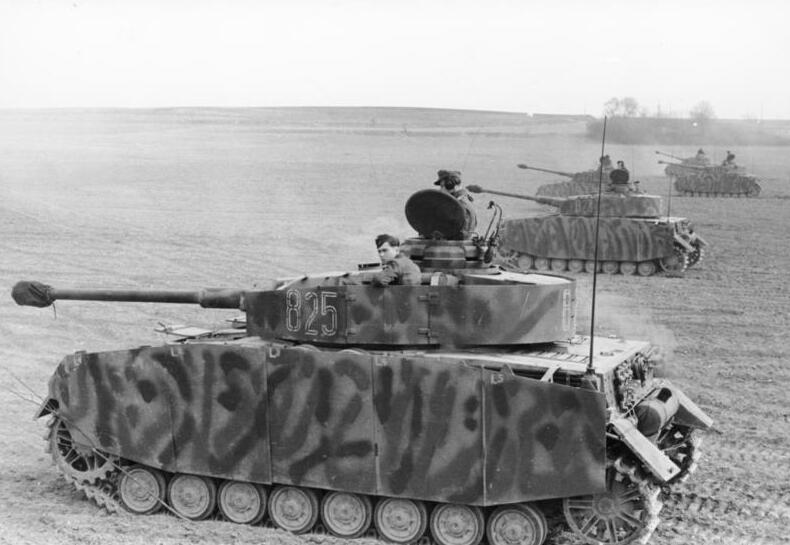
The definitive version of the tank, the Ausf. H, appeared in 1943. It featured the longer L/48 gun and 80mm frontal armor as standard. It also introduced the Schürzen (skirts) along the sides. While often mistaken as protection against tank rounds, these mesh or steel plates were primarily intended to disrupt Soviet anti-tank rifles, which were wreaking havoc on the Panzer IV’s thinner side armor.

By 1944, the Panzer IV was technically inferior to the later marks of the Sherman and the T-34-85. The Panther was supposed to replace it, but German industry could never produce Panthers in sufficient numbers. The Wehrmacht could not afford to stop the lines at Nibelungenwerke (the primary Panzer IV factory).
Consequently, the final variant, the Ausf. J, was a retrograde step. It was an "austerity tank." To speed up production and save strategic materials, the electric turret traverse motor was removed, forcing the gunner to hand-crank the turret—a fatal disadvantage in close-quarters combat. The result was a vehicle that was harder to fight in, produced by a nation running out of time and resources.
Variants and Versatility
One of the Panzer IV’s greatest strengths was its adaptability as a platform for other weapons. When the chassis became too obsolete for a main battle tank, it found new life as the Jagdpanzer IV (tank destroyer), which featured a low profile and sloped armor that offered better protection than the turreted tank.
It also served as the basis for self-propelled artillery (the Hummel) and anti-aircraft platforms (Wirbelwind, Ostwind). This commonality of parts was a logistical blessing for German maintenance crews, who were often struggling to keep a chaotic mix of vehicles operational.
Assessment
The Panzer IV is a study in diminishing returns. In 1939, it was a competent, comfortable, and reliable support vehicle. By 1942, it was a lethal, balanced main battle tank. By 1944, it was an overworked, overweight, and outdated design that remained in service simply because there was no alternative.
It lacked the sloped armor of the T-34 and the automotive refinement of the Sherman. Yet, its spacious three-man turret, excellent optics, and commander’s cupola gave its crews a tactical efficiency that often outweighed its paper statistics. It remained in service long after the war, notably in the Syrian army, where Panzer IVs exchanged fire with Israeli Centurions in the 1960s—a testament to a design that simply refused to die.
Frequently Asked Questions
How many were built?
Roughly 8,500 Panzer IVs (all variants) were produced. While this made it Germany's most
numerous tank, it pales in comparison to the ~50,000 M4 Shermans or ~84,000 T-34s produced
by the Allies.
Why didn't the Panther replace it?
The Panther was expensive, complex, and suffered from severe teething issues upon
introduction. Furthermore, retooling the Panzer IV factories to build Panthers would have
resulted in a drop in production that the Wehrmacht could not afford. They needed tanks
immediately, even if they were older designs.
How did it compare to the Sherman?
Against the early 75mm Sherman, the Panzer IV (with the long gun) had superior firepower but
inferior reliability and mobility. Against the late-war 76mm Sherman, the Panzer IV was
outclassed in almost every metric, though it remained dangerous due to its high-velocity
gun.
What was the "Schürzen" for?
The skirts on the side of the Panzer IV were primarily designed to stop Soviet 14.5mm
anti-tank rifles, which could penetrate the weak side armor of the hull. They also offered
some protection against hollow-charge weapons, though this was secondary.