
I've written about Germany's guided missiles before — the Fritz X, the Hs 293, the Ruhrstahl X-4. Clever weapons, all of them. Impressive engineering. The X-4 in particular was genuinely ahead of its time, a wire-guided air-to-air missile that hit targets in testing and could have been a nightmare for Allied bomber crews.
But here's the thing about all those weapons: they were complicated, expensive, and — in the case of the X-4 — never actually fired at anything in anger. The Fritz X sank a battleship, sure. The Hs 293 had its moments. But by late 1944, Germany didn't need elegant engineering. It needed something that could be stamped out by the tens of thousands, bolted onto whatever fighters were still flying, and fired at the bomber streams that were grinding the country into rubble.
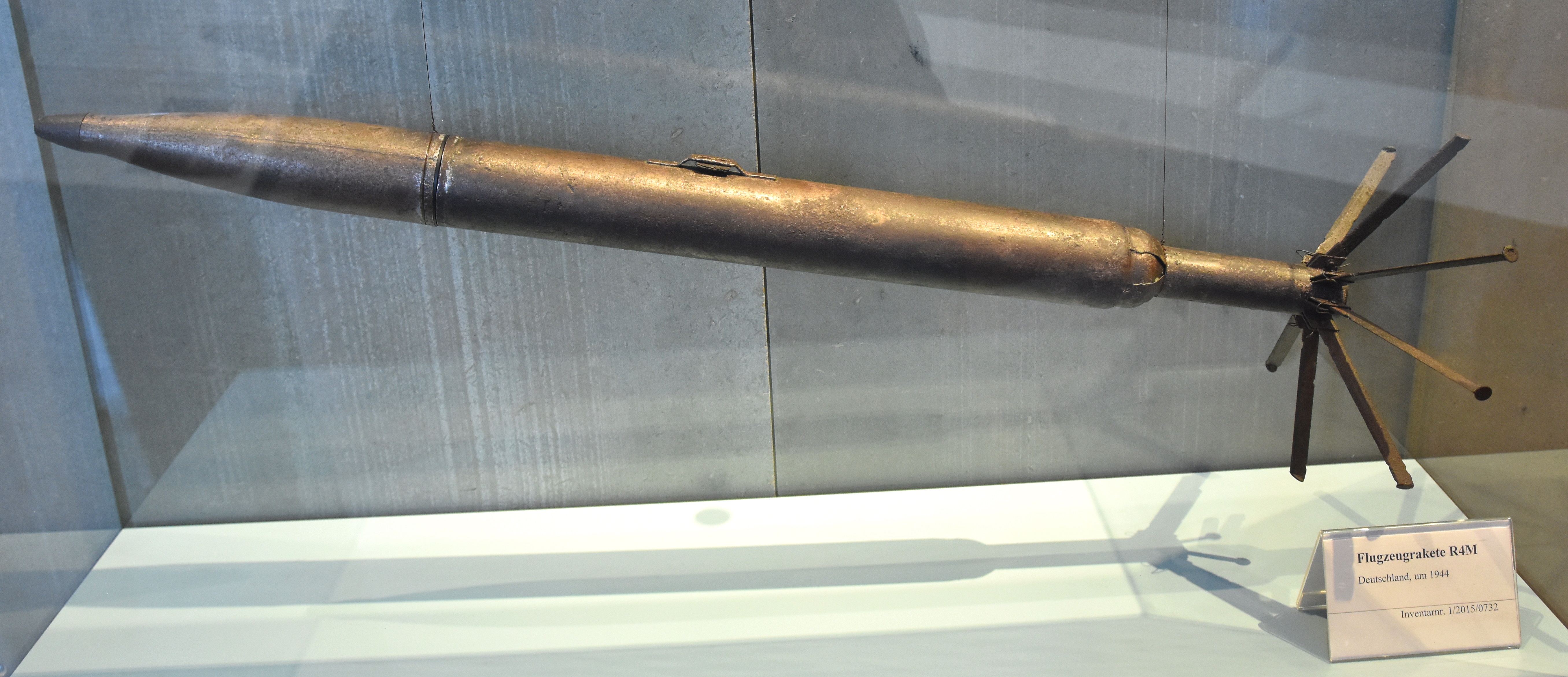
Enter the R4M Orkan. "Hurricane." A 55mm unguided rocket, barely 80 centimeters long, weighing under four kilograms. No guidance system, no wire, no radio link. You pointed the plane at the bombers, pressed the button, and twenty-four of them ripped off the rails in under a second. At a thousand meters — well outside the effective range of those .50-cal turrets — the salvo slammed into the formation and things started exploding.
It wasn't sophisticated. It wasn't elegant. But it actually saw combat, it actually destroyed bombers, and it was cheap enough to produce by the tens of thousands even as Germany's industrial base was collapsing around it. Sometimes boring works.
The Problem: How Do You Kill a Fortress?

By 1943, German fighter pilots had a truly awful job. American B-17s and B-24s flew in tight "combat box" formations that were specifically designed to create overlapping fields of defensive fire. A 36-plane formation could bring something like 400 machine guns to bear on you simultaneously. Every approach angle was covered. You were never attacking one bomber — you were attacking thirty-six of them, all shooting at you at the same time.
To use the standard 30mm MK 108 cannon — which was powerful, sure — you needed to close to maybe 400 meters. Three or four hundred meters from a formation that's putting out a wall of .50-caliber fire. Pilots described it as flying into a meat grinder, and the casualty statistics backed them up. For every bomber shot down, Germany was losing fighters and pilots it couldn't replace.
And it got worse. The MK 108 had a muzzle velocity of only 540 m/s, which meant the trajectory dropped like a stone at any real distance. You essentially had to be at point-blank range to hit anything, which put you at point-blank range for every gunner in the formation to hit you back. The math was brutal and it was getting worse by the month — America could build bombers and train crews faster than Germany could replace fighters and train pilots.
What they needed was obvious: something that could reach out beyond defensive gun range, that didn't require ace-level marksmanship, and that could actually be produced in quantity. The 21cm rocket mortar had the right idea — stand-off attack — but the thing was so inaccurate you basically had to be suicidally close anyway. Guided missiles like the X-4 were perfect on paper but nowhere near ready for production.
"For every bomber destroyed, Germany often lost multiple fighters and their irreplaceable pilots. The mathematics were brutal: America could replace bombers and crews faster than Germany could replace fighters and pilots."
Someone needed to find the middle ground. Something simple, something that worked well enough, something that existed.
The Design: Elegant in Its Simplicity
Development kicked off in mid-1943 under Dr. Wolffram at Deutsche Waffen und Munitionsfabriken, and the brief was refreshingly honest: don't try to build the perfect rocket. Build one that's good enough, that any pilot can use, and that can be manufactured by the trainload.
The designation tells you what they were going for: R4M — Rakete, 4 Kilogramm, Minengeschoß. Rocket, four kilograms, mine shell. The "Minengeschoß" part is key: it referred to a thin-walled, high-explosive shell design that maximized bang relative to weight. Same principle as the cannon rounds German fighters already used, just scaled up and strapped to a rocket motor.
The specs read like they were designed by someone who'd had enough of overcomplicated weapons programs:
| Specification | Detail |
|---|---|
| Length | 812 mm (about 32 inches) |
| Diameter | 55 mm |
| Weight (launch) | 3.85 kg (~8.5 lbs) |
| Warhead | 520 g Hexogen (RDX) high explosive |
| Propellant | 1.7 kg Diglycol powder, solid fuel |
| Max velocity | 525 m/s (~1,180 mph) |
| Effective range | 600–1,000 m |
| Max range | ~1,500 m |
| Motor burn time | 0.7 seconds |
| Typical loadout (Me 262) | 24 rockets (12 per wing) |
Look at those numbers. Under four kilos each. That meant a single Me 262 could carry twenty-four of them without breaking a sweat — twelve under each wing. An Fw 190 could manage twelve to fourteen. You weren't carrying one big expensive weapon that had to work; you were carrying a swarm of cheap ones where the odds were in your favor just through volume.
The Folding Fins
One of those small details that matters more than it sounds: the R4M had spring-loaded folding tail fins. Collapsed flat against the body for storage and transport, popped open automatically on launch. Why does that matter? Because it meant you could pack them tight for shipping, ground crews could handle them without worrying about snapping off delicate fins in field conditions, and they slotted neatly into standard launcher rails. It's the kind of practical detail that separates a weapon that actually gets used from one that sits in a depot because it's too fragile to handle.
The Motor
Solid-fuel. No liquids to mix, no pumps, no turbopumps, no plumbing of any kind. A metal tube packed with Diglycol propellant, an electrical igniter, done. It burned for 0.7 seconds — long enough to kick the rocket up to 525 m/s — and then the thing coasted ballistically to the target. No sustained thrust needed. No moving parts. Almost nothing to go wrong.
Compare that to the X-4's BMW 109-448 liquid-fuel motor that ran on hypergolic propellants and needed careful handling. The R4M's motor could be built by semi-skilled workers in dispersed small facilities. When your factories are getting bombed daily, that's not a minor advantage — it's the whole point.
The Warhead
Only 520 grams of explosive. That doesn't sound like much, does it? But it was enough. The Minengeschoß design used a thin-walled casing that maximized the explosive content relative to weight, and when it went off next to an aluminum-skinned bomber, the results were ugly. Blast, fragmentation, incendiary effect — hit a wing and you could sever control cables, rupture fuel tanks, or crack a spar. Hit the fuselage and you could kill crew members, knock out systems, start fires.
A single R4M hit could — and regularly did — bring down a B-17. And even near-misses caused damage: the estimated lethal radius against aircraft was 3–5 meters. You didn't need to thread a needle. You needed to get close.
Putting It on Aircraft

The Me 262: Made For Each Other
The Messerschmitt Me 262 was the natural platform. The jet's speed meant it could blast through escort fighter screens, close to firing range, dump its rockets, and be miles away before the P-51s could react. Twenty-four R4M sat on wooden rails under the wings — twelve per side, arranged in three tiers of four. Simple fittings, standard electrical wiring from the cockpit firing controls to distribution boxes at each wing station.
The drag penalty was minimal. These were small, streamlined projectiles packed tight against the wing — nothing like lugging a bomb or a drop tank. Performance barely suffered. Fire them off and the empty rails added almost nothing. Some pilots jettisoned the rails after firing to clean up the aerodynamics, but most didn't bother.
The standard tactic was to carry both R4M and the nose-mounted 30mm MK 108 cannon. Open with a rocket salvo at 800–1,000 meters, then close for cannon on anything damaged or straggling. Two-stage attack — and the first stage happened before the bomber crews could really fight back.

The Fw 190: It Worked, But...
Focke-Wulf Fw 190s also carried R4M — typically twelve to fourteen rockets, six or seven per wing. The problem wasn't the weapon; it was the airplane. The 190 was a piston fighter. It couldn't run away from a bomber formation the way a jet could, which meant pilots stayed in the danger zone longer after firing. Escort fighters could catch them. Defensive gunners had more time to track them.
Some Fw 190 variants carried up to eighteen or twenty rockets on centerline and additional underwing stations, but the performance hit was brutal. Heavy, draggy, and slow — fine if your only job was bomber interception and you didn't plan on encountering any Mustangs. Not exactly a safe bet by early 1945.
Other types were tried or proposed — the Bf 109 (too light), the Ta 152 (too few available), the He 162 (tested late), the Me 163 (rocket interceptor, but the combination was awkward). In practice, the Me 262 and Fw 190 were the R4M's real combat platforms, with the 262 being far and away the better of the two.
How You Used It
The doctrine was simple and it didn't pretend to be anything else: point the formation, fire everything, get out.
A typical R4M attack went like this: approach the bomber formation from the front quarter or head-on. At about 1,000 to 1,200 meters — right at the edge of where defensive fire starts getting genuinely dangerous — hit the firing button. All twenty-four rockets ripple-fire in under a second. Break away immediately. Don't linger. Don't admire your work. Leave.
The math was what made it work. Each individual rocket had a CEP (circular error probable) of roughly 2–3 meters at 1,000 meters range. That's not great accuracy for a single shot, but you weren't firing a single shot. You were firing twenty-four. A four-plane element firing together put ninety-six rockets into a bomber formation in the space of a few seconds. Statistically, you could expect eight to twelve hits — enough to bring down four to six heavy bombers in a single pass.
Front quarter and head-on attacks were preferred for good reason: fewer defensive guns could bear on you from that angle, the closing speed made it harder for gunners to track you, and the bombers presented their biggest target profile — wings and fuselage broadside. Stern attacks gave you more time on target but walked you straight into the heaviest fire from tail and waist gunners. Not worth it.
Most pilots went with full salvos. Once you pressed the button, the rockets' motor flash and smoke trail gave away your position anyway. Fire everything, break away, live to fight another day. Some tried half salvos — twelve rockets, save twelve for a second pass — but the consensus was that one devastating attack beat two half-hearted ones.
Into Combat: Late 1944 and the Final Months

The R4M reached operational units in November–December 1944. Jagdgeschwader 7 — the Luftwaffe's premier Me 262 outfit — got them first. KG(J) 54, a converted bomber unit also flying 262s, followed. A handful of Fw 190 units — JG 1, JG 11 — received limited stocks.
Early results were mixed in the way that early results always are. Pilots overclaimed — that happened with every new weapon — and distinguishing R4M kills from cannon kills in the same attack pass was basically impossible. But the underlying effectiveness was real. Bombers were going down, and they were going down at ranges where cannon fire alone couldn't have touched them.
JG 7 and the Me 262 Attacks
JG 7 quickly figured out how to make R4M work. The tactics leaned into the Me 262's strengths: come in high, come in fast, saturate the formation with rockets, and be gone before the P-51 escort could do anything about it. Multiple jets attacking from different angles compounded the chaos — bomber gunners couldn't track multiple high-speed targets coming from multiple directions while rockets were detonating inside their formation.
Some of the most documented R4M engagements:
March 18, 1945. Multiple Me 262s from JG 7 hit B-17 formations over central Germany in successive waves over about thirty minutes. German claims: over twenty bombers destroyed. What Allied loss records actually confirm: fourteen bombers down in the matching time window and geography. Not all were necessarily R4M kills — some were certainly cannon — but the correlation is hard to ignore. This was probably the R4M's single best day.
April 10, 1945. Eight Me 262s armed with R4M attacked a bomber stream near Berlin. Claims: eight bombers. Confirmed Allied losses matching the engagement: four to five. By this point the war had three weeks left.
Individual pilots racked up notable scores — Major Hermann Buchner, Oberleutnant Fritz Müller (credited with three bombers in one sortie). But exact attribution is messy. When a pilot fires twenty-four rockets and then follows up with cannon, which weapon actually got the kill? Gun cameras sometimes showed R4M hits, but often the finishing blow came from the 30mm follow-up.
KG(J) 54: Same Weapon, Fewer Opportunities
KG(J) 54 operated mostly in defense of synthetic fuel plants in central Germany. On paper, R4M-equipped Me 262s should have been devastating. In practice, they could barely fly. Chronic fuel shortages meant most missions got scrubbed before they started. When they did get airborne, results were decent — but sporadic operations couldn't dent the bomber offensive in any meaningful way.
This was the story of every late-war German weapon system: the hardware existed, the pilots were willing, and there was no fuel. The R4M worked, but a grounded jet with full rocket racks is just a very expensive lawn ornament.
Fw 190 Results
The Fw 190 units had a harder time. Without jet speed, getting to the bombers and surviving the approach was tougher. Hit rates dropped — roughly 5–8% per rocket from 190s versus 10–15% from 262s. The slower platform meant more exposure to defensive fire, more vulnerability to escorts, and less ability to dictate the terms of the engagement. R4M still extended the Fw 190's reach compared to cannon alone, but the combination was never as lethal as it was with the Me 262.
The Numbers: What R4M Actually Accomplished
Let me be upfront: pinning down exact R4M kill counts is an exercise in frustration. German records from early 1945 are incomplete, overclaiming was endemic, and Allied loss reports often just say "lost to fighter attack" without specifying how. That said, here's the best picture we can assemble:
Confirmed bomber kills attributable to R4M: roughly 50–70 aircraft. Probable additional kills that can't be definitively confirmed: another 20–30. Bombers severely damaged: 80–100+. All told, something like 150–200 heavy bombers destroyed or effectively knocked out of action.
Is that a lot? In absolute terms, against the sheer scale of the Allied bombing campaign, not particularly. But consider the context: this was accomplished in three to four months of operational use, by a weapon that cost about 40–50 Reichsmarks per rocket, fired from aircraft that were chronically short of fuel. Per engagement, per Reichsmark spent, the R4M was probably the most cost-effective anti-bomber weapon Germany ever fielded.
Kill Rates and How They Compare
This is where it gets interesting. The R4M achieved hit rates of roughly 8–12% overall — 10–15% from Me 262s, 5–8% from Fw 190s. That doesn't sound impressive until you compare it to conventional gunnery: the 30mm MK 108 cannon managed maybe 2–5% hit rates under combat conditions, and you needed three to five hits to kill a bomber.
Per 100 rounds fired, the MK 108 might get you half a bomber to one bomber destroyed. Per 100 R4M rockets, you could expect three to five bombers destroyed or crippled. That's a three-to-five-times improvement — and you were doing it from 800–1,000 meters instead of 400 meters, which meant you were far less likely to get killed in the process.
A four-plane Me 262 formation firing 96 rockets could statistically destroy three to five bombers per pass. That's devastating. That's the kind of exchange ratio that could make a bomber offensive unsustainable — if, and it's a massive if, you had enough fuel and pilots and functioning airfields to sustain operations.
Why It Didn't Change the War
The obvious question: if the R4M was this effective, why didn't it matter?
Timing, mostly. The thing didn't reach combat units until late 1944. By then, the Luftwaffe was a shadow of its former self. Allied fighters outnumbered German interceptors five to one or worse. Fuel supplies were catastrophic — jets sat on their hardstands with full rocket racks because there was no aviation fuel to fly them. Airfields were being overrun or bombed into craters.
Of the roughly 20,000–25,000 R4M produced, perhaps 15,000–18,000 were actually fired in combat. Five to seven thousand were captured unfired by Allied forces. Thousands more were in various stages of assembly when the factories were overrun. The production numbers were actually impressive for a weapon that only entered manufacturing in late 1944 — but they weren't enough, and they came too late.
If — and I know this is a big counterfactual — the R4M had been available twelve months earlier, during the period when Allied bomber losses were peaking and German fighters still had fuel and numbers, the picture might have looked very different. A simple, cheap weapon that let even average pilots kill bombers from beyond gun range? Deployed across the entire fighter force during the Combined Bomber Offensive's most vulnerable phase? That could have complicated things seriously for the Eighth Air Force.
But it wasn't. Because that's how the war went for Germany — the right idea, too late, never enough.
What the Allies Did About It
Bomber crews tried. Gunners were trained to spot the bright motor flash and smoke trail of incoming rockets. Formations tightened up to maximize defensive fire. Some bombers attempted evasive maneuvers when rockets were detected.
None of it really worked, and here's why: the rockets covered the distance from launch to impact in about two and a half to three seconds. By the time a gunner spotted the launch signature, the rockets were already most of the way there. You can't dodge a three-second flight time in a four-engine bomber flying in close formation.
The real countermeasure was the one that worked against everything else Germany threw at the bomber offensive: overwhelming numbers. More escort fighters, more aggressive patrols, more P-51s hunting German interceptors before they could reach firing position. By early 1945, there were so many Allied fighters over Germany that even getting to the bomber stream was a dicey proposition. The R4M couldn't overcome that kind of numerical disadvantage no matter how well it worked.
Variants: The Panzerblitz and What-Ifs
The standard R4M stayed essentially unchanged through its entire production run. When your whole design philosophy is "simple and mass-producible," you don't mess with it. Some late-production rockets used substitute steel alloys or slightly modified propellant formulations as materials got scarcer, but performance stayed about the same.
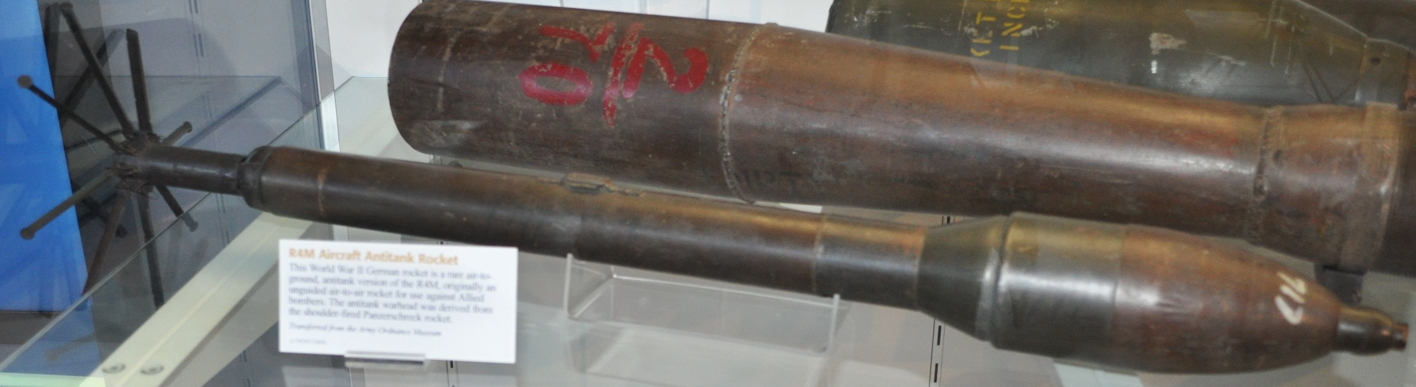
The one real variant was the R4/M Panzerblitz — same rocket body, but with a shaped-charge warhead instead of the blast-fragmentation type, optimized for punching through armor on ground attack missions. It saw limited use in the tank-hunting role but never really proved itself. Flying low and slow enough to hit tanks with unguided rockets was suicidal by 1945, and the Panzerblitz wasn't accurate enough to justify the risk.
There were proposals for improved versions — better fins for tighter accuracy, a bigger motor for 2,000+ meter range, heavier warheads, incendiary warheads, even a radio proximity fuze for air-burst detonation. None of them made it to production. The war ended first, and honestly, the standard R4M was good enough. Sometimes the best upgrade is just making more of what already works.
Production: How You Build 20,000 Rockets While Losing a War
This might be the most impressive part of the R4M story — not the combat results, but the production numbers.
Manufacturing started at DWM's facilities and quickly dispersed to subcontractors and satellite plants. The logic was survival: if one factory got bombed, the others kept going. Final assembly happened in small facilities, some of them underground. The rocket used mild steel, wood, and common explosives — no tungsten, no exotic alloys, no specialized electronics, nothing that was already critically short.
The output ramped fast:
- October–December 1944: ~4,000 rockets
- January–March 1945: ~12,000 rockets
- April–May 1945: ~4,000 (disrupted by Allied advances)
Total: somewhere around 20,000–25,000 completed rockets, with thousands more in the pipeline when everything collapsed. Each one cost roughly 40–50 Reichsmarks — about the same as twenty to twenty-five rounds of 30mm cannon ammo. Except one R4M hit could do what a dozen cannon hits might not.
For comparison: the X-4 guided missile was orders of magnitude more expensive, required skilled labor and specialized components, and zero were ever fired in combat. The R4M program produced more usable weapons in its first two months of production than all of Germany's guided missile programs combined ever deployed operationally. Sometimes boring engineering wins.
After the War: Who Noticed, and What They Did About It
Allied forces captured thousands of unfired R4M at German depots and factories. All three major powers — the US, Britain, and the Soviet Union — hauled them home for testing and analysis.
The Americans tested them extensively at Wright Field and confirmed what German pilots already knew: they worked. The ballistics matched German claims, the warheads were lethal against aircraft structures, and reliability was good. For a weapon that looked like it was designed in an afternoon, it performed remarkably well.
The Soviet influence was the most direct. The Soviets' own wartime rockets — the RS-82 and RS-132 — were bigger and cruder than the R4M. Post-war Soviet air-to-air rocket designs borrowed heavily: the S-5 was the same 55mm caliber with a similar warhead design, the S-8 used R4M design principles at a larger scale, and the folding-fin mechanism showed up in Soviet rocket designs for decades afterward.
On the Western side, the American 2.75-inch Folding-Fin Aerial Rocket (FFAR, "Mighty Mouse") and the French SNEB followed the same philosophy: cheap, unguided, fired in salvos. The FFAR in particular was a direct spiritual descendant — a small rocket designed to be fired in large numbers from fighter aircraft at bomber targets. It stayed in service well into the jet age.
Of course, guided missiles eventually made the whole concept obsolete. By the late 1950s, the AIM-9 Sidewinder and its contemporaries could do what the R4M did — kill aircraft at stand-off range — but with guided accuracy instead of salvo volume. The unguided air-to-air rocket had maybe a fifteen-year run as a viable concept before technology caught up.
What to Make of It All
The R4M is one of those weapons that history tends to overlook because it lacks drama. The Fritz X sank a battleship — great story. The X-4 was a wire-guided missile decades ahead of its time — fascinating engineering. The R4M was a tube with a motor and a warhead that you bolted to a wing and fired in bulk. Not exactly the stuff of documentaries.
But if you're interested in what actually works in wartime — not what's impressive on paper, but what gets built, deployed, and used — the R4M is the real story. Twenty thousand units produced in six months by a country whose industrial base was being systematically destroyed. Fifty to seventy confirmed bomber kills in three months of combat. A design so simple it could be built by semi-skilled labor in dispersed workshops. Cost-effective enough that even late-war Germany could afford it in quantity.
"Twenty thousand units produced in six months by a country whose industrial base was being systematically destroyed. A design so simple it could be built by semi-skilled labor in dispersed workshops."
The lesson is one that military procurement keeps having to relearn: perfect is the enemy of good enough, and good enough that exists beats perfect that doesn't. The X-4 was the better weapon on every technical metric. The R4M was the one that actually fought. I know which one the Eighth Air Force bomber crews worried about more, and it wasn't the missile sitting in a test facility.
Seventy-odd years later, that tension between sophisticated and simple, between optimal and available, between perfect and deployed still defines every weapons program. The R4M Orkan — tiny, cheap, unglamorous, effective — is the permanent reminder that sometimes the right answer is the boring one.
Frequently Asked Questions
How many bombers did the R4M actually destroy?
Honest answer: we don't know exactly, and anyone who gives you a precise number is guessing. The best estimate from cross-referencing German claims with Allied loss records puts confirmed kills at 50–70 heavy bombers, with maybe another 20–30 probables and 80–100+ severely damaged. Call it 150–200 bombers destroyed or effectively written off. Not a war-changing number in absolute terms, but remember this was accomplished in barely three months of combat, mostly by fuel-starved units that could barely fly. The per-sortie effectiveness was genuinely impressive — the problem was there weren't enough sorties.
Why was it so much better than cannon against bombers?
Two reasons, really. First, range — you could fire R4M from 800–1,000 meters where the .50-cal turrets were barely effective, instead of closing to 400 meters into the teeth of concentrated defensive fire. That alone improved pilot survivability enormously. Second, lethality per hit — one R4M could wreck a bomber, while cannon typically needed three to five hits. When you combine better range, higher hit probability (8–12% vs. 2–5%), and single-hit kill potential, the R4M comes out three to five times more effective per round fired. The trade-off was ammunition capacity: 24 rockets versus 100+ cannon rounds. Most pilots sensibly carried both.
Could the R4M have changed the air war if deployed earlier?
Maybe. If you push the development timeline back twelve to eighteen months — available in mid-1943 instead of late 1944 — you're putting it into service during the period when the Eighth Air Force was taking its worst losses, when the Luftwaffe still had fuel and experienced pilots, and before long-range escort fighters like the P-51D made deep-penetration bombing viable. A cheap, mass-produced stand-off weapon distributed across the entire German fighter force during the Schweinfurt-Regensburg era? That's a genuinely scary counterfactual for the Allied strategic bombing campaign. Whether it would have changed the war's outcome is a different question — probably not, given everything else — but it could have made the bomber offensive far more painful than it already was.