On August 20, 1939, a group of Soviet I-16 fighters over the Mongolian steppe did something no pilot in history had ever done. They fired rockets at enemy aircraft in flight—and hit them. Five Japanese fighters went down. The weapon was the RS-82, an 82mm unguided rocket that looked more like a pipe bomb with fins than a piece of sophisticated ordnance. It was inaccurate, unreliable by modern standards, and absolutely revolutionary.
That engagement at Khalkhin-Gol was a footnote in a border war most people have never heard of. But it was the opening act for a family of rockets—the RS-82 and its bigger brother the RS-132—that would go on to arm the most-produced military aircraft in history, inspire the most feared artillery weapon of World War II, and fundamentally reshape how air forces thought about ground attack.
The story starts, like a lot of Soviet military innovation, in a cramped laboratory with engineers who were one bad day away from the gulag.
RNII: The Institute That Built Rockets While Dodging Stalin
The Reaction-Engine Scientific Research Institute—RNII, or in Russian, Реактивный научно-исследовательский институт—was formed in 1933 by merging two earlier groups: the Gas Dynamics Laboratory (GDL) in Leningrad and the Group for the Study of Reactive Motion (GIRD) in Moscow. If those names sound familiar, it's because GIRD was where a young engineer named Sergei Korolev was cutting his teeth. Yes, that Korolev—the one who'd later put Sputnik in orbit and Gagarin in space. In the 1930s, though, he was just another rocket enthusiast trying not to get arrested.
RNII's early work was all over the place. Liquid-fuel engines, solid-fuel motors, jet-assisted takeoff boosters—they were trying everything. The institute had some genuinely brilliant people. Boris Petropavlovsky had been working on rocket projectiles since the late 1920s. Georgy Langemak developed the propellant charges and rail launchers. Ivan Kleymyonov ran the place. Yuri Pobedonostsev handled the ballistics.
They also had a patron in high places: Marshal Tukhachevsky, who we've written about separately. Tukhachevsky saw rockets as a key part of his modernization program and funneled resources to RNII. When Stalin had Tukhachevsky shot in 1937, the institute's protection evaporated overnight. Kleymyonov and Langemak were arrested and executed. Korolev got sent to the gulag. Glushko went to a sharashka—a prison design bureau. The people who built the RS-82 were being killed or imprisoned even as their creation was entering production.
That's worth sitting with for a moment. The Soviet state was simultaneously mass- producing a weapon and executing the men who invented it.
What Exactly Were These Things?
Strip away the history and the RS-82 was mechanically simple—almost elegant in its crudeness. A steel tube, 82mm in diameter (hence the name), about 600mm long, weighing around 6.8 kilograms. Stick a solid-propellant grain inside, screw a warhead on the front, weld some stabilizer fins on the back, and you've got a rocket. No guidance. No fancy electronics. Point it in the general direction of whatever you want to ruin, fire, and hope.
The propellant was a nitrocellulose-based smokeless powder packed into a tubular grain. When ignited, it burned for roughly a second, accelerating the rocket to something in the neighborhood of 340 meters per second. After that, it was ballistic—coasting on momentum and gravity, decelerating the whole way. Effective range depended on whether you were shooting from an aircraft or the ground, but for air-launched work, Soviet VVS ordnance manuals from the period suggest engagement distances of 200-600 meters for air-to-ground and maybe 1,000 meters maximum for area targets.
The RS-132 was the same concept, scaled up. 132mm diameter, around 23 kilograms, carrying a substantially larger warhead. It hit harder—much harder—but it was also heavier and created more drag, which mattered when you were strapping them to a biplane fighter that wasn't exactly swimming in excess power.

The Accuracy Problem
Here's the thing nobody likes to talk about in the heroic narratives: these rockets were not accurate. At all. The stabilizer fins helped, but there was no spin stabilization on the early variants (that came later with the improved RBS-82 and RBS-132, which added a spin motor). Without spin, the rockets wobbled. Wind affected them. Manufacturing tolerances affected them. The propellant grain burning unevenly affected them. Yefim Gordon, probably the most respected historian of Soviet aviation in the English-speaking world, describes the RS-82's accuracy as suitable for "area targets" rather than precision strikes.
What does that mean in practical terms? It means you didn't fire one rocket at a specific tank. You ripple-fired a full salvo—eight RS-82s was a common aircraft loadout—at a cluster of vehicles, a troop concentration, a supply dump, and let probability do the work. It was shotgun tactics, not sniper tactics. And for the kind of targets the Soviets were hitting, that was fine.
Khalkhin-Gol: The Combat Debut Nobody Expected
The RS-82's first real test came not in a lab or on a test range but in a messy border war between the Soviet Union and Japan on the Mongolian frontier. The Battle of Khalkhin-Gol (or Nomonhan, as the Japanese call it) in 1939 was a serious fight involving tens of thousands of troops on each side. The air combat was especially intense—Soviet and Japanese fighters tangled daily, and the Japanese Ki-27 fighters were giving Soviet I-16s a hard time with their superior maneuverability.
Someone—the records aren't entirely clear on who made the decision—authorized equipping five I-16 fighters with RS-82 rockets for air-to-air use. On August 20, 1939, these aircraft engaged a formation of Japanese fighters. The I-16 pilots fired their rockets in salvo at the Japanese formation from several hundred meters. The Japanese, who had absolutely no experience with or expectation of air-to-air rockets, were caught completely off guard.
Five Japanese aircraft were shot down. The RS-82s didn't need to score direct hits— the blast and fragmentation radius was enough to damage or destroy aircraft in the general vicinity. For fighters in formation, this was devastating. One salvo could threaten an entire flight.
The Japanese were baffled. They reportedly assumed some new type of anti-aircraft weapon was involved. The Soviets, for their part, classified the results immediately. They'd found something genuinely useful, and they weren't about to explain it to anyone.
From Air Weapon to Everything Weapon
After Khalkhin-Gol, the RS-82 and RS-132 went from experimental curiosity to standard armament remarkably fast. By 1941, they were showing up everywhere.
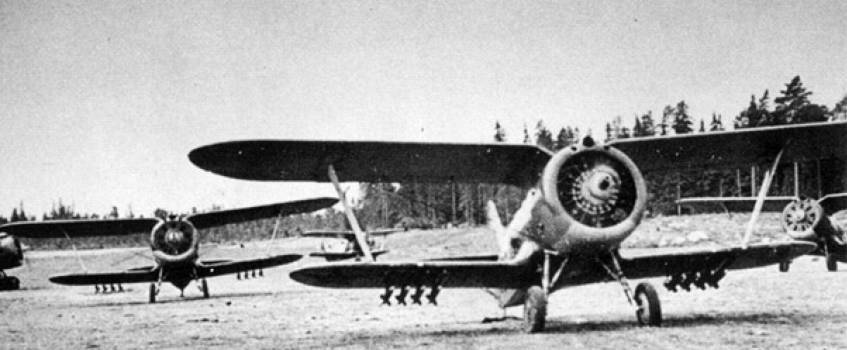
The primary air-to-ground platform became the I-153 Chaika and I-16, carrying four to eight RS-82s on underwing rails. But the weapon really found its calling on the Il-2 Sturmovik—the armored ground-attack aircraft that became the most- produced military aircraft in history, with over 36,000 built. The Il-2 typically carried eight RS-82s or four RS-132s in addition to its cannons, bombs, and machine guns.

According to the Osprey Publishing monograph Il-2 Sturmovik Units of World War 2, the standard attack profile was grimly straightforward. The Il-2 would approach at low altitude—sometimes as low as 50-100 meters—fire its rocket salvo at 400-600 meters range, then follow up with cannon fire and bombs in the same pass. Against soft targets like trucks, infantry positions, and supply columns, this was absolutely murderous. Against tanks, the results were more mixed. The RS-82's warhead could damage tracks, optics, and external equipment, but penetrating armor was beyond it. The RS-132 could do more, but still wasn't a reliable tank-killer against anything with serious armor.
The VVS ordnance handbooks from the period—the technical manuals that guided armorers in loading and fusing the rockets—specify different warhead types depending on the target. Fragmentation warheads for personnel and light vehicles. HEAT (shaped-charge) warheads were introduced later in the war for the improved variants, giving at least some anti-armor capability. But for most of the war, the rockets were primarily blast-and-fragmentation weapons.
The Ground-Launched Version: Hello, Katyusha
Here's where the story takes its most famous turn. The RS-132, mounted on a truck- based rail launcher instead of an aircraft, became the M-13 rocket—the ammunition for the BM-13 Katyusha multiple rocket launcher. If you know anything about World War II on the Eastern Front, you know the Katyusha. The Germans called it "Stalinorgel"—Stalin's Organ—because of the hellish shrieking sound the rockets made in flight.
The connection between the air-launched RS-132 and the ground-launched M-13 is direct. Same basic rocket motor. Same propellant. Same caliber. The M-13 was longer and heavier—it needed more range for ground use—but the engineering DNA was identical. A single BM-13 launcher could fire 16 rockets in roughly 7-10 seconds, saturating an area about the size of four football fields with high-explosive fragmentation. A battery of four launchers could fire 64 rockets in under 15 seconds and then drive away before counter-battery fire arrived.

The psychological effect was as devastating as the physical one. The rockets arrived before the sound of the launch. One moment you're in a trench; the next, the world is exploding around you with no warning. German veterans' accounts describe the Katyusha as the single most terrifying weapon they faced, worse than conventional artillery because of its suddenness and the density of fire. Fritz Bayerlein, a Panzer commander who served at Stalingrad and in Normandy, called them "the most psychologically effective weapon the Russians possessed."
The Engineers Who Didn't Live to See It
This is the part that stings. The RS-82 and RS-132 were arguably the most consequential rocket weapons of the entire war. They armed tens of thousands of aircraft and thousands of Katyusha launchers. They killed more Axis soldiers than probably any other rocket system in history. They were a genuine Soviet success story.
And most of the people who made them possible were dead or in prison by the time the weapons saw combat.
Ivan Kleymyonov, RNII's director, was arrested in November 1937 and shot in January 1938. Georgy Langemak, who developed the rocket launchers, was arrested the same month and executed on the same day. Both were charged with being part of an "anti-Soviet sabotage organization"—the standard fabricated charge of the Great Terror. Boris Petropavlovsky, who'd started the solid-fuel rocket work in the 1920s, died of illness in 1933, which in the Soviet context counts as getting off easy. Sergei Korolev was arrested in 1938, beaten during interrogation until his jaw was broken, and sentenced to hard labor in the Kolyma gold mines—one of the deadliest gulag sites. He survived, barely, and was eventually transferred to a sharashka where he could continue engineering work as a prisoner.
The surviving engineers at RNII—renamed NII-3 after the purges, presumably because the old name was tainted—continued development under the shadow of potential arrest. They improved the rockets. They developed new warhead types. They worked out the mounting systems for different aircraft. They created the Katyusha launcher design. And they did it all knowing that their predecessors had been murdered for doing the same kind of work.
Langemak and Kleymyonov were posthumously rehabilitated in 1955. Langemak was eventually recognized as a Hero of Socialist Labor in 1991—53 years after his execution. The Russian Federation named a crater on the Moon after him. Cold comfort, you might think, and you'd be right.
Combat Performance: Honest Assessment
Soviet wartime propaganda loved the RS-82 and the Katyusha, and postwar Soviet military histories tended to present rocket weapons as devastatingly effective in every engagement. The reality, as Yefim Gordon and other historians have documented from declassified Soviet after-action reports, was more complicated.
Against soft targets—infantry in the open, truck convoys, horse-drawn transport, supply dumps, field positions without overhead cover—the rockets were genuinely devastating. A full salvo from an Il-2 or a Katyusha battery into a column of vehicles was catastrophic. The combination of blast, fragmentation, and psychological shock could break a unit's cohesion in seconds.
Against hard targets, the picture was different. Soviet studies conducted during and after the war found that the RS-82's hit probability against a single tank- sized target was very low—some reports suggest as little as 1-3% per rocket at typical engagement ranges. The RS-132 was better due to its larger warhead and blast radius, but still not what you'd call precise. The improved variants with spin stabilization (RBS-82 and RBS-132, introduced from 1942 onward) improved accuracy noticeably, but these were still area weapons, not precision munitions.
The honest assessment is that the RS-82 and RS-132 were excellent at what they were designed for—suppression, area denial, soft-target destruction, and psychological warfare—and mediocre at things they weren't designed for, like killing individual tanks. The Soviet military eventually acknowledged this and developed dedicated anti-tank weapons like the PTAB cluster bomblet for the Il-2, which proved far more effective against armor.
The Improved Variants
The RS-82 and RS-132 didn't stay static through the war. Soviet engineers—the ones who hadn't been shot—kept iterating.
The most significant improvement was spin stabilization. The original rockets relied on tail fins alone, which meant they wobbled in flight and lost accuracy rapidly with distance. The RBS-82 and RBS-132 variants (the "B" stood for bronevoy, meaning "armored" or in this context referring to the reinforced design) introduced a small spin motor that rotated the rocket around its longitudinal axis. This dramatically improved flight stability and roughly doubled the effective accuracy.
Later in the war, the M-8 rocket (a ground-launched version of the RS-82) equipped the lighter BM-8 Katyusha launchers, which could fire 36 or even 48 rockets per salvo from smaller truck chassis. These were lighter, more mobile, and could be deployed in terrain where the larger BM-13 couldn't operate.
Warhead development continued too. Standard fragmentation gave way to enhanced fragmentation, incendiary variants, and eventually shaped-charge warheads. By 1944-45, the RS family was considerably more capable than the weapons that had debuted at Khalkhin-Gol five years earlier. Not transformed—they were still unguided rockets with all the inherent limitations—but refined.
Legacy: More Than Just a Weapon
The RS-82 and RS-132 matter for reasons beyond their direct combat impact. They were proof-of-concept for an entire category of weaponry.
Before Khalkhin-Gol, air-launched rockets were theoretical. After it, they were proven. The British developed their RP-3 rockets independently during the war. The Americans fielded the HVAR "Holy Moses." The Germans had their own programs. But the Soviets got there first, by years, and deployed them at a scale nobody else matched.
The ground-launched legacy is even bigger. The Katyusha concept—cheap, mass- produced rockets fired in salvos from mobile launchers—spawned an entire lineage of multiple rocket launcher systems. The postwar BM-21 Grad, still in service today in dozens of armies, is a direct conceptual descendant. So is the BM-27 Uragan, the BM-30 Smerch, and the modern Tornado-G. Every multiple rocket launcher in every army in the world traces its operational concept back to what Langemak and Kleymyonov's team built in the 1930s.
And then there's the space connection. RNII's solid-fuel rocket work fed directly into the Soviet missile and space programs. The same institute that built the RS-82 employed the people who'd later design ICBMs and launch vehicles. Korolev's journey from GIRD to RNII to the gulag to Sputnik is one of the most improbable career arcs in history, but the technical thread runs straight through.
Specifications at a Glance
| Parameter | RS-82 | RS-132 |
|---|---|---|
| Caliber | 82 mm | 132 mm |
| Length | ~600 mm | ~845 mm |
| Weight | ~6.8 kg | ~23 kg |
| Warhead weight | ~0.5 kg | ~1.9 kg |
| Muzzle velocity | ~340 m/s | ~350 m/s |
| Effective range (air-launched) | 200-600 m | 200-600 m |
| Motor burn time | ~1 sec | ~1 sec |
| Stabilization | Fin (later spin) | Fin (later spin) |
| First combat use | August 1939 | 1941 |
| Primary platforms | I-16, I-153, Il-2, LaGG-3, Pe-2 | Il-2, Pe-2, BM-13 (as M-13) |
Data compiled from Soviet VVS ordnance handbooks, Yefim Gordon's works on Soviet aviation, and RNII technical documentation. Exact figures vary by production batch and variant.
What They Tell Us
The RS-82 and RS-132 weren't elegant. They weren't precise. They were, in many ways, the most Soviet weapons imaginable—simple enough to mass-produce by the hundreds of thousands, robust enough to work in the worst conditions, and designed to overwhelm through volume rather than sophistication.
But they worked. They gave the Red Air Force a standoff weapon when all it had otherwise was guns and bombs that required flying straight into the teeth of anti-aircraft fire. They gave the Red Army a mobile artillery system that could deliver crushing firepower and displace before the enemy could respond. They scored the world's first air-to-air rocket kills. They armed the most-produced warplane ever built. And the men who created them were murdered by their own government for imaginary crimes.
That last part is what makes this story more than just a technical history. The RS-82 works as a weapon. It also works as a parable about what happens when a state treats its most talented people as threats to be eliminated rather than assets to be protected. The rockets flew. The engineers who built them didn't survive to see it.
Frequently Asked Questions
What does RS stand for?
"Reaktivnyy Snaryad"—Reactive Projectile, or Rocket Shell. The number is
the caliber in millimeters. So RS-82 is an 82mm rocket projectile, RS-132
is 132mm. Simple naming convention that the Soviets used for most of their
rocket ammunition. The later ground-launched versions got different
designations (M-8, M-13) but were the same basic technology.
Were they really the first air-to-air rockets used in combat?
Yes, genuinely. August 20, 1939, at Khalkhin-Gol. Soviet I-16 fighters fired
RS-82 rockets at Japanese Ki-27 fighters and scored kills. There's no
verified earlier instance of air-to-air rocket combat. The British used
Le Prieur rockets against observation balloons in World War I, but those were
air-to-static-target, which is a very different proposition. The RS-82 at
Khalkhin-Gol was genuine fighter-vs-fighter rocket combat, and it worked
well enough that the Soviets immediately classified the results.
How do RS-82/RS-132 compare to their Western equivalents?
The British RP-3 (60-pound rocket) was larger and hit harder than the RS-132
but entered service later (1942-43). The American HVAR was more accurate thanks
to better manufacturing tolerances but didn't appear until 1944. The RS family
had the advantage of being first and being produced in enormous quantities.
In terms of raw accuracy, the Western rockets were probably somewhat better,
but the Soviets compensated with volume—eight RS-82s per Il-2 versus typically
four RP-3s on a Typhoon. Different philosophies, both effective for their
intended roles.
Is the Katyusha really a direct descendant of the RS-132?
Absolutely. The M-13 rocket used in the BM-13 Katyusha was a ground-optimized
version of the RS-132. Same caliber, same basic propulsion, lengthened for
more range. The engineering team was the same—or rather, the survivors of
the purges from the same team. This isn't a vague conceptual link; it's the
same weapon adapted for a different launch platform. The air version came
first, the ground version followed.
Why were the RNII engineers arrested?
The Great Terror of 1937-38 didn't need rational reasons. Kleymyonov and
Langemak were accused of participating in an "anti-Soviet organization"—
standard fabricated charges. Their real vulnerability was their connection
to Tukhachevsky, who had championed RNII's work. When Tukhachevsky fell,
anyone associated with him became suspect. Korolev was arrested on similarly
absurd charges in 1938. The pattern was depressingly familiar across Soviet
military and scientific institutions: a patron gets purged, and everyone in
the patron's network gets swept up regardless of guilt or innocence.