
There are weapons that win battles, and then there are weapons that change history. Most military hardware falls into the first category — useful, sometimes decisive, but ultimately forgotten once something better comes along. A rare few cross into that second category. The S-75 Dvina is one of them. It shot down a CIA spy plane over Soviet territory and triggered an international crisis. It killed American pilots over North Vietnam by the hundreds. It forced the United States Air Force to completely reinvent its tactics, develop entirely new aircraft, and rethink the fundamental relationship between radar, missiles, and electronic warfare. It was exported to every corner of the Soviet sphere of influence and fired in conflicts on four continents. And it achieved all of this while being, by the standards of its successors, a fairly crude and demanding system to operate.
What Is the S-75 Dvina?
The S-75 Dvina (NATO reporting name: SA-2 Guideline) is a Soviet-developed mobile high-altitude surface-to-air missile system that entered service in 1957. Named after the Dvina River in northwestern Russia — a Soviet tradition for naming missile systems after rivers — it was designed to engage high-flying aircraft at altitudes and ranges beyond the reach of conventional anti-aircraft guns and early radar-guided cannon systems.
The system consists of a radar acquisition and tracking complex, a command post, and typically six launch rails arranged in a hexagonal pattern around the central radar. Unlike the static S-25 Berkut that it partially complemented and eventually superseded in importance, the S-75 could be moved — a crucial operational advantage that made it deployable across the entire Soviet Union and exportable to allied countries around the world.
It used a radio command-guided missile to intercept its targets, with ground-based radar tracking both the incoming aircraft and the outgoing missile simultaneously, feeding correction commands throughout the engagement. Simple in concept, devastatingly effective in practice — at least until adversaries figured out how to fight back.
Cold War Origins — Why the S-75 Had to Exist
The High-Altitude Bomber Problem
By the mid-1950s, the S-25 Berkut was protecting Moscow. But Moscow was just one city in a country that spanned eleven time zones. The Soviet Union needed mobile air defense that could be deployed wherever the threat materialized — along the borders, around industrial centers, protecting strategic military assets scattered across an enormous territory.
At the same time, the threat itself was evolving. American jet bombers — particularly the B-47 Stratojet and the massive B-52 Stratofortress — were operating at altitudes that conventional anti-aircraft artillery simply could not reach. The ceiling for effective AAA fire in the Korean War era was roughly 15,000 meters. The B-52 flew at over 15,000 meters routinely, and the reconnaissance aircraft the CIA was developing — what would eventually become the U-2 — was designed to fly even higher, at altitudes above 21,000 meters.
The message was clear: if the Soviets wanted to defend their territory against American airpower, they needed guided missiles that could reach those altitudes. They needed them in large numbers. And they needed them to be mobile enough to follow the threat.
From S-25 to Something Mobile
The S-25 had proven the concept — guided SAMs could intercept high-altitude targets reliably. But its designers had deliberately chosen fixed deployment over mobility in order to meet Stalin's deadline. As soon as the S-25 program was delivering results, Soviet engineers were already working on the next generation: a system that would give the mobile air defense brigades of PVO Strany the same capability that the S-25 gave the fixed Moscow defense ring.
That system was the S-75. And when it emerged, it exceeded expectations in ways that nobody — not the Soviets, not the Americans, not the analysts on either side of the Iron Curtain — fully anticipated.
Development History
The Design Bureaus and Key Engineers
The S-75 was developed at KB-1 — the same design bureau responsible for the S-25 — under the technical leadership of Alexander Raspletin, who had already proven himself on the earlier system. The missile itself was developed at MKB Fakel under Pyotr Grushin, who would go on to become one of the most important missile designers in Soviet history, responsible for virtually every major Soviet SAM missile for the next four decades.
Grushin's team faced a genuine engineering challenge: they had to build a missile capable of reaching altitudes above 20,000 meters, maneuvering hard enough to intercept a fast-moving target, surviving the aerodynamic stresses of high-altitude flight, and doing it all within the weight and size constraints of a system that had to be transported on standard Soviet military trucks. The V-750 missile they produced was a masterpiece of pragmatic engineering — not elegant, not simple, but extraordinarily capable within its design envelope.
From Drawing Board to Test Range
Development began in the early 1950s, and test launches at Kapustin Yar started in 1955. The trials were extensive and occasionally catastrophic — early versions of the V-750 suffered control failures, propulsion problems, and guidance anomalies that sent test missiles wildly off course. But the engineering teams worked through the problems systematically, and by 1957 the system had demonstrated sufficient reliability to be accepted into service.
The speed of the development — from initial requirement to operational deployment in roughly five years — was a testament to the priority the Soviet state placed on the program and the caliber of the engineering teams involved.
Technical Specifications
The Fan Song Radar System
The S-75's radar complex — known in the West by the NATO codename "Fan Song" — was the operational brain of the system. It performed two distinct functions simultaneously: it tracked the target aircraft and it tracked the outgoing missile, comparing their positions many times per second to generate guidance commands.

The Fan Song radar operated in two frequency bands — a low-frequency acquisition beam and a higher-frequency tracking beam — which gave it reasonable resistance to some forms of jamming but also gave it exploitable characteristics that American electronic warfare specialists would eventually learn to use against it. The radar had a distinctive figure-eight antenna configuration that became one of the most recognizable symbols of Cold War air defense.
The V-750 Missile Family
The missile at the heart of the S-75 system was the V-750 — a large, two-stage weapon with a solid-fuel booster and a liquid-fuel sustainer. The basic configuration was approximately 10.6 meters long with a launch weight of around 2,300 kilograms — a substantial weapon that required dedicated handling equipment and considerable infrastructure to operate.
Propulsion and Flight Profile
The solid booster ignited at launch and burned for approximately 4–5 seconds, accelerating the missile to supersonic speed. The liquid-fuel sustainer then took over, burning for roughly 20–22 seconds and propelling the missile to its operating altitude and velocity. The use of liquid propellant — specifically an aggressive and toxic combination of red fuming nitric acid and kerosene-based fuel — made the missile hazardous to handle and slow to prepare for launch. Ground crews required protective equipment and elaborate safety procedures to fuel the missiles, and the fueled weapon had a limited hold time before it had to be fired or defueled. This was one of the system's most persistent operational headaches.
Warhead and Fuzing System
The V-750 carried a high-explosive fragmentation warhead weighing approximately 190 kilograms — a substantial lethal volume capable of destroying an aircraft within a radius of 65 meters when detonated optimally. The warhead used a combination of radar proximity fuze and command detonation — the ground operator could command-detonate the warhead if the proximity fuze failed or if the engagement geometry demanded it. This gave operators a degree of flexibility that pure proximity-fuzed systems lacked.
How the S-75 System Works — Step by Step
Understanding how the S-75 actually functions helps explain both why it was so effective and where its vulnerabilities lie. When a target was detected by acquisition radar, the target data was passed to the Fan Song tracking radar, which locked onto the aircraft and began precise tracking. The fire control computer — analog, by necessity in that era — calculated the optimal launch point based on the target's altitude, speed, and heading.
At the moment of launch, the missile's booster ignited and the Fan Song began tracking both the missile and the target simultaneously. The guidance computer continuously calculated the difference between where the missile was and where it needed to be, generating radio correction signals that were transmitted to the missile's autopilot several times per second. The missile effectively flew a collision course with the target, constantly being steered toward it by commands from the ground. When it reached close proximity, the warhead detonated — ideally directly below the target aircraft where the fragmentation pattern would be most destructive.
The entire engagement from launch to detonation might last 25–30 seconds. For the pilot of the targeted aircraft, it was often over before they even knew a missile was in the air.
Combat History — Where the S-75 Made History
Shooting Down the U-2 — May 1, 1960
This is the S-75's most famous moment — the one that put it on the front pages of every newspaper in the world and triggered a full-blown superpower crisis. On May 1, 1960, CIA pilot Francis Gary Powers was flying his Lockheed U-2 reconnaissance aircraft over the Soviet Union at approximately 21,000 meters altitude — well above what American intelligence believed any Soviet SAM could reach.

They were wrong. A battery of S-75s near Sverdlovsk (now Yekaterinburg) acquired the U-2 on radar, and after some initial tracking difficulties, fired a salvo of missiles. One of them — or possibly the proximity detonation of a nearby miss — disabled the aircraft. Powers' U-2 broke apart and fell from the sky. Powers survived, parachuting down to Soviet territory where he was captured, tried as a spy, and eventually exchanged in a famous bridge swap in 1962.
The incident destroyed the Paris Summit between Eisenhower and Khrushchev, ended the U-2 overflight program over Soviet territory, and demonstrated to the world that no aircraft was safe from the S-75 at any altitude within its engagement envelope. The psychological impact on American air planners was enormous and lasting.
Cuba, 1962 — The Missile Crisis Angle
The Cuban Missile Crisis of October 1962 brought the S-75 into another pivotal moment in Cold War history. Soviet-operated S-75 batteries in Cuba shot down an American U-2 reconnaissance aircraft on October 27, 1962 — the day historians call "Black Saturday," the most dangerous day of the entire crisis. The pilot, Major Rudolf Anderson, was killed — the only American combat fatality of the crisis.
The shoot-down nearly escalated the crisis to open warfare. President Kennedy had previously decided that any attack on American aircraft over Cuba would trigger retaliatory strikes against Cuban air defense sites. That he ultimately chose not to retaliate — recognizing that escalation at that moment could spiral into nuclear war — was one of the most consequential decisions of the Cold War.
Vietnam — The SAM War in the Skies
North Vietnam was the proving ground where the S-75 truly earned its fearsome reputation against a peer military adversary. Beginning in 1965, Soviet-supplied and Soviet-advised S-75 batteries began appearing throughout North Vietnam, and American aircraft losses mounted rapidly.
The early engagements of the Rolling Thunder bombing campaign were shocking to American aircrews. The S-75 was effective at the altitudes where American tactical aircraft typically operated on strike missions — between 3,000 and 12,000 meters. The missiles were fast, the engagement happened quickly, and the standard American evasive maneuver — a hard descending turn — worked only if the pilot saw the missile in time and executed the maneuver correctly.
Over the course of the war, approximately 200 American aircraft were shot down by S-75 missiles over North Vietnam. The number sounds modest compared to total losses, but the psychological impact on American aircrews and the tactical changes it forced were disproportionate to the raw kill figures.
Wild Weasel — America's Response
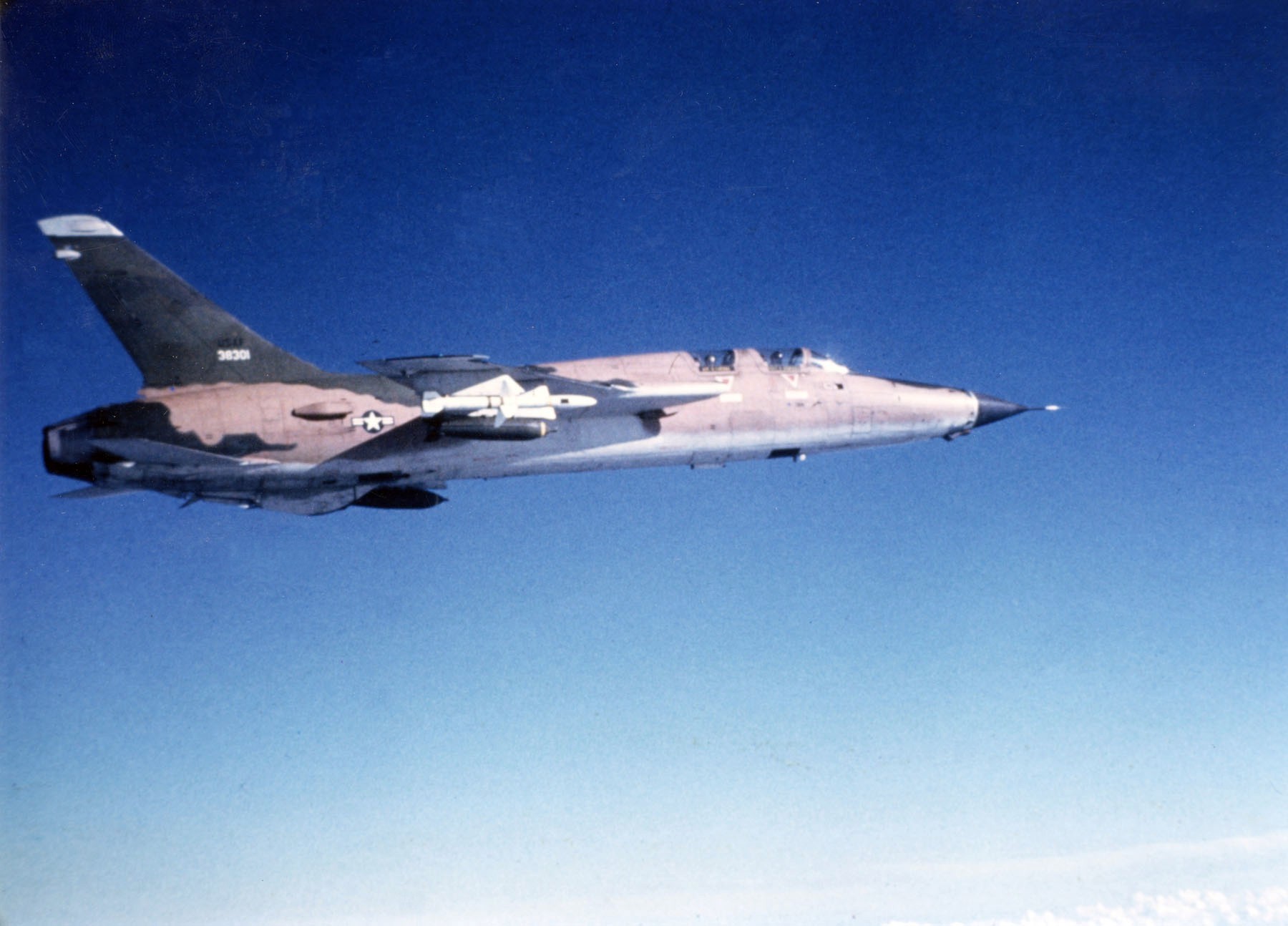
The S-75 threat directly created one of the most specialized and dangerous missions in modern military aviation: the Wild Weasel. Recognizing that they couldn't simply bomb their way through the SAM threat, the U.S. Air Force developed aircraft and crews specifically tasked with hunting and destroying SAM radar sites — flying deliberately into SAM engagement zones to provoke radar emissions, then using anti-radiation missiles to home in on the Fan Song radar and destroy it.
The F-100F Super Sabre was the first Wild Weasel aircraft, followed by the F-105F/G Thunderchief. These crews operated under the darkly appropriate motto: "First In, Last Out" and "YGBSM" — a colorful expression of disbelief that became the unofficial battle cry of the Wild Weasel community. The tactics and aircraft they developed directly evolved into today's F-16CJ and EA-18G Growler electronic attack mission profiles. The S-75 created an entire operational discipline that persists to this day.
The Arab-Israeli Wars and S-75 Performance
1967 — A Humbling Defeat
During the Six-Day War of June 1967, Egyptian S-75 batteries achieved almost nothing against Israeli airstrikes. Israel's preemptive strikes were conducted at low altitude and high speed — precisely the flight profile that minimized S-75 effectiveness, since the system's minimum engagement altitude left a dead zone below roughly 300 meters. Israeli pilots flew under the radar, and the S-75 batteries that did engage often found their missiles unable to achieve the required angle for a valid intercept.
The 1967 experience was humiliating for Egyptian air defense and provided American planners — watching carefully — with valuable lessons about how to defeat the system.
1973 — The SAM Comeback
The 1973 Yom Kippur War told a completely different story. Egypt and Syria, having absorbed the lessons of 1967 and worked intensively with Soviet advisors on their tactics, deployed S-75 batteries as part of an integrated, overlapping air defense network alongside S-125, ZSU-23-4 guns, and shoulder-launched SA-7 missiles.
The Israelis, overconfident after 1967, flew into this layered defense without adequate electronic warfare support, and the results were devastating. In the first three days of the war, Israeli air losses reached crisis levels. The SAM umbrella had become effective enough to genuinely threaten Israeli air superiority — not through the S-75 alone, but through the integrated network of which it was a crucial part. The 1973 war rewrote air defense doctrine for the entire world.
Other Conflicts Involving the S-75
Beyond Vietnam and the Middle East, the S-75 has been fired in combat across an astonishing range of conflicts. During the Indo-Pakistani War of 1971, Indian S-75 batteries engaged Pakistani aircraft. During the Ogaden War between Ethiopia and Somalia in the late 1970s, both sides possessed the system. During the Gulf War of 1991, Iraqi S-75 batteries were comprehensively suppressed and destroyed by coalition forces using Wild Weasel tactics and anti-radiation missiles — a fitting bookend to the lessons learned in Vietnam.
The system was also used during the 1999 NATO bombing of Yugoslavia, the various conflicts in Africa involving former Soviet client states, and multiple Middle Eastern confrontations. No other SAM system in history has been fired in as many different conflicts as the S-75.
Export Success — Who Operated the S-75?
The S-75 was exported on a scale that no Western air defense system has ever matched. At its peak, the system was operated by over 40 countries across the Soviet sphere and beyond. Major operators included North Vietnam, Cuba, Egypt, Syria, Iraq, North Korea, China (which produced its own copy, the HQ-1/HQ-2), Poland, East Germany, Czechoslovakia, Hungary, Bulgaria, Romania, Yugoslavia, Libya, Algeria, Somalia, Ethiopia, India, Afghanistan, Angola, Mozambique, and many others.
This extraordinary export reach transformed the S-75 from a Soviet weapon into a defining feature of global military geography during the Cold War. Any American aircraft operating in a Soviet-aligned country had to plan for the S-75 threat. The system shaped tactical aviation doctrine worldwide for three decades.
Variants of the S-75 — A Family Tree
The S-75 went through numerous variants during its production life, each addressing weaknesses identified in operational service:
- S-75 Dvina (SA-2a) — The original production version. Entered service 1957. Used the V-750 missile. Effective ceiling approximately 22,000 meters.
- S-75 Desna (SA-2b) — Improved variant with better guidance and a new missile version. Entered service 1959.
- S-75M Volkhov (SA-2c/d/e) — The most widely exported variant, with significantly improved performance at both high and low altitude. The missile family expanded to include the V-750VN and V-750VK versions with varying warhead options. This was the variant that fought in Vietnam and the 1967/1973 Arab-Israeli wars.
- S-75M3 Volkhov — Late-production Soviet variant with improved ECCM capabilities and a new missile.
- HQ-1 / HQ-2 (China) — Chinese reverse-engineered copies produced without Soviet licensing, built in enormous numbers and forming the backbone of Chinese air defense for decades. Further developed into the HQ-2B and later variants, some of which remained in Chinese service into the 2010s.
Strengths and Weaknesses of the S-75
What Made It a Game-Changer
The S-75 combined high-altitude reach, reasonable mobility, and genuine lethality in a package that could be deployed and operated by a reasonably trained crew. Its simultaneous track capability — tracking missile and target together — was operationally proven and reliable. Its export simplicity meant that Soviet-allied militaries could be trained to use it without deep technical sophistication. And its sheer numbers, deployed across dozens of countries, created a global air defense problem that no Western air force could ignore.
Its Exploitable Vulnerabilities
For all its achievements, the S-75 had serious weaknesses that skilled adversaries learned to exploit. The Fan Song radar had specific frequency and emission characteristics that could be detected, jammed, or homed in on with anti-radiation missiles. The system had a dead zone at low altitude — aircraft flying below approximately 300 meters were often safe from engagement. The liquid propellant made rapid reaction difficult and was genuinely hazardous to ground crews. The system performed poorly against maneuvering targets at close range. And it was susceptible to saturation — flooding the air defense network with multiple targets simultaneously to overwhelm the tracking capacity.
American Wild Weasel crews, Israeli pilots, and — in later years — NATO strike planners all developed detailed playbooks for defeating the S-75, and those playbooks worked.
The S-75 vs. American Nike Hercules

The Nike Hercules was the primary American fixed-site SAM equivalent during the S-75 era. In terms of raw performance — altitude reach, missile speed, warhead lethality — the two systems were broadly comparable. Nike Hercules had the advantage of nuclear warhead capability, which gave it a theoretically devastating kill probability against mass bomber attacks.
But Nike Hercules was fixed in place, deployed around specific American cities and military installations. It could not be redeployed, could not follow Soviet forces, and could not be exported to allies in the same way. In terms of operational flexibility and geopolitical impact, the S-75 won the comparison decisively. Mobility and exportability proved more strategically valuable than raw nuclear lethality.
Retirement, Replacement, and Surviving Examples
The Soviet Union itself began replacing the S-75 with the S-125 (for low-altitude targets) and eventually the S-300 (for all-altitude strategic defense) from the 1960s onward. By the time the Soviet Union collapsed in 1991, the S-75 had been largely retired from Russian service, though export customers continued operating it for decades longer.
China's HQ-2 variants remained in active service until the mid-2010s. North Korea is believed to still operate modified versions. Several Middle Eastern and African operators maintained their systems in varying states of readiness well into the 21st century.
Numerous S-75 systems are preserved as static displays at military museums around the world — in Russia, China, Vietnam, Egypt, Poland, and the United States, where captured examples were extensively tested. The missile's distinctive shape, with its large cylindrical body and swept delta fins, is one of the most recognizable silhouettes in the history of surface-to-air weaponry.
The S-75's Enduring Legacy in Air Defense History
The S-75 Dvina's legacy is written in the tactics, aircraft, and electronic warfare systems that militaries around the world developed in response to it. Every anti-radiation missile — from the AGM-45 Shrike to the AGM-88 HARM to modern systems — exists because of the need to defeat the Fan Song radar. Every Wild Weasel mission profile, every suppression of enemy air defenses (SEAD) doctrine, every electronic warfare aircraft traces its lineage directly to the tactical problems the S-75 posed to Western airpower.
The S-75 also demonstrated, definitively and repeatedly, that air defense missiles were not a theoretical concept but a decisive operational reality that demanded to be planned around. After Vietnam, no Western air force ever again flew strike missions without dedicated SEAD assets and electronic warfare support. The S-75 made that lesson unavoidable through the hardest possible teacher: combat experience.
The S-75 Dvina is arguably the most consequential air defense system ever built. Not the most sophisticated, not the most technically advanced, and certainly not the most effective against a fully equipped modern adversary. But in terms of its impact on military history, its influence on doctrine and tactics, its geographic reach, and the sheer number of conflicts in which it played a role, nothing else comes close. From its first operational deployment in 1957 to its final export users decades later, the S-75 Dvina shaped the skies of the Cold War more profoundly than any other single weapon system. The golden age of uncontested high-altitude flight ended the moment the Fan Song radar first locked onto Francis Gary Powers' U-2. And military aviation has never been the same since.
Frequently Asked Questions
How many aircraft did the S-75 shoot down in total across all conflicts?
Precise numbers are difficult to confirm across all operators and conflicts, but conservative estimates suggest the S-75 was responsible for well over 300 confirmed aircraft kills across all theaters, with some estimates considerably higher when all operators and conflicts are included. North Vietnam alone is credited with roughly 200 American aircraft downed by S-75 missiles during the Vietnam War.
Why was the S-75 so effective against the U-2 when the CIA believed it was safe?
American intelligence underestimated the ceiling improvements in the later V-750 missile variants. The original S-75 had a ceiling around 20,000 meters, and the CIA's operational ceiling for U-2 flights was set at 21,000 meters based on intelligence data that was outdated by the time Powers was shot down. The improved V-750VN missile used against Powers could reach approximately 24,000 meters — well above where Powers was flying.
Can the S-75 engage ballistic missiles or cruise missiles?
The S-75 was not designed for anti-ballistic missile defense and has no practical capability against modern ballistic missiles. Against early cruise missiles flying at medium altitude, a properly operated S-75 could theoretically score engagements, but its slow reaction time, large minimum engagement altitude, and the general complexity of engaging small, fast, low-flying targets made it poorly suited to the cruise missile threat.
What made the Fan Song radar so vulnerable to anti-radiation missiles?
The Fan Song radar had to continuously emit radio frequency energy to track both the target and the missile during an engagement. This constant emission created a trackable signal that anti-radiation missiles — equipped with passive radar homing seekers — could home in on and follow to the source. The radar had to choose between tracking and being tracked. Early versions had limited frequency agility, making them easier to lock onto. Later variants incorporated some frequency-hopping capability, but the fundamental vulnerability of an active radar in an anti-radiation missile environment was never fully solved.
Are any S-75 systems still operational today?
As of the most recent available information, several countries are believed to maintain S-75 systems in various states of operational readiness, including North Korea, which has heavily modified its domestic variants. Some systems in the Middle East and Africa may also remain technically operational, though their actual combat capability against modern aircraft is extremely limited given advances in electronic warfare, stealth technology, and anti-radiation missile capability.